Swarm Mobs
- By
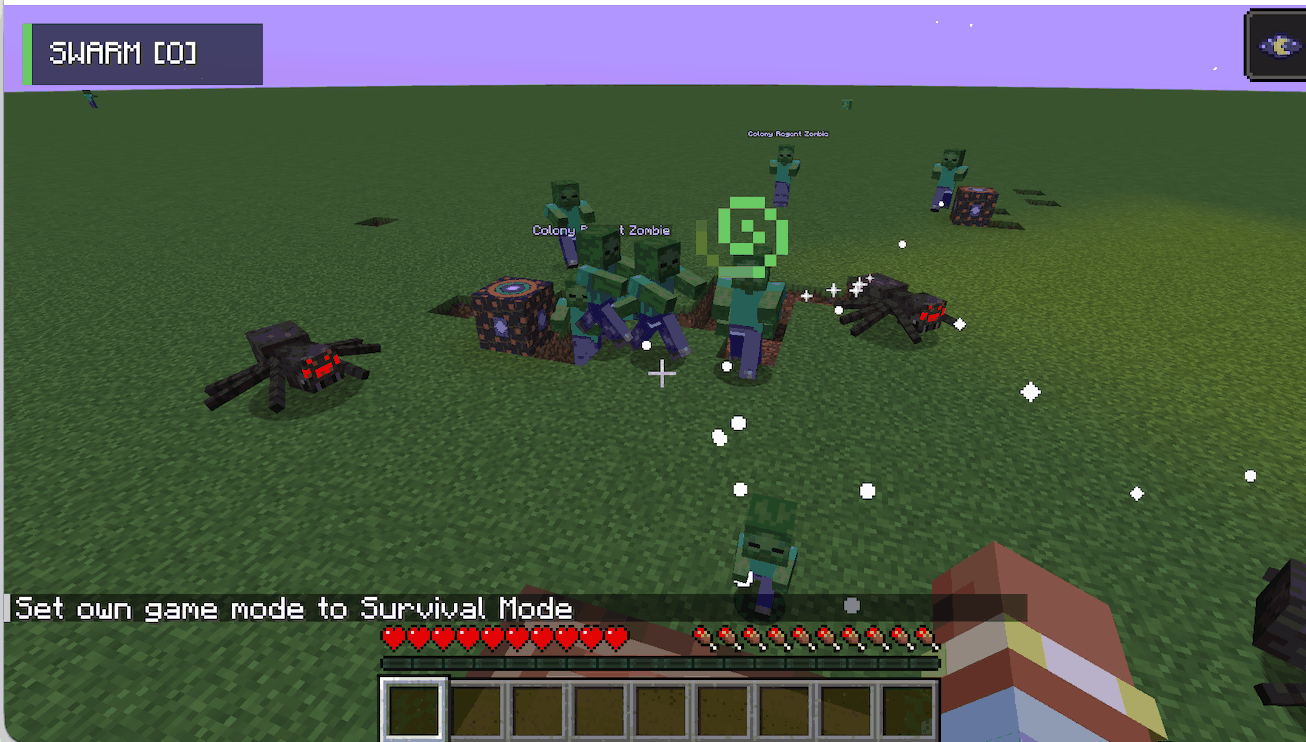
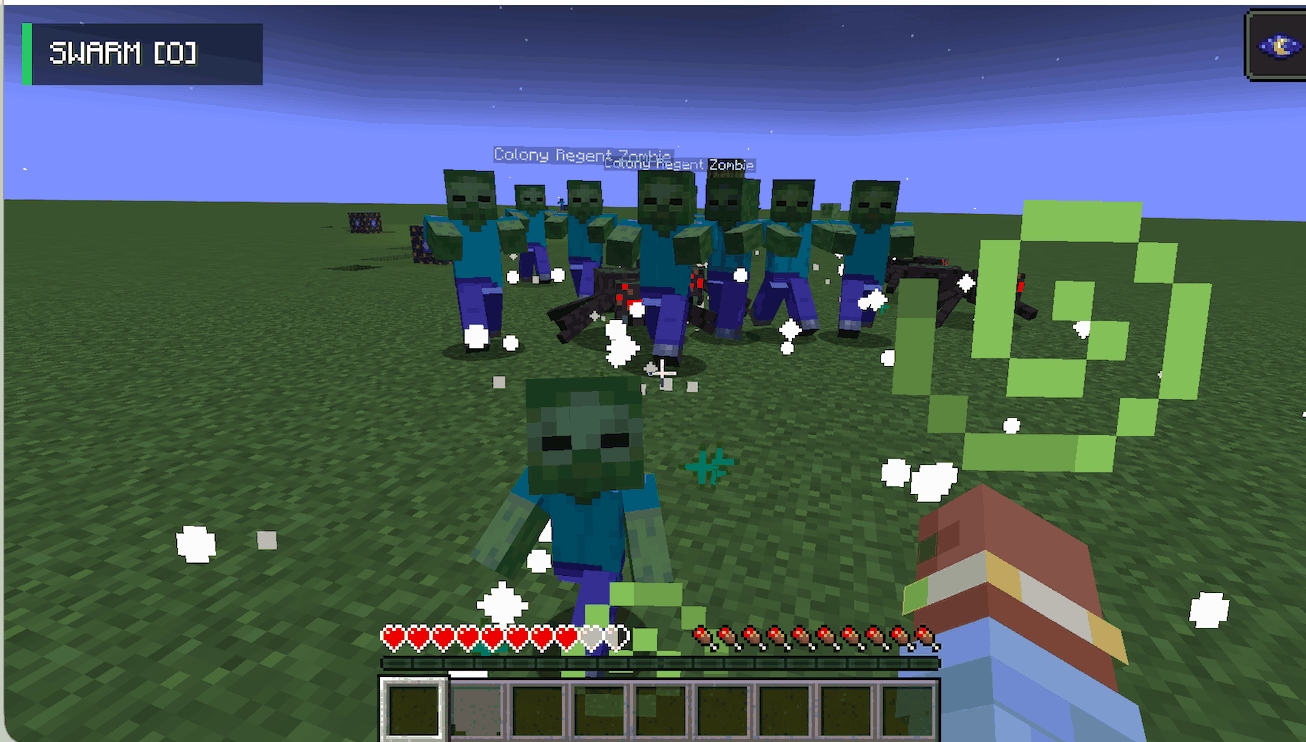
Swarm Mobs gives Zombies, Skeletons, Spiders, and Creepers coordinated local swarm intelligence with shared target memory, dynamic roles, formation-aware movement, recovery planning, bounded Zombie engineering,
b6f8009df722d33338423d4e11f68d9a1780d6e5.png
2ddf5d0fdc52a3fe835aee575feee609ab0a5af1.png
Description
Swarm Mobs transforms Minecraft’s hostile mobs from isolated enemies into a coordinated, adaptive swarm.
Zombies, Skeletons, Spiders, and Creepers can share target information, coordinate movement, divide responsibilities, recover from blocked paths, and work together instead of simply charging the player independently.
The mod is built around decentralized multi-agent behavior rather than scripted encounters. Each mob still operates locally, but nearby mobs can exchange information and temporarily specialize based on the situation.
Core Features
Coordinated Swarm Behavior
Hostile mobs share target information and react as a group. Their behavior can adapt as the swarm composition, terrain, and target position change.
Dynamic Division of Labor
Mobs can temporarily take on roles such as Engineer, Carrier, Scout, Interceptor, Overwatch, or Lead Breacher depending on local demand and their capabilities.
Smarter Navigation
The swarm uses obstacle detection, local detours, path evidence, congestion awareness, stuck detection, and recovery planning instead of endlessly walking into the same obstacle.
Zombie Engineering
On Hard difficulty with mobGriefing enabled, Zombies can perform bounded engineering actions when normal navigation fails. They may break suitable obstacles, recover usable building material, coordinate engineering tasks, and create limited bridge supports.
Engineering is intentionally constrained by hardness limits, task ranges, material limits, execution leases, and safety checks.
Target Memory and Search
Mobs can retain last-known target information after losing direct sight, communicate observations to nearby swarm members, and transition into decentralized search behavior when target confidence decreases.
Imperfect Sensing and Communication
Optional experimental controls allow sensing dropout, position noise, communication latency, packet loss, and limited communication range. These systems make it possible to test how well the swarm performs under imperfect information.
Vanilla Combat Handoff
Swarm behavior is designed to cooperate with Minecraft combat rather than replace it. Skeletons still use ranged attacks, Creepers retain their explosion behavior, Spiders retain melee combat, and Zombies return to normal close-range fighting when appropriate.
Optional Local AI with Ollama
Swarm Mobs can connect to a local Ollama model for high-level strategy recommendations.
The AI layer is intentionally bounded. It can influence high-level strategic demand, but it does not directly control individual attacks, exact paths, block coordinates, or per-tick mob movement.
The deterministic swarm system remains responsible for real-time gameplay.
Swarm Command Center
Press O or use the SWARM interface button to open the Command Center.
The Cloth Config-powered interface provides scrollable controls and live telemetry for:
- Swarm master control
- Local AI and bounded active-AI mode
- Zombie engineering
- Dynamic labor and specialization
- Sensing imperfections
- Communication faults
- Search and prediction
- Navigation and recovery
- Experiment configuration
- Runtime swarm statistics
Configuration changes are server-authoritative. Players without the required server permission can inspect the panel in read-only mode.
Requirements
- Minecraft 1.21.1
- NeoForge 21.1.249 or newer
- Java 21
- Cloth Config 15.x on the client
Ollama is optional and is only required if you want to use the local AI integration.
Recommended Gameplay
For the full engineering experience:
Difficulty: Hard
mobGriefing: true
Swarm Mobs is especially noticeable when fighting groups of enemies around walls, buildings, uneven terrain, chokepoints, and defensive structures.
Instead of asking only:
“Can this mob reach the player?”
the swarm begins asking:
“What should each member do next?”
Swarm Mobs Team