redstones-engineering
- By
A Minecraft-native engineering systems mod that expands vanilla redstone into instrumentation, metrology, control, mechatronics, diagnostics, and commissioning while preserving the 0–15 signal boundary.
æªå±2026-09-04 18.23.51.png
æªå±2026-09-04 18.38.44.png
Description
Redstone Systems Engineering(this is in development---many bugs and problems:(
Fix will be implements soon. new version is out-be sure to check:)
Redstone Systems Engineering (RSE) is a Minecraft-native engineering systems mod that expands vanilla redstone into a deeper instrumentation, control, communication, mechatronics, and commissioning environment—while preserving the familiar 0–15 redstone signal boundary.
Instead of replacing redstone with an unrelated technology system, RSE builds outward from Minecraft's existing logic and signal mechanics.
The central engineering workflow is:
Measurement → Conditioning → Sampling → Control → Actuation → Optimization → Acceptance → Evidence → Comparison
Required Dependencies
RSE currently uses several platform dependencies as intentional runtime requirements, not merely optional compatibility integrations.
Minecraft
Minecraft 1.21.1
Mod Loader
NeoForge 21.1.249 or newer compatible release
Required Mods
- Jade — 15.10.6 or newer compatible 15.x release
- GeckoLib — 4.9.2 or newer compatible 4.x release
- **LDLib2 2.2.26+
All required dependencies must be installed for the appropriate Minecraft and NeoForge version.
Engineering Systems
RSE introduces interconnected engineering systems designed to behave as parts of one larger technical environment rather than as isolated machines.
Instrumentation & Measurement
Measure and inspect signals using engineering-oriented instrumentation, including signal probes, analyzers, oscilloscopes, meters, calibration references, and diagnostic tools.
The goal is simple:
measure before controlling.
Signal Conditioning
Process redstone and engineering-domain signals through devices such as:
- Signal conditioners
- Precision filters
- Sample-and-hold modules
- Threshold and edge detection
- Pulse shaping
- PWM control
- High-impedance signal taps
Signal processing remains bounded by the physical and logical rules of the system rather than acting as unrestricted magic.
Control Engineering
Build closed-loop systems using components such as the Discrete PID Controller.
RSE includes engineering concepts such as:
- Setpoint
- Process value
- Error
- Control output
- Manual and automatic modes
- Inhibit states
- Tuning presets
- Rise time
- Settling time
- Overshoot
- Saturation
- Commissioning status
The control system is designed around authoritative simulation rather than UI-side approximation.
Sensors & Transducers
Convert physical or simulated quantities into usable engineering signals.
Examples include systems for:
- Distance
- Light
- Temperature
- Magnetic fields
- Optical power
- Voltage
- Tank level
- Entity density
- Position feedback
Electrical Engineering
RSE contains an electrical domain built around components such as:
- Copper electrical cable
- Voltage sources
- Resistive loads
- Series resistors
- Capacitors
- Fuses
- Circuit meters
- Electromagnets
- Induction coils
These systems provide a foundation for circuits that go beyond simple vanilla redstone logic.
Timing & Precision Signals
Quartz-based engineering components provide timing and synchronization systems, including:
- Oscillators
- Clock dividers
- Phase delays
- Stability monitoring
- Triggered sampling
These systems are useful when signal timing matters as much as signal strength.
Data & Communications
RSE expands engineering beyond individual redstone lines with communication systems including:
- 8-bit bundled data buses
- Byte encoders and decoders
- Serial data lines
- Serializers and deserializers
- Differential signaling
- Digital regeneration
- Radio transmitters and receivers
- Free-space optical communication
The objective is to make information transport itself an engineering problem.
Optical Systems
Optical engineering components include:
- Optical fiber
- Emitters and receivers
- Optical splitters
- Optical filters
- Attenuators
- Optical power measurement
- Free-space optical links
Magnetic & Resonant Systems
RSE also includes magnetic and resonance-oriented engineering devices such as:
- Permanent magnets
- Electromagnets
- Magnetic sensors
- Gradient meters
- Resonators
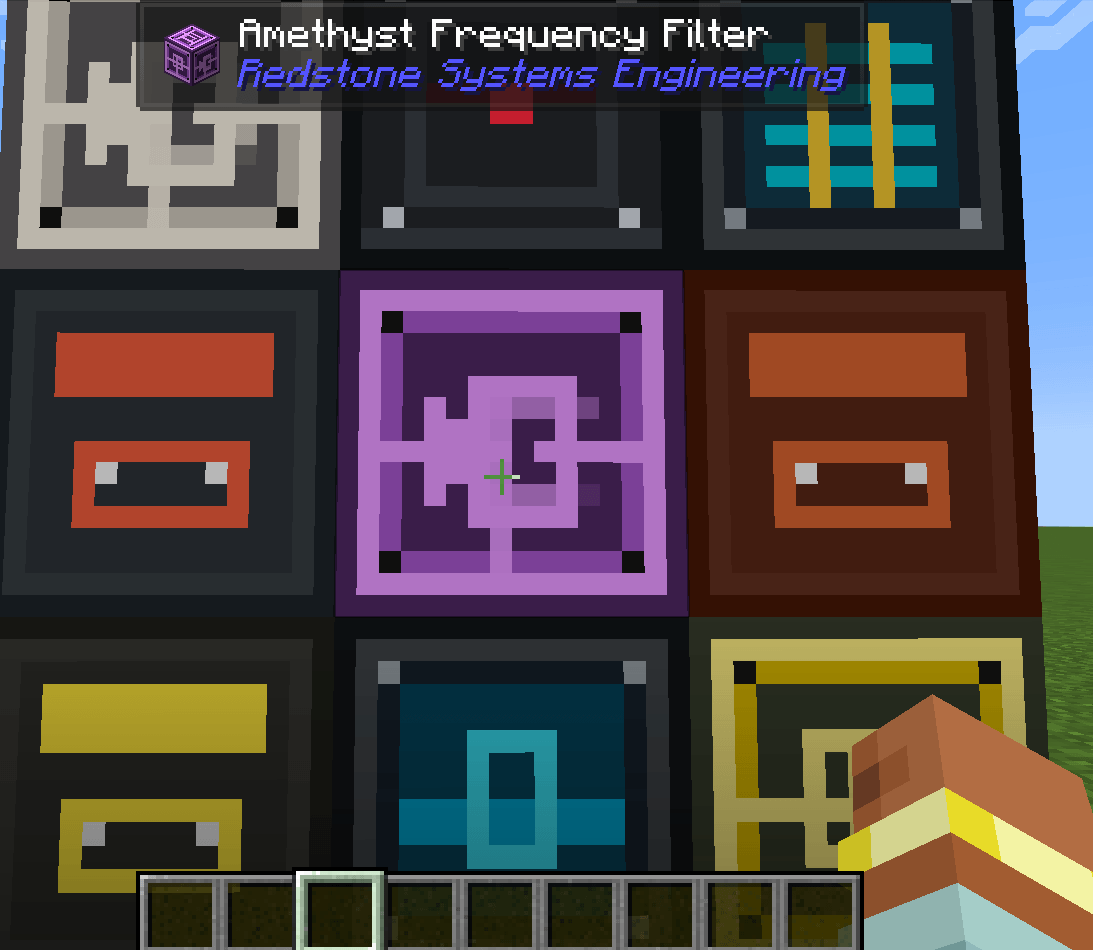
- Frequency filters
- Spectrum analysis components
Thermal Systems
Thermal engineering introduces components such as:
- Thermal masses
- Heaters
- Radiators
- Temperature sensors
- Calorimeters
- Thermal pulse systems
Pneumatics
Build compressed-air systems using:
- Compressors
- Pneumatic pipes
- Air reservoirs
- Pressure regulators
- Isolation valves
- Check valves
- Flow meters
- Proportional valves
- Safety relief valves
- Pneumatic cylinders
These components extend RSE into fluid-power and actuator engineering.
Mechatronics
RSE connects sensors, control systems, and physical actuators through a mechatronics layer.
Examples include:
- Servo actuators
- Position feedback sensors
- Mechanical excitation
- Vibration transmission
- Pneumatic actuation
- Closed-loop motion systems
Reliability & Fault Engineering
Engineering systems should not only work under ideal conditions.
RSE includes concepts and components related to:
- Watchdogs
- Fault latching
- Redundant voting
- Inhibit systems
- Diagnostics
- Fault injection
- Bounded runtime state
- Commissioning evidence
Commissioning & Acceptance
RSE treats system verification as part of engineering itself.
Later stages of the workflow include:
Optimization → Acceptance → Evidence → Comparison
Systems can expose operational evidence, commissioning metrics, diagnostic information, and bounded run history instead of reducing success to a single output signal.
Engineering Interface
RSE includes an engineering-oriented UI architecture for supported devices.
Current interactive engineering interfaces include systems such as:
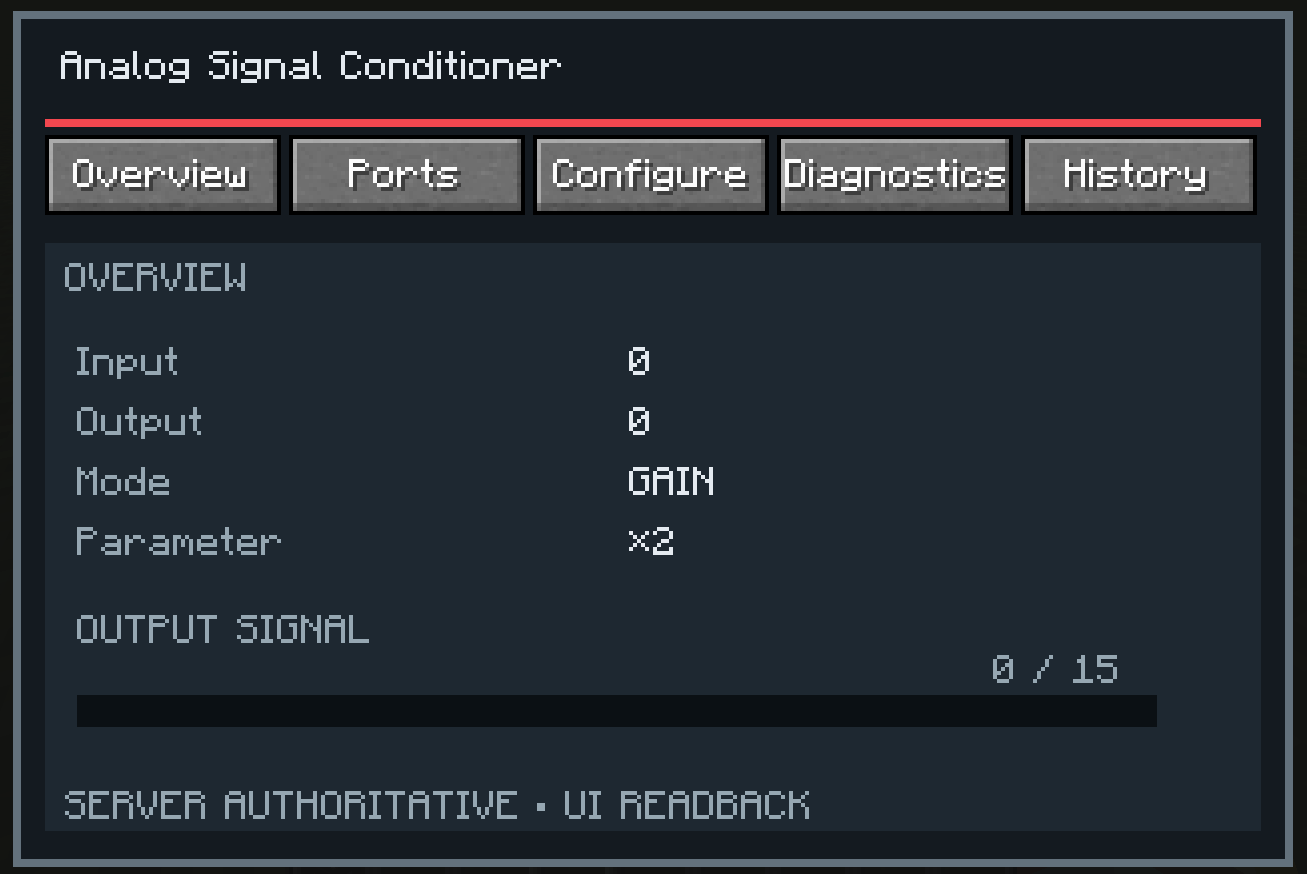
- Analog Signal Conditioner
- Discrete PID Controller
- RSE Diagnostics Console
Engineering screens can expose:
- Overview
- Ports
- Configuration
- Diagnostics
- History
The UI remains an observer and control interface for authoritative simulation state rather than becoming a second physics engine.
RSE Diagnostics Console
RSE includes a session-level diagnostics system accessible from the player inventory.
It can provide:
- RSE-related INFO, WARN, and ERROR entries
- Severity filtering
- Runtime version information
- Diagnostic counters
- Pagination
- Clear controls
- Copyable diagnostic reports
Diagnostic reports include relevant runtime information while limiting and sanitizing collected data.
Design Philosophy
RSE follows several core principles:
- Preserve vanilla Minecraft's 0–15 redstone boundary
- Measure before controlling
- Give ports and signal domains explicit engineering meaning
- Separate measurement from intervention
- Use meaningful configuration parameters
- Make non-ideal behavior useful rather than purely decorative
- Keep authoritative simulation state separate from visualization
- Treat diagnostics and regression testing as part of the product
- Make automation inspectable
- Prefer interconnected engineering systems over isolated utility blocks
RSE is intended to feel like an engineering extension of Minecraft—not a replacement for Minecraft.
Current Version
Redstone Systems Engineering 1.0.20-alpha
For:
Minecraft 1.21.1 NeoForge 21.1.249+
License
RSE is released under the Mozilla Public License 2.0 (MPL-2.0).
redstones-engineering Team