Iron Road - Bedrock Train Simulator
- By
Trains for Bedrock edition that continue to work in unloaded chunks. No player, no problem! The start to a whole world of trains and everything that goes with them. This is just the beginning. Lots of new features and additional items are in the works.
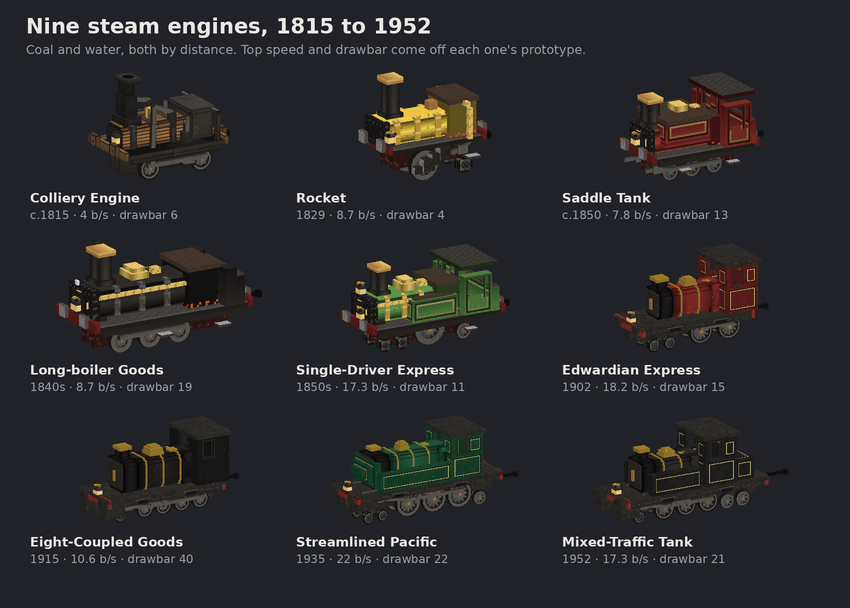
engines_steam.png
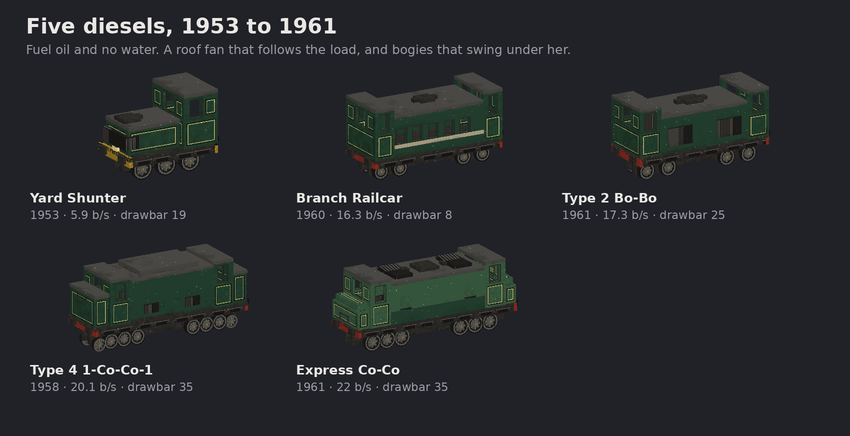
engines_diesel.png
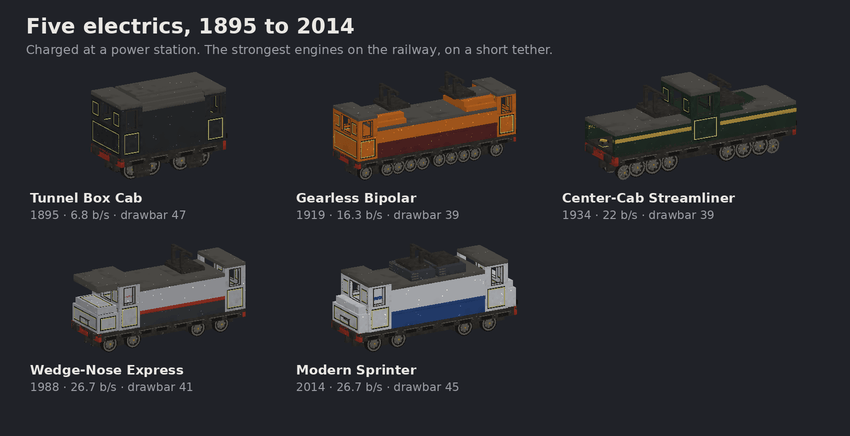
engines_electric.png
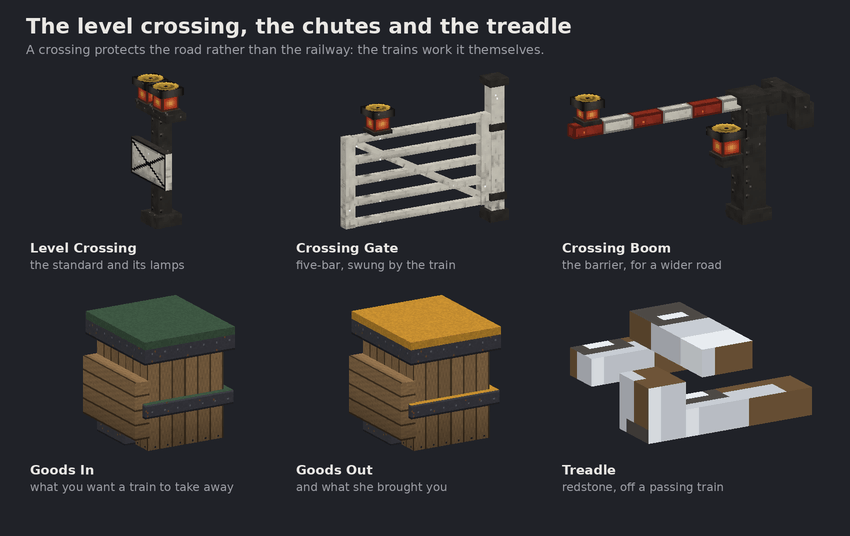
crossing.png
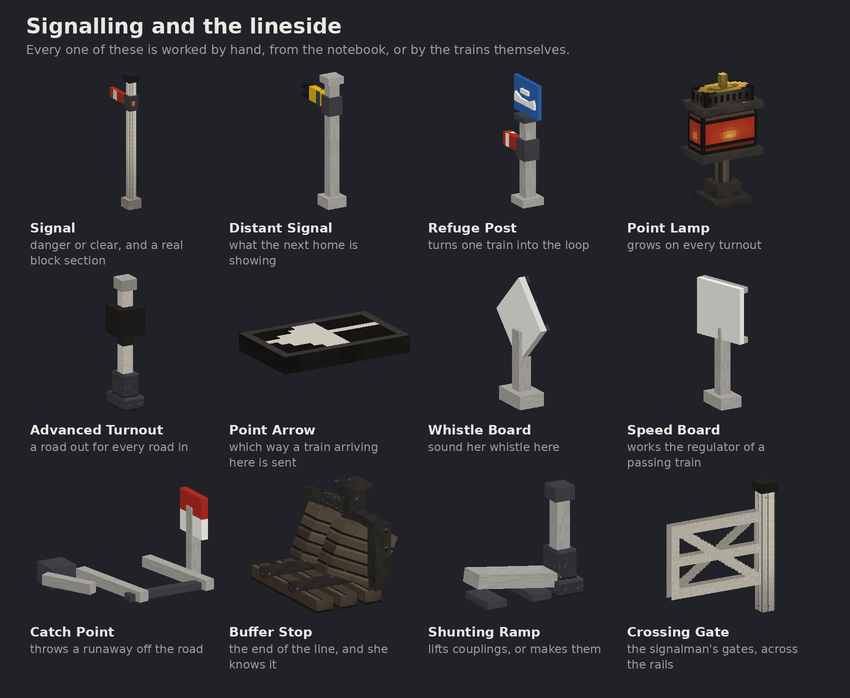
signalling.png
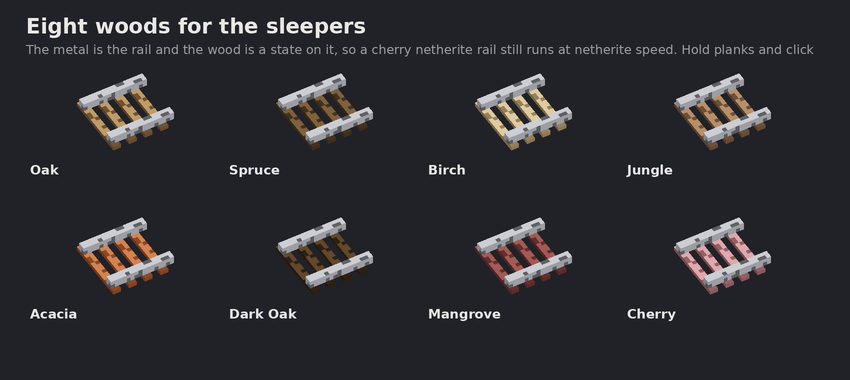
woods.png
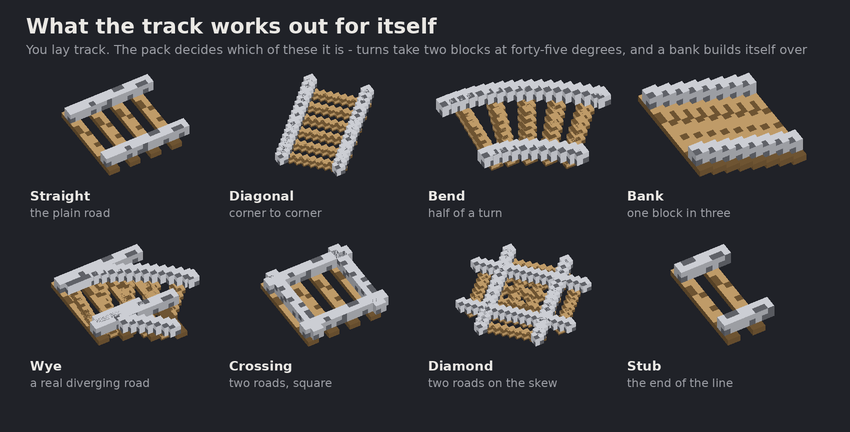
shapes.png
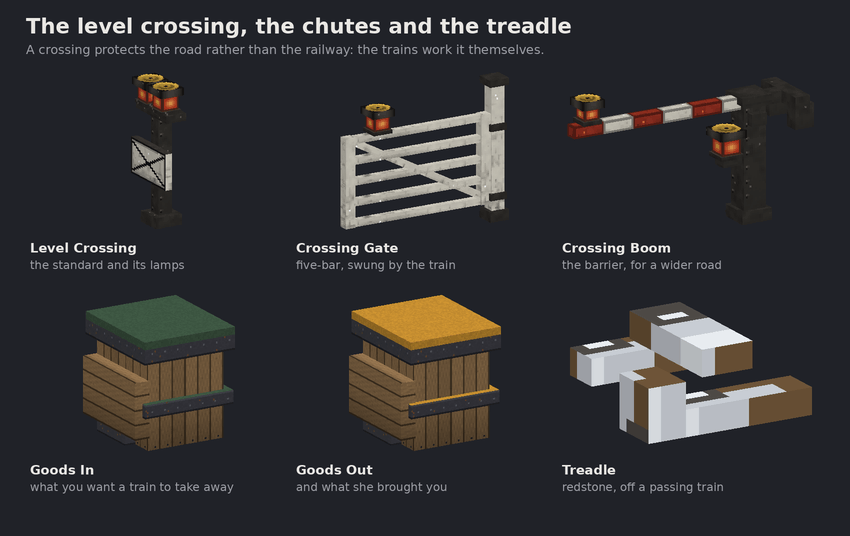
crossing.png
stock_general.png
stock_live.png

train_express.png

train_diesel.png
train_electric.png

train_goods.png
Description
Massive Update! Because the packs are getting large, they are now split into a RESOURCE pack and a BEHAVIOR pack, be sure to download and import them both.
The 4 of us are working to get out as many features as possible that actually work -- please let us know if you see issues on our discord. ty!


Iron Road
A railway that owns everything it uses. Its own track blocks, its own locomotives, its own movement engine. No vanilla rails anywhere in it, and not a reskinned minecart in sight - nineteen engines in three kinds of power, eleven kinds of wagon, 113 craftable items, 34 blocks and 60 entities.
Iron Road · Minecraft Bedrock 1.26.30 or newer · no experimental toggles · ten languages
The track is the interesting part
Six rails, and the metal you make one from is the speed it carries. A train can never pass the line speed of the block she is standing on, so track is the ceiling and the engine is what reaches it.
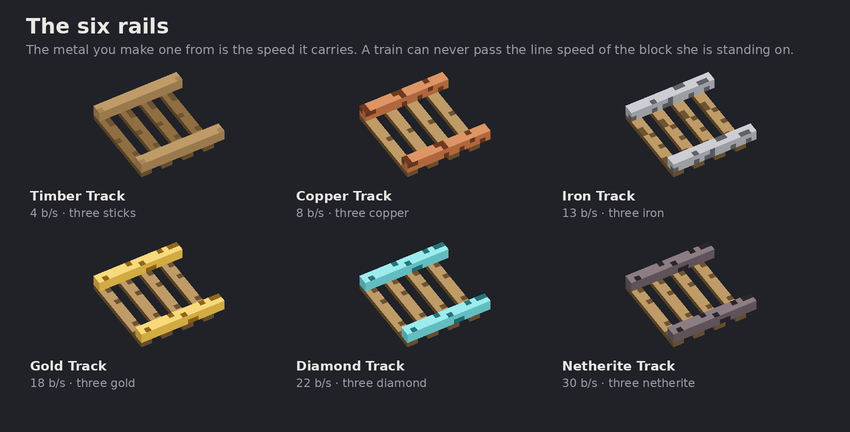
| Rail | Recipe | Line speed | Makes | Runs flat out on it |
|---|---|---|---|---|
| Timber | 3 sticks over 2 planks | 4 b/s | 8 | the Colliery Engine |
| Copper | 3 copper ingots over 2 planks | 8 b/s | 8 | the Yard Shunter, the Saddle Tank and the Tunnel Box Cab |
| Iron | 3 iron ingots over 2 planks | 13 b/s | 8 | the Rocket, the Long-boiler Goods and the Eight-Coupled Goods |
| Gold | 3 gold ingots over 2 planks | 18 b/s | 8 | the Single-Driver Express, the Mixed-Traffic Tank, the Branch Railcar, the Type 2 and the Bipolar |
| Diamond | 3 diamonds over 2 planks | 22 b/s | 6 | the Edwardian Express, the Streamlined Pacific, the Type 4, the Express Co-Co and the Center-Cab Streamliner |
| Netherite | 3 netherite ingots over 2 planks | 30 b/s | 12 | the Wedge-Nose Express and the Modern Sprinter - with room for something faster |
Each rail is a real line speed - 5, 25, 50, 75 and 100 mph, then netherite above them all - worked out on the same scale the engines are rated on, so an engine is never held back by the rail made for her class. Lay copper and a shunter is wasting nothing; lay diamond and an A4 runs at a hundred miles an hour. Netherite is the only rail the two modern electrics reach their own 125 mph on,.
The metal is the rail and the wood is the sleepers. Eight woods on any of the six, so forty-eight rails you can hold - and the wood is a state rather than a block, so a cherry netherite rail is still a netherite rail and still runs at 30. Hold planks and click a rail to re-stain it; sneak-click and the color runs the length of the line, around the curves and up the banks. Glowstone dust lights a rail, and a glow ink sac gives a dimmer glow.
Turns take forty-five degrees at a time
A quarter turn is two bends with a diagonal between them, so a corner takes two blocks and the line cuts across it the way a real one does - ninety degrees in a single block is a radius no railway on earth has been built to. The bend leaves the block square and arrives at the corner at forty-five, so it meets a straight without a kink and a diagonal without a jolt. Two diagonals crossing make a diamond.
You lay it the way you already lay track. Put the next rail down diagonally from the railhead and the pack bends both ends to meet; put one down square beside it, the old corner gesture, and it comes down on the diagonal for you.
- Hills build themselves. Lay a rail a block up and one along, and the three blocks behind the step become a 1-in-3 bank. There is no ramp block to place and nothing new to learn. And a bank is felt: a train works harder up it, and one too heavy for the gradient says so, naming the drawbar she wants against the drawbar she has.
- A line in the air is a bridge you can walk along - flat track and every slice of a bank are solid - and where one goes down over nothing, a trestle grows under it, down to the first thing that will hold it, up to 64 blocks. Lift the rail and the bent comes up with it.
- Click the railhead with a rail in your hand to carry the line on a block at a time in the direction you are facing; hold the button and it runs out ahead of you. It steps past what is already laid, climbs a bank that is in the way, and brings the color of the rail in your hand.
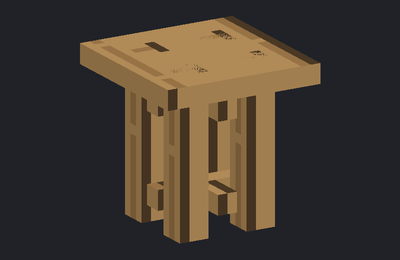
And you can survey a run before you build it
Sneak-click the railhead, look at where the line should finish, and click the spot. Between the two clicks the route appears on the ground as a silhouette - straights, curves and banks, drawn as the pieces that will actually go there - and the second click lays the lot.
- A green ring on the far mark means she reaches it. A red cross means she cannot, and what is drawn is as far as she gets.
- The run you cannot pay for is drawn as a gray shadow, with the rails in your hand counted on the action bar, so a forty-block line does not stop in a field because you were carrying eighteen.
- The readout tells you how steep it is - how far the run climbs or falls, and whether a bank runs long enough for a heavy train to feel it - measured off the run that is drawn.
- The run carries on. After a run is laid the survey picks up again from the railhead you just reached, so a long line is click, look, click, look, click.
- And it comes back up. Sneak-click the railhead you just laid to and the run is offered back; sneak-click again and the whole run lifts with the rails returned - walking back one run a press, as far as the last six. Take my last run back up in the notebook does the same. Anything built on it since is named rather than taken.
- Look at the end of another line and the run goes in and joins it, which closes a loop in one stroke. Look at open sky and you get the flyover instead: sixteen blocks on your bearing, at the gradient of your look.
Nineteen engines, and they are not reskins of each other
Nine steam, five diesel and five electric, from about 1815 to 2014, and each one is a different machine to drive. Drawbar is what she will haul; a bank adds to what every wagon weighs against it. Top speed and drawbar come off each engine's real prototype - a steam engine off her starting pull, a diesel off her continuous tractive effort, an electric off her continuous power - so the roster is ordered the way the real machines were.
Two more numbers belong to the locomotive and nothing else. Adhesion is how much of that drawbar reaches the rail on a bank: a single driving axle costs nothing on the level and leaves her spinning on a climb, while a coupled engine of the same rating walks away from her. The curve factor is hers too - a long rigid wheelbase fights a corner, so a short saddle tank goes around one faster than an express twice her speed.
Steam: coal and water, both by distance
| Engine | Date | Top | Drawbar | Bunker | What she is for |
|---|---|---|---|---|---|
| Colliery Engine | c.1815 | 4 b/s | 6 | 96 | the tramroad, and all a timber line needs |
| Rocket 0-2-2 | 1829 | 8.7 b/s | 4 | 80 | fast for her age and feeble - she will not pull and she will not climb |
| Saddle Tank | c.1850 | 7.8 b/s | 13 | 88 | yards and twisty layouts; the tightest-turning steam engine here |
| Long-boiler Goods 0-6-0 | 1840s | 8.7 b/s | 19 | 288 | mineral trains, slowly, up anything |
| Single-Driver Express 4-2-2 | 1850s | 17.3 b/s | 11 | 224 | a coach and a clear run on the flat |
| Edwardian Express 4-4-0 | 1902 | 18.2 b/s | 15 | 240 | a light train flat out on diamond; gold holds her to 18 |
| Eight-Coupled Goods 2-8-0 | 1915 | 10.6 b/s | 40 | 320 | the strongest steam engine in the pack: sixteen chaldrons on the level |
| Streamlined Pacific 4-6-2 | 1935 | 22 b/s | 22 | 400 | diamond line speed exactly; an express, not a coal train |
| Mixed-Traffic Tank 2-6-4T | 1952 | 17.3 b/s | 21 | 160 | fast and heavy work, well enough that you stop keeping two engines |
Bunker is in units of fire - a lump of coal is 8, a block of coal 80, a log 4 and a plank 3. Fuel and water are spent by the block, not by the tick, so a train that has been away in a chunk nobody has loaded comes back having burnt what the journey says. Run one dry a long way from a tower and you are walking back with a bucket - which works, and is deliberately a poor substitute for the tower.
The motion is real. Every driving wheel carries a crank pin, the two sides are quartered, and the three engines with outside Walschaerts valve gear have it solved rather than posed - crosshead, main rod, eccentric rod, expansion link and radius rod all stay on their pins through a whole turn of the wheel. The Colliery Engine has her grasshopper beams.
And a standing engine blows off. Her cylinder cocks the moment she comes to a stand and again as she pulls away, a lazy wisp at the cylinders while she waits, a hiss down the train as the brakes let go, and a plume off the safety valve - each jet coming out of the pipe it comes out of on the real thing. /ironroad:rule blow off if you would rather not.
Every steam engine carries the lamps she would have carried - a tin hand-lantern on the colliery engine, a goods lamp low and central on the long-boiler, a pair on the express - because engines of this period carried oil lamps to say what class of train they were, not to see by.
Diesels: fuel oil, and no water at all
| Engine | Date | Top | Drawbar | Tank | What she is for |
|---|---|---|---|---|---|
| Yard Shunter 0-6-0DE | 1953 | 5.9 b/s | 19 | 160 (2 drums) | moving trains about a yard at a walk |
| Branch Railcar | 1960 | 16.3 b/s | 8 | 160 (2 drums) | her own train - a cab at each end and seats in the saloon |
| Type 2 Bo-Bo | 1961 | 17.3 b/s | 25 | 320 (4 drums) | the workaday mixed-traffic diesel |
| Type 4 1-Co-Co-1 | 1958 | 20.1 b/s | 35 | 480 (6 drums) | heavy freight; the longest engine in the pack |
| Express Co-Co | 1961 | 22 b/s | 35 | 560 (7 drums) | the only diesel that works a diamond line at line speed |
Fuel Oil is smelted from a block of coal, and a drum is 80 units - the same as the block it came from. The trade is not a profit in units but in distance: a diesel burns about two thirds of what a comparable steam engine does. Every tank is a whole number of drums, so a fuel point never has oil she cannot take.
She has no rods, so other things move. A roof fan that follows the load and not the speed, bogies that swing off the road under her as she takes a curve - the two ends opposite ways, the way a body on bogies really sits - and a thin exhaust haze at the roof that follows the regulator. And a proper horn, in two families.
Electrics: the strongest engines on the railway, on a short tether
| Engine | Date | Top | Drawbar | Battery | What she is for |
|---|---|---|---|---|---|
| Tunnel Box Cab | 1895 | 6.8 b/s | 47 | 40 | drags a whole train through a tunnel; the one electric that can be Victorian |
| Gearless Bipolar | 1919 | 16.3 b/s | 39 | 70 | a mountain engine: a heavy train up a bank that would stall anything else |
| Center-Cab Streamliner | 1934 | 22 b/s | 39 | 80 | holds diamond line speed with a train on |
| Wedge-Nose Express | 1988 | 26.7 b/s | 41 | 75 | the reason for netherite; driven from either end |
| Modern Sprinter | 2014 | 26.7 b/s | 45 | 90 | the biggest battery, and the strongest engine bar the box cab |
All five out-pull every steam engine, which is what electric traction did. The balance is that an electric is tethered to a power station and goes about a fifth as far between charges. Her pantograph stays folded on the road - there is no overhead wire, and an engine running under an empty sky with her pan up is the one thing a railway man would look at twice - and rises only at the power station, where the station's arm comes out to meet it. The 1895 box cab has no pantograph at all; she takes her current from a shoe.
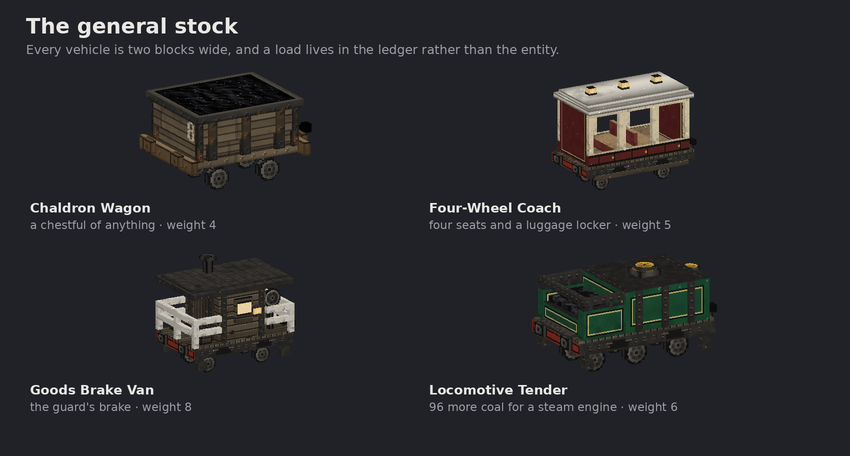
The stock
Everything is two blocks wide, which is the width at which a train reads as a machine rather than a toy. A wagon's load survives anything the world does to the chunk she is standing in. A real coupling hangs in every gap between two vehicles, and on a bank the whole train leans - every body lies along the line between her front and rear wheels, so both ends stay on the rail.

- Chaldron Wagon - tapered timber body, iron-strapped. Weight 4, a chestful (27 slots) of anything. The cheapest way to move goods.
- Four-Wheel Coach - a compartment body in lake and cream with lit windows. Weight 5. A plain click gets you a seat, and there are four; click again aboard for her luggage locker.
- Goods Brake Van - a planked van with a verandah at each end, a stove chimney and a red tail lamp. Weight 8. A goods train of this era had no continuous brake, so each van shortens the braking envelope by 30%, capped at 60% for any number of them - and because the movement engine reads all its stopping out of that one figure, the platform approach, the buffer and the signal overlap all follow.
- Locomotive Tender - a coal space at the front and a water tank behind. Weight 6. Behind a steam engine she extends the bunker as well as the tank: capacity is the whole train's, not the engine's.
Four wagons that know what they are for
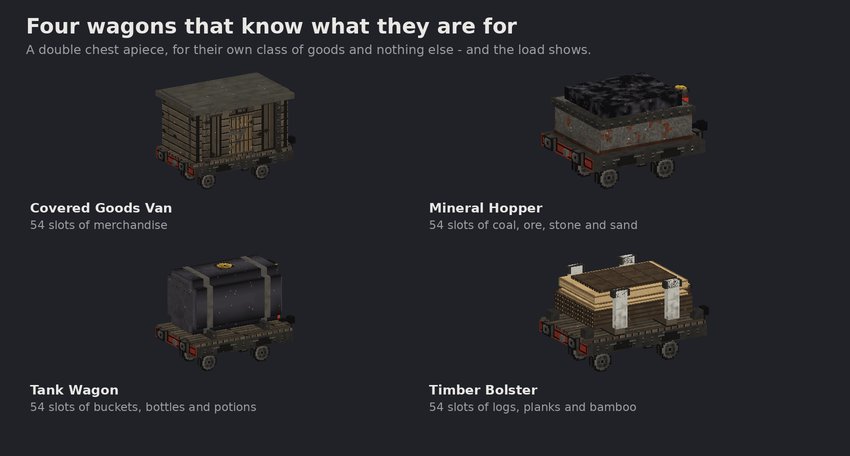
A double chest a piece (54 slots), for their own class of goods and nothing else - and the load shows. Coal heaps above the hopper's rim, crates stand in the van's open door, logs lie between the bolster's stanchions, and the tank wagon's gauge glass fills.
| Wagon | Weight | Carries |
|---|---|---|
| Covered Goods Van | 6 | merchandise - anything that is not bulk, liquid or timber |
| Mineral Hopper | 7 | coal, ore, stone, sand and gravel |
| Tank Wagon | 7 | buckets, bottles and potions |
| Timber Bolster | 7 | logs, planks, stems and bamboo |
A station loading a train offers each crate to each wagon in turn, so a specialist that refuses something leaves it for the next wagon in the rake.
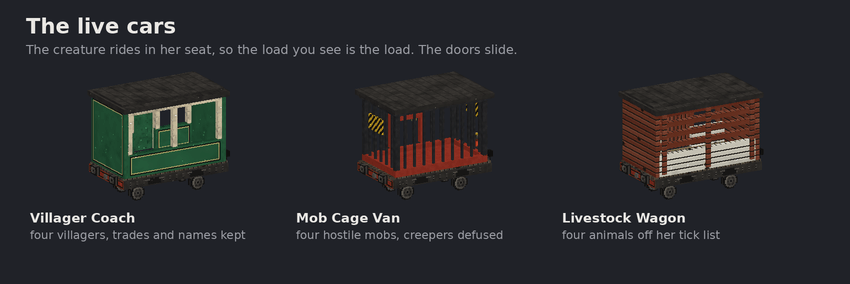
The live cars
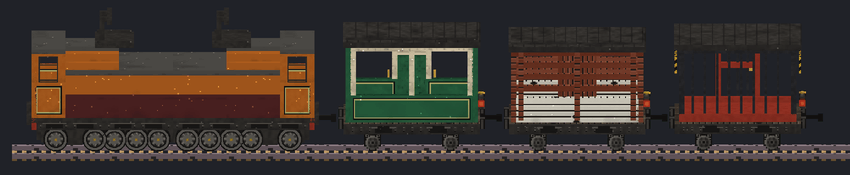
Three cars that carry living things, four places each - and the creature rides in her seat, so the load you see is the load.
- Villager Coach - villagers, who keep their trades and their names.
- Mob Cage Van - hostile mobs off her tick list, never a villager, an animal or a boss. A creeper riding in her stays defused, and the roof keeps a zombie from burning in daylight.
- Livestock Wagon - animals off her tick list, the farm ticked by default.
Click one for her doors: Load, Unload, Closed, or Load now (everything she takes within eight blocks). The doors slide open when she has stood a moment and shut before she has gone a block, and everybody gets out on the door side - so stop her with that side to the platform. While anybody rides in her live cars, her engine holds her ground, keeping the chunks around the train ticking so nobody is left behind in the dark; you can also switch that on for any engine from her page.
Shunting, cuts and runaways
- Sneak-click a wagon and she uncouples there, after an "Uncouple here?" you can switch off. That vehicle and everything behind it stand as a cut; bring an engine back within five blocks and sneak-click to couple on again.
- Or just back on to it. Set the reverser and buffer up: she stops dead on contact and the cut goes on her drawbar with no clicking at all. Running nose-first into a cut does not couple - she stops against it.
- A wagon does not need an engine to go on the rails. Put one down on any track and she stands there on the books, ready to be pushed, coupled to, or loaded.
- Walk into a loose wagon and she rolls, keeps what you gave her, and loses it slowly to rolling resistance. A hand on her beats the steepest bank in the pack, so she can be shoved uphill; step away and gravity has her again.
- A loose wagon on a gradient runs away - and that is what the catch point is for.
- Save a train you like. Save her make-up keeps her vehicles in order and her paint under a name; build her again on the rail you are looking at, out of your pockets in survival and for nothing in creative.
Driving her yourself
Tap the rail beside a standing engine with an empty hand and the regulator opens. A plain tap never stops a running train; a sneaking tap does. Get aboard and the throttle is on your HUD: six cells - two reverse notches in red, Stop in white, and Slow, Half and Full in green - and the movement stick notches it, forward to notch up and back to notch down. A notch is a fraction of what she may do here, since the ceiling is already the smallest of the rail, the engine, the curve, the load and the brake.
- Jump opens the full footplate screen, on every platform, and so does
/ironroad:drive. - She will back up. The reverse notches propel her - the engine pushes from the rear and nothing turns around, which is how a shunt is actually done. A turntable is still the way to turn an engine for good.
- You can ride on the footplate without mounting anything: stand on a locomotive or in a wagon and she takes you with her, and you can still walk about up there while she runs. Step on to an engine and you land in the driving seat, looking out through the cab windows.
- An action-bar line gives her speed, her top speed, what she is burning - coal, fuel oil or charge - and how far it will get her.
- Point at anything of Iron Road's and the action bar says what a click and a sneak-click will do to it. With Better on Bedrock installed, that text goes in Better on Bedrock's own pointer box instead (with Animal Fun, in Animal Fun's), so the two packs do not fight over one line.
/ironroad:rule bar offhands the line over entirely.
Build the railway around her
Most buildings go up by clicking a piece of track with the item, beside the line on your side. Whatever you put down is yours, and its screen has Owner and access.
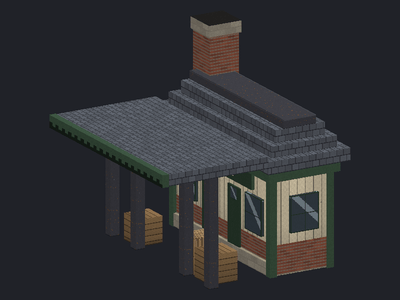
The Goods Station goes up beside the line and lays a five by three deck of real platform block at rail level. That block becomes a calling point: trains brake for it from far enough off to make it, stand in the middle of the platform, do their business and go on. The building is the store - click it for 27 slots - and two chutes at its back corners take goods in (green) and put them out (amber), so a hopper or a chest wired to either one loads and unloads the railway for you. It keeps two lists: what it TAKES off a train (anything, by default) and what it SENDS out onto one (nothing, by default). Goods move at ten a second, with crates flying between the chute and the wagon, and no stop lasts more than two minutes.
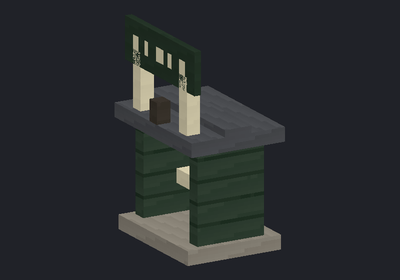
The Wayside Halt is a goods station the size of a shed, and the one building you put down off the line. It finds the nearest track within five blocks that can carry a calling point, marks it and turns to face it. Take goods off a train, put them on one, or just hold her - a stand of up to ninety seconds, a class of goods and a tick list of particular items, its own 27-slot shelf, and a name. It works a train even out on ground nobody has loaded.
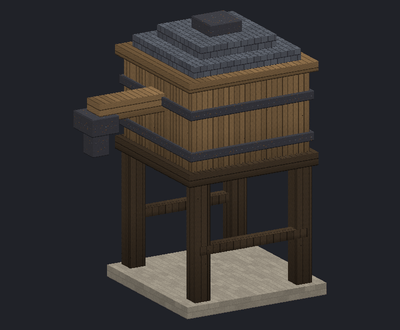
The Water Tower stands over the line with its arm across it. A steam train that stops under it is coaled first out of its bunker and watered second - the order a fireman would work in - and an engine whose fire has gone out is relit and sent on her way. It pumps from any water within five blocks in any direction, weeded brooks and waterlogged blocks included, so a tower beside a stream fills itself for ever and a tower up a dry hillside holds only what you carry to it. The pump is slow on purpose: about forty minutes from dry. A tag over the roof says how much water it has, how many blocks of running its coal is worth, and - in red - if it has nothing to pump.
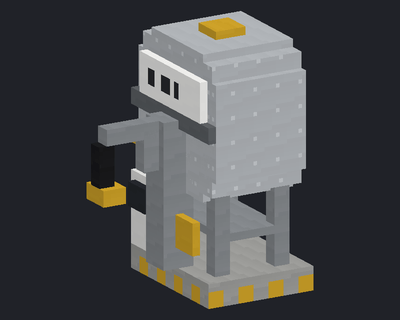
The Fuel Point is the water tower for engines that do not drink: a tank of oil on a frame and an arm over the road. Fill its 27-slot store with drums of fuel oil, by hand or with a hopper, and a diesel that stops under it fills and goes, the arm running out to meet her. It gives a steam engine nothing, and it refuses to be built in the Victorian era - nothing burned oil in 1880.
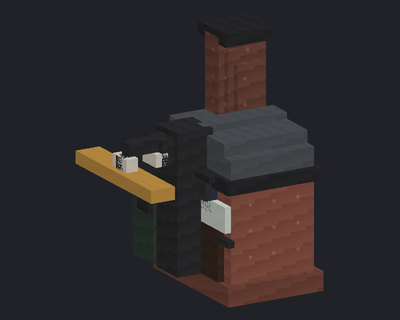
The Power Station is the first building in the pack that makes something rather than holding it. It burns anything that burns - coal, charcoal, logs, planks, dried kelp, blaze rods, even fuel oil - into charge, on its own beat, awake or asleep, so a station left with a chest of coal is full when you come back. An electric that stops at its post charges, with the arm lifting out over the road to her raised pantograph, and the gauge over the roof counts down as it goes. It can be built in all three ages, because the first main-line electric went to work in 1895.
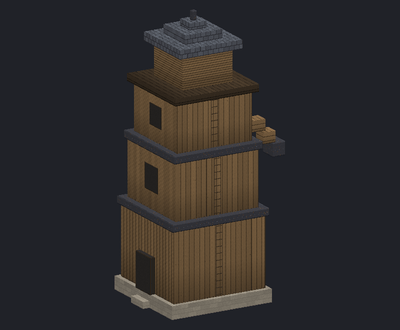
The Silo is a timber grain elevator: three battered tiers strapped in iron, a vented headhouse under a slated cap seven and a half blocks up, and a stepped spout out the back. It holds one commodity in bulk - 20,736 of it, about twelve chests - keeps its purpose when it is emptied, takes a train's delivery at thirty-two a second, and paints its name and count above it so you can read it from a passing footplate.
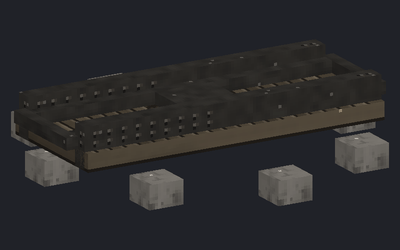
The Turntable is a stone pit with a girder deck that turns to any of eight roads - four square and four diagonal - so line can be laid against any side of the pit. It marks its block a calling point, so an engine running on to it comes to a stand and waits; uncouple what is behind her, click the deck, and it swings to the next road with line against it. Its screen sets the road it sends engines down, whether it turns them itself and lets them go, and whether a redstone pulse swings it.
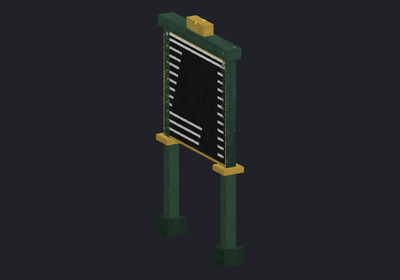
The Departure Board stands within 24 blocks of a calling point and shows the trains due there over its face - at the platform, on the way with the time, held, or calling later. Click it for the list in words, with a button to each train's page.
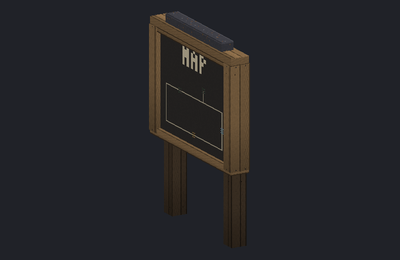
The Map Board draws the whole railway from wherever you are standing - north up, one scale on both axes, stations and towers and silos in their own colors, you as a bright aqua block, and trains green running, amber loaded, white standing, red fire out. Under the map it talks: every station by name with its distance and bearing, and every train's button reading like a report.
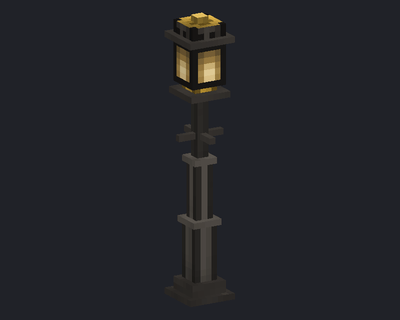
Lamp posts - a tapered iron column with a bolted base and a glazed lantern with a wick you can see burning. The lineside lamp goes up two blocks out from a rail on the side you are standing; the yard lamp goes anywhere. They burn always, at dusk, or only when a train is within twenty blocks, and Light the line walks the road a train would take and puts a post up every eight blocks, up to forty-eight at a time.
Three ages of the same railway
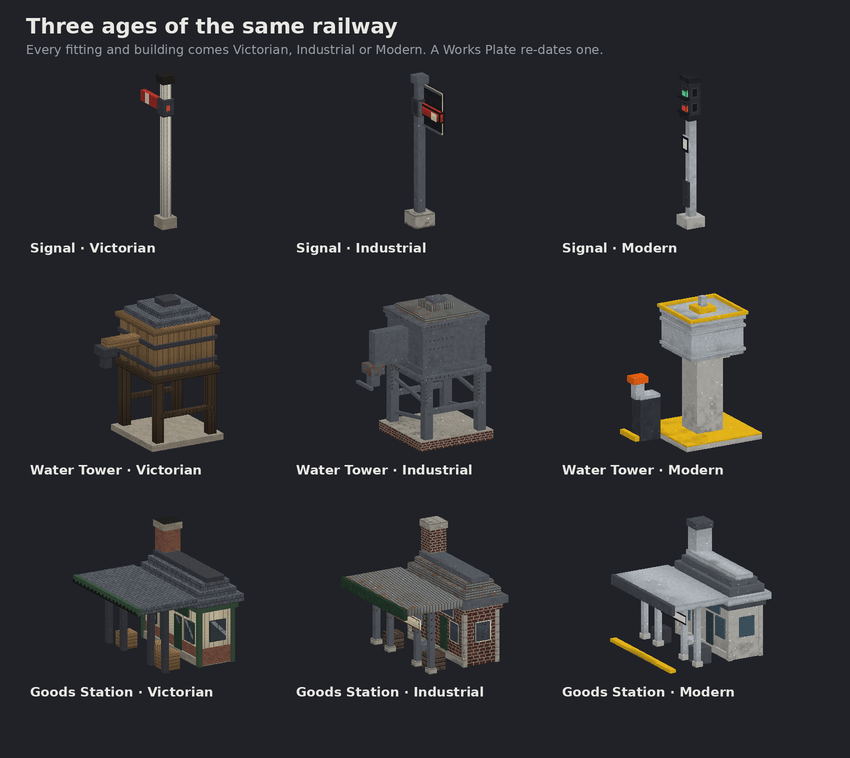
Every lineside fitting and building comes in three eras: Victorian, Industrial (riveted steel, corrugated iron, enamel, upper-quadrant semaphores) and Modern (galvanized steel, concrete, hi-vis, LED color lights). /ironroad:rule era sets the age new work is built in, /ironroad:redate re-dates everything standing around you, and the Works Plate (an iron ingot and a sign) moves a single fitting on an era with a click, or back with a sneak-click.
Signaling that actually signals
The signal is a semaphore - post, arm, a lamp at the spindle. Arm at danger and that block is the end of the line to every train coming towards it; the arm cleared and whoever was held sets off from a stand. Its menu will hang a pair of five-bar gates on it to bar the rails, or set it to work itself, which is absolute block working: a train passing the post puts the arm to danger behind her and the section beyond is hers, and it clears once the train ahead is a full train length past the next post she claims.
- Two posts facing each other are a single-line section, held against both directions, so the train coming the other way stands at her own post rather than being let in to meet the first one halfway down it.
- Put a signal up on a junction and the whole interlocking goes up - one post on every road in, each guarding the junction, standing a block short of the diamond so a train brakes clear of it.
- The distant signal - a yellow fishtail arm on a shorter post - cannot tell you to stop. It tells you what the next home signal is showing, which is what makes driving by hand at line speed possible when a braking envelope goes as the square of the speed. It finds its own home by walking the road ahead, and looks again in case you move it.
- The refuge post is blue, stands on a passing loop, and adopts the junction at each end. When two trains' plans cross its loop from opposite ends it turns one of them in before they are in sight of each other, sets the road back for the other, and lets the first out again when the road is clear. Nothing reverses and nothing is undone.
- And if two trains meet nose to nose anyway, one of them backs down her own road to the nearest place she can be got off the line, waits, and carries on. A train with somebody aboard is never set back by the railway.
Wyes, and knowing which way they lie
A Wye is a piece of track: hold one and lay it, and a proper forty-five degree junction arrives facing you, straight ahead and branch to one side. An empty hand throws it, sneak-click opens its screen, and redstone works it too - level or pulse, your choice. An Advanced Wye is the other tool: put it on a block where three or more arms already meet and every road in gets a setting of its own, so a train from the north can be sent south while a train from the east is sent north.
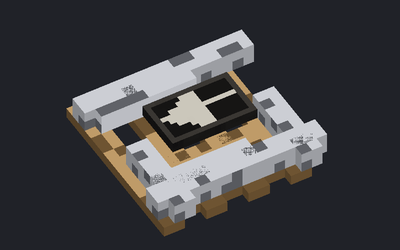
Every way into a junction carries a small route arrow at its mouth, lying on the rails, pointing where a train arriving there will be sent. Click one and it sets that road and nothing else. The arrows are drawn off the same routing the train follows, so they cannot disagree with her.
And every wye grows a point lamp - a squat cast stand at the toe carrying an oblong lantern geared to the blades. By day the shape tells you: the lantern lies along the road that is set. By night the glass does: one white pane and three red, which is the only painting that reads correctly on a left-hand wye, a right-hand wye, and a driver arriving at the heels.
A lever you can see, and a frame to pull it from
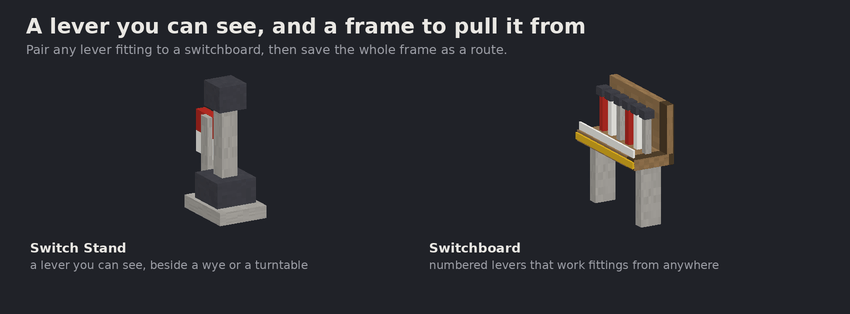
- The Switch Stand is a weighted ground lever planted beside a wye or a turntable, with a red and white target beside the handle. Click to pull it. Its handle follows the junction however it was moved - by hand, by redstone, by the arrows, from the notebook or from a switchboard - so a wye finally has a lever you can read from a distance.
- The Switchboard is a frame of numbered levers on a desk, placed anywhere, that works any fitting paired to it however far off it stands: switch stands, Advanced Wyes, signals, catch points, shunting ramps and turntables. Hold a switchboard and touch fittings out on the line to note them, then touch the desk to put them on. A route is the whole frame written down: save the yard as it stands under a name, and pulling that route puts every lever back - including the ones somebody else left over. Eight routes and twenty-four levers to a frame.
The rest of the lineside
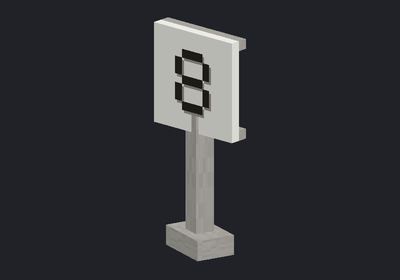
- The Speed Board works the regulator of a passing train: set to a handle position it is a stop board or a starting signal, set to a ceiling it holds trains to a speed until another board lifts it - and the legend on its face says which.
- The Whistle Board - a white diamond on a short post - orders the driver to sound the whistle or horn: one long, two short, or the crossing code. A loose wagon passes it in silence, because there is nobody on her to pull the cord.
- The Catch Point is a safety trap laid in the running line with a red and white target beside it. By default it throws off runaways only, so anything under power passes safely; its screen offers the stricter rule. What it catches comes off the road and lies there as items, load and all.
- The Buffer Stop goes at the end of a road - timber baulks against a riveted iron face, with a lamp bracket. Trains always stopped there; now it looks like they should.
- The Shunting Ramp is an uncoupling ramp with a lever beside it, and a redstone signal swaps its two jobs: lifting couplings, or making them. Three cut rules on its screen - whatever coupling is over it, behind car N, or the last vehicle - and it marks its block a calling point, so it works a train nobody is driving.
- The Treadle puts out redstone while a train is on the rail it was laid against - level or pulse - and strongly powers whatever is set on top of it.
The level crossing
Use it on plain line and a lamp standard goes up on the corner with a pair of white five-bar gates on the verges. The trains work it: one about twenty-four blocks off swings the gates across the road and lights the lamps, and they swing back when her last vehicle is past. Its menu will hang lowering booms instead, and set the warning to twelve, eighteen, twenty-four or thirty-two blocks.
Nothing here stops a train, and that is the point of it: a crossing protects the road, not the railway. The gates that come with a signal are the other thing entirely - those bar the rails while the arm is at danger.
A train that knows where she is going
Give a train a working timetable - up to twelve calls, made up on her own page - and she finds her own road to each one, sets the points on the way, works the goods when she arrives, waits her time and goes on to the next.
- She finds the road in what the railway knows, costed in time rather than distance, so she keeps to the main line without being told which one it is - up banks and on to bridges, around loops and triangles, and to a station whose chunks are all asleep.
- Where there is no road onward she sets back off the terminus and works her way home, and she calls at a turntable and has herself turned.
- Express or pick-up. An express runs through every calling point that is not on her list; a pick-up calls wherever her owner may work.
- A departure interval per call, kept against the pack's own clock, so two trains given the same interval keep station with each other for ever.
- She puts every road back behind her. Every junction she throws is set back the way she found it the moment she is clear, so one lap of a diagram never quietly re-lays the railway for the next train up that arm.
- Send her to… and Bring her home on every train's page are the one-off version: a trip, gone when she arrives.
And it runs while you are not there
- When there is nobody in the world at all, nothing moves. Trains, dwells, signals, crossings, chutes, silos and pumps all stand, the clock is held rather than skipped, and you come back in the morning to the railway you left with the coal you left it with.
/ironroad:rule pause offif you would rather it ran all night. And/ironroad:onleave onstables your own trains when you log out and lets the running ones out again when you come back.
Two books, and three desks
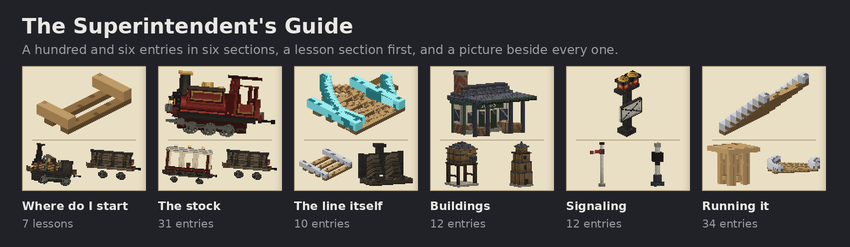
The Superintendent's Guide is handed to every player the first time they join: a hundred and six entries in six sections with a picture beside every one, and the real recipe written out at the foot of the page. It opens on seven lessons - lay a line, put an engine on her, couple a wagon on, set her going, turn a corner and climb a hill, keep her in steam, and where to go next - and eleven first-time hints, said once each and never again, catch you the first time you lay a rail, place an engine or build a station. A book and a stick makes another copy. Thirty-six screens carry a What is this? button straight to the right page.
The Superintendent's Notebook (a book and an iron ingot) is the railway on one screen, and it works from the footplate of a moving train. Your trains and what each is doing; the works, nearest first, with a line of plain English about what each is doing; signals and points, nearest first, worked from where you stand; and the map. From a train's page you can drive her, fill her, name her, paint-save her, timetable her, or send her somewhere. Any building can be named, and the name is what the works list, the map board and the roof all call it.
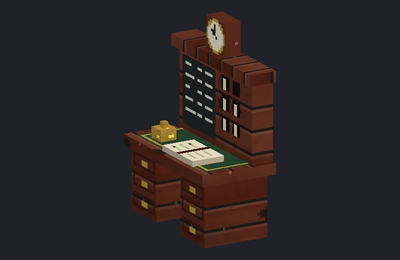
The Scheduling Desk (two books, a clock and five planks) is a station master's desk you place anywhere: every train on the railway with the picture of her engine, your own first, filtered to mine, moving, standing, on a timetable, in trouble or near me. Trouble on the line lists everything wrong that is yours to see to, worst first, each with a button that does something about it. Operators also get the Operator's Panel: every command and rule in the pack, explained, with its current setting and a button for everything it does.
The control desk (/ironroad:desk) is every train on one screen with her levers under her - and it tells apart the reasons a train is doing 0.0 b/s: at a platform, held at a signal, out of fuel, out of water, parked by her owner, or waiting on ground nobody has loaded.
A Bedrock screen is a picture taken when it went up, so the notebook and both desks carry a Refresh button rather than redrawing under your finger.
On a server
- Whoever puts a thing down owns it - trains, buildings, signal posts, wyes, treadles. Owner and access on its screen: open to anybody, to the owner and his crew (up to 24), or to the owner alone; give it away or make it nobody's. Operators pass every lock, and things built before ownership existed are nobody's and open.
- An owner reaches his own things from anywhere. Working somebody else's from the other end of the railway asks for an operator, which is what keeps the notebook from handing a visitor every regulator on the line.
/ironroad:rule remote anyoneopens it up. - Filling her is paid for. Fill her coal and water takes it from your pockets, a silo you own or a water tower you own - free only in creative.
- A train's messages go to her owner, not to whoever is standing there. Five levels -
debug,info,warn,crit(she is stuck and somebody must act) andfault(the pack itself went wrong) - each switchable for the owner and crew, the operators, anybody near, and the log. Each player picks what he hears on his own crew page. Answers to what you are doing are never silenced, because a pack that can be made silent about your own click is one where every refusal looks like a click that did not register.
A train is a thing in the way
- A train stops for a train. The road she stands on reads to everybody else the way a signal at danger does, and she goes again by herself when it clears.
- A train does not stop for a cow. Under a walking pace she is shunting in a yard and what she meets is pushed sideways, unhurt; over it she is a moving train.
/ironroad:rule strike offif you would rather not. - A creeper's fuse is put out rather than lit by the engine that struck it - and the railway's own blocks come out of the blast list before the crater is dug, so an explosion goes around your railway rather than through it.
- Water has a depth. One block over the rail is a ford: she runs through it and works harder. Two blocks and a steam engine's chimney is under, so the fire is out and she coasts to a stand until she is in the air again.
Rules, and presets
Every world setting is one command. /ironroad:rule <name> [value] sets or reports any of them - fuel, strike, water, blast, runaway, pause, stow, lamps, head lamps, smoke, blow, sound, remote, chatter, hints, the rider's readout, the action bar, hearts, era, lean on a bank, and the rest - and a value a rule does not take is refused rather than guessed at. /ironroad:rules <preset> applies several at once:
| Preset | What it is |
|---|---|
standard |
what a new world starts at |
relaxed |
a railway that forgives: no fuel, no strike, no deep water, no runaways |
realistic |
everything the railway can do to you |
light |
the cheap end of every rule, for a busy server or a slow device |
showcase |
the relaxed rules with all the smoke and every lamp lit |
Some of the commands
| Command | What it does |
|---|---|
/ironroad:map |
the whole railway: map, works, signaling, trains |
/ironroad:desk |
every train on one screen, with her levers |
/ironroad:drive |
the footplate of the train you are riding |
/ironroad:dump |
every train: speed, target, tier, shape under her, odometer, cars |
/ironroad:why |
why is everything stopped: trains, meetings, posts, refuges, timetables |
/ironroad:rule <name> [value] |
one world rule: set it, or say what it is |
/ironroad:rules [preset] |
every rule and its setting, or a preset |
/ironroad:fill |
fill every locomotive's bunker and tank |
/ironroad:towers water|fuel|both |
fill every water tower on the railway |
/ironroad:redate <age> [radius] |
re-date the fittings standing around you |
/ironroad:stable / steam |
stand, or start, every train of your own |
/ironroad:onleave on|off |
stable your trains when you log out, and let them out again when you return |
/ironroad:fix [radius] |
re-derive the connections around you, and say what changed |
/ironroad:perf |
the pack's own stop-watch, for proving whether a slow tick was Iron Road's |
/ironroad:help |
the whole list |
Twenty-eight of them, registered properly so the game tab-completes them - and the Operator's Panel on the scheduling desk puts every one behind a button.
Looking is open to everybody: dump, audit, probe, why, map and help. Everything that changes the world asks for an operator.
Ten languages, and good neighbors
Every name, screen, message and guide page in English (US), English (UK), German, Spanish (Spain), Spanish (Mexico), French, Japanese, Portuguese (Brazil), Russian and Chinese (Simplified). The creative menu files everything in seven Iron Road folders under Construction.
With Better on Bedrock or Animal Fun in the same world, Iron Road writes its pointer text in that pack's own box and holds Better on Bedrock's tooltip off while you aim at a train or ride one, so the two do not flicker over one line.
Installing it
Two packs - behavior and resource - and both have to be on the world. Minecraft Bedrock 1.26.30 or newer, which is the version the newest thing in the pack actually needs rather than the newest version it was built on. No experimental toggles.
Add it to a world you have already built: nothing here generates and nothing here is looted, so not a block of it changes until you lay the first rail. Take it off again and you have a world with some holes in it where the railway was, which is true of every add-on that adds blocks.
Updating from an older version needs nothing from you. Retired rails convert themselves to their nearest metal as their ground loads, retired items upgrade in your pockets, and the Six-Coupled Tank, which has left the recipe list, keeps running on any railway she is already on.
It is in active development and things get added and fixed often. If something is wrong, /ironroad:dump first: its first two lines say which version the behavior pack is and which version the resource pack is, separately, and half an add-on is the cause of most of what looks like a bug.
Sound credits
The sounds in this add-on are real railway recordings, apart from the few listed at the bottom. Every recording is CC0, public domain, or Creative Commons Attribution. Nothing NonCommercial, NoDerivatives or ShareAlike is used anywhere in this pack.
Attribution required
lakewoodsound — Creative Commons Attribution 4.0 https://freesound.org/people/lakewoodsound/ Geared steam locomotives of Mountain Rail West Virginia at Cass, WV: Climax #9: Departure (752271), Shay #2: Departure 1 (752567), Shay #4: Arrival 3 (752573), Shay #4: Departure 1 (752407). Used for the chime whistles, a plain whistle and the bell.
Benboncan — Creative Commons Attribution 4.0 https://freesound.org/people/Benboncan/ Ffestiniog Railway, North Wales. Steam Train L To R (119125), Steam Train 1 (94216), Blanche Uphill (63925), Steam Train (58293). Used for the exhaust beats, the brake and the wheels on the rail.
eliasheuninck — Creative Commons Attribution 4.0 https://freesound.org/people/eliasheuninck/ steam train horn 01 (170464). Used for a plain whistle.
patchen — Creative Commons Attribution 4.0 https://freesound.org/people/patchen/ Locomotive 2 Near horn approaching (17852). Used for a horn.
alex36917 — Creative Commons Attribution 4.0 https://freesound.org/people/alex36917/ passenger train sounds - track, rail squeal, click clack, horn, crossing bells (639232). Used for a horn.
YleArkisto (Yle, the Finnish Broadcasting Company) — Creative Commons Attribution 4.0 https://freesound.org/people/YleArkisto/ Rautatievaihde / Manual railway switch, points, metal lever rattling and clicking, railway yard (334138, 334139), recorded in 1971. Used for the ground lever and the signal arm.
toam — Creative Commons Attribution 3.0 https://freesound.org/people/toam/ Train car coupling sounds (198605). Used for the couplings.
IENBA — Creative Commons Attribution 4.0 https://freesound.org/people/IENBA/ Heavy bag drop (545476). Used for goods handling.
Walking.With.Microphones — Creative Commons Attribution 4.0 https://freesound.org/people/Walking.With.Microphones/ Steam Locomotive blowing off steam (P36) (556126). Used for the steam release.
kangaroovindaloo — Creative Commons Attribution 4.0 https://freesound.org/people/kangaroovindaloo/ Slow Moving Steam Train Onboard Clickety Clack (442211). Used for the rail joints and the wheels on the rail.
WeenyBeany — Creative Commons Attribution 4.0 https://freesound.org/people/WeenyBeany/ Fast Freight Train Clickety-Clack over Track Joint (769890). Used for a rail joint.
newlocknew — Creative Commons Attribution 4.0 https://freesound.org/people/newlocknew/ The freight train starts moving and leaves the station, Kosulino (580462). Used for a brake squeal.
No attribution required — listed as a courtesy
Ratspeed — CC0 · https://freesound.org/people/Ratspeed/ Bigboy 4014 Steam Excursion Train (746322). Used for a chime whistle.
Jack_Carsons_RV — CC0 · https://freesound.org/people/Jack_Carsons_RV/ K5HLB (455013). Used for a horn.
kyles — CC0 · https://freesound.org/people/kyles/ freight train pass slow … stop start cars slam (453437). Used for the couplings.
ldezem — CC0 · https://freesound.org/people/ldezem/ Forge - Adding coal (386143). Used for firing.
keithpeter — CC0 · https://freesound.org/people/keithpeter/ steam-train-leaving-moor-st-station (125211), a GWR Hall leaving Birmingham Moor Street.
Garuda1982 — CC0 · https://freesound.org/people/Garuda1982/ small steam locomotive hiss and honk (575649).
Thank you freesound.org for hosting all the sound files anyone could hope for! We appreciate you!
Iron Road - Bedrock Train Simulator Team