Animal Fun Zoo - Birds
- By
Animal Fun - Birds expansion pack. This is an expansion to the Animal Fun - Land add-on. Adding 67 birds to the base pack.
af-birds-aviary-chick.gif
af-birds-aviary-effects.gif
af-birds-aviary-swing.gif
af-birds-categories.png
af-birds-dimorphism.png
af-birds-drops.png
af-birds-poses.png
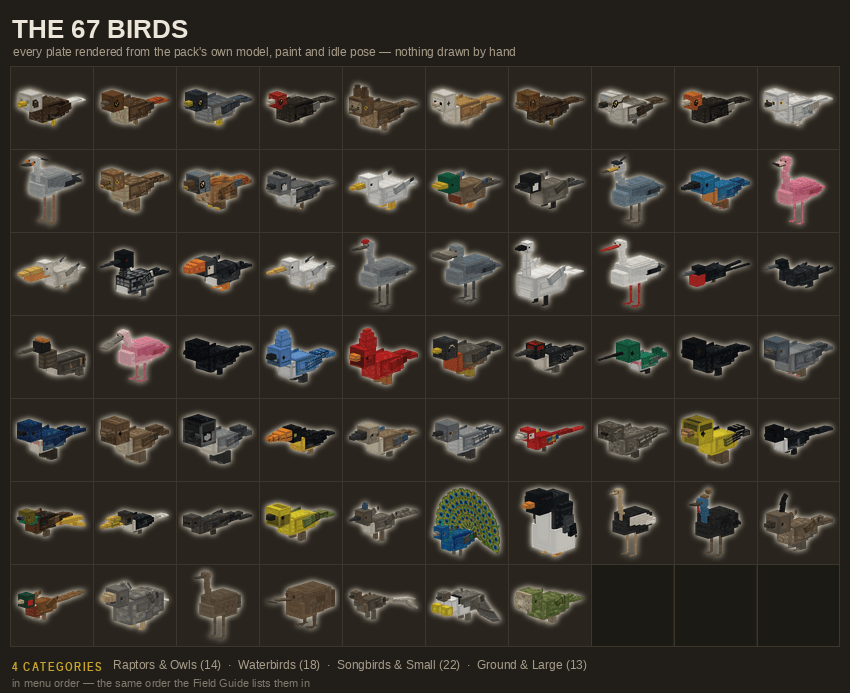
af-birds-roster.png
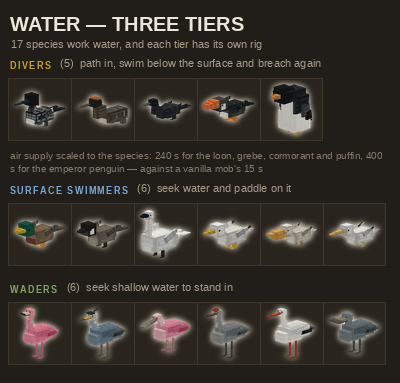
af-birds-water.png
Description


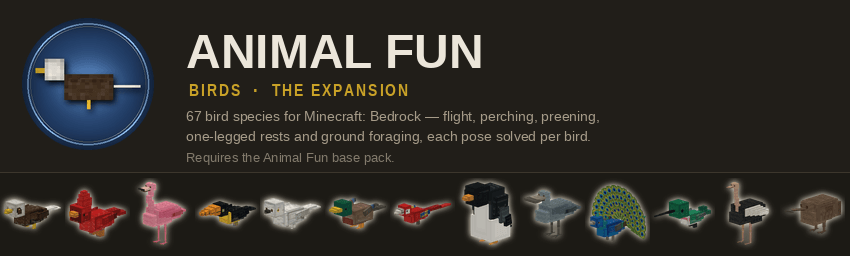
Sixty-seven bird species for Minecraft: Bedrock Edition, built so that how a bird flies, where it perches, which leg it stands on and how far down it can reach to feed are all modeled on the real bird — and seventeen aviary pieces to keep them in.
This is an expansion pack. It ships the birds — entities, models, textures, spawn rules, loot tables, items and aviary blocks — and plugs into Animal Fun - Land, the base pack, which drives everything they do: the settings menu, taming, breeding, riding, drops, spawns, the Field Guide and the zoo healing. Install the base pack first, or this one registers nothing and has no menu of its own.
It overrides no vanilla entity, no vanilla recipe and no vanilla UI control, which is what keeps it out of the way of everything else you have installed.
Requirements
| Requirement | Detail |
|---|---|
| Animal Fun - Land (base pack) | required — v1.28.31 or newer for the birds; v1.57.3 or newer for the aviary pieces to heal and feed. v1.61.1 is current. |
| Minecraft: Bedrock Edition | behavior pack 1.26.0 or later · resource pack 1.21.120 or later · works with Vibrant Visuals |
| Experimental toggles | none — the pack runs on the stable script API, so the world stays non-experimental and keeps achievements |
| Script API | @minecraft/server 2.1.0 |
| Languages | 29 — every bird, item and aviary piece is named in each |
| The download | Animal Fun - Birds v1.15.12.mcaddon — 1077 files, 4.9 MB, carrying both packs |
Import the .mcaddon and activate both its behavior and resource packs in the world. Order between packs does not matter — the base pack simply has to be active. It is deliberately not a manifest dependency, so Minecraft will happily load this pack alone; it just won't do anything.
Always exit and re-enter the world after updating a pack. Entities and pack content hold stale state until a reload, and the symptom looks exactly like "the update didn't apply" — and don't forget to activate the latest version if you have downloaded a previous version since.
Vibrant Visuals is supported since v1.15.12. Minecraft keeps it grayed out while any active resource pack lacks support, so update all five Animal Fun packs together (Land v1.61.1 or newer).
New in v1.15.12
- Vibrant Visuals. The pack no longer holds a world at Fancy graphics, so Vibrant Visuals can be switched on. Feathers stay matte; nothing changes in the Classic look.
- The dodo's wing and the cassowary's casque are joined on — they stood a little apart from the body in game.
- The Field Guide pictures and placard faces are redrawn to match how the game draws the models.
The 67 birds
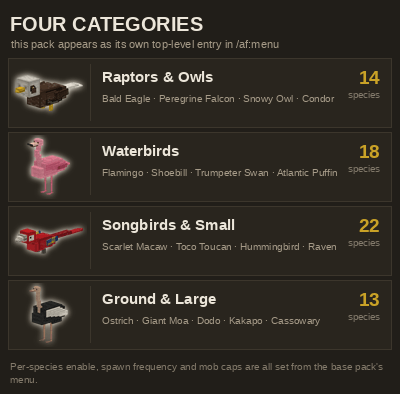
- Raptors & Owls (14) — Bald Eagle, Red-tailed Hawk, Peregrine Falcon, Turkey Vulture, Great Horned Owl, Barn Owl, Golden Eagle, Osprey, California Condor, Snowy Owl, Secretary Bird, Burrowing Owl, American Kestrel, Harpy Eagle
- Waterbirds (18) — Seagull, Mallard Duck, Canada Goose, Great Blue Heron, Belted Kingfisher, Flamingo, Brown Pelican, Common Loon, Atlantic Puffin, Wandering Albatross, Sandhill Crane, Shoebill, Trumpeter Swan, White Stork, Magnificent Frigatebird, Cormorant, Western Grebe, Roseate Spoonbill
- Songbirds & Small (22) — Raven, Blue Jay, Northern Cardinal, American Robin, Pileated Woodpecker, Hummingbird, American Crow, Pigeon, Barn Swallow, House Sparrow, Black-capped Chickadee, Toco Toucan, Laughing Kookaburra, Northern Mockingbird, Scarlet Macaw, Common Nighthawk, American Goldfinch, Black-billed Magpie, Bird of Paradise, Great Hornbill, Common Swift, Masked Weaver
- Ground & Large (13) — Greater Roadrunner, Indian Peafowl, Emperor Penguin, Ostrich, Cassowary, California Quail, Ring-necked Pheasant, Dodo, Giant Moa, Kiwi, Superb Lyrebird, Greater Sage-Grouse, Kakapo
Four of them are extinct or nearly so — the Dodo, the Giant Moa, the California Condor and the Kakapo.
No two birds in a flock look quite alike. Every bird rolls one of four coat values when it spawns. The first is the painted texture as drawn; the other three lay a tint over it, taken from that bird's own colors — a darker morph, a wash of its own accent color and a paler morph — so a hedgerow full of sparrows reads as individuals rather than as one bird stamped out sixty times. The same roll also decides which side a bird preens first and which leg a wader stands on.
How the birds behave
52 species fly; 15 walk. The ostrich, moa, cassowary, kiwi, kakapo, dodo, penguin, peafowl, pheasant, quail, sage-grouse, lyrebird, roadrunner, secretary bird and burrowing owl work the ground. No bird ever takes fall damage.
Flight
Forty-eight fliers take off, fly and land again on their own. Each one cycles between aloft and perched — a swift is in the air for minutes and down for seconds, a shoebill the other way round — and each flies to one of eleven flight profiles, from the swift's fast, wide sweeps to the heavy flap of a heron or a swan. The Hummingbird and American Kestrel hover for a living and never stop beating.
Twelve big birds soar. The two eagles, red-tailed hawk, turkey vulture, condor, white stork, sandhill crane, pelican, albatross, frigatebird, seagull and peregrine circle up on a thermal, glide out on a near-straight line, and come down on a shallow landing approach instead of dropping. A soaring bird hands itself back to its ordinary behavior when a player is within ten blocks, so walk up to one and it reacts to you like any other bird — watch a soarer from a distance.
Wings stop beating when a bird glides. The flap slows and fades as a bird stops climbing, so a soaring eagle holds its wings level while a sparrow keeps working; birds bank into their turns and nose down when they descend.
The four divers that also fly — the Common Loon, Western Grebe, Cormorant and Atlantic Puffin.
Idle behavior
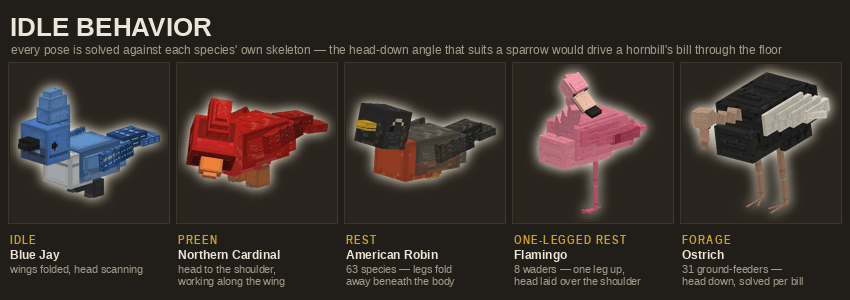
Every one of the 67 preens — head to the shoulder, working out along the wing, which side depending on the individual.
Wings fold on the ground and on the water. A landing bird sweeps its wings back along its flanks, and a bird taking off opens them again in a quarter of a second. The cormorant still stands with its wings spread to dry.
63 rest. Fifty-five settle with the legs folding away beneath them; eight waders — Flamingo, Great Blue Heron, Sandhill Crane, White Stork, Roseate Spoonbill, Shoebill, Western Grebe and Common Loon — pull one leg up and lay the head over the shoulder. The four aerial specialists are excluded on purpose: the Hummingbird, Common Swift, Barn Swallow and Common Nighthawk perch rather than brood in the open.
31 forage, head down. Every pose is solved per species against its own skeleton, because the head-down angle that suits a sparrow would drive a hornbill's bill through the floor — so each gets the deepest version of the pose it can actually hold.
Water
Seventeen species work water, in three tiers. Five divers — Common Loon, Western Grebe, Cormorant, Atlantic Puffin and Emperor Penguin — path into water, swim below the surface and breach again. The Cormorant and the Puffin also fly straight off the water. Six surface swimmers seek water and paddle on it. Six waders seek shallow water to stand in. A flier that lands in water it cannot swim in is flown back out.
The aviary
Seventeen blocks for building an aviary, all named Aviary … (zoo), so searching zoo in the creative inventory or recipe book finds them beside every zoo piece from the base pack. All 67 birds fly or walk to them on their own. What they do — the healing and the feeding — is run by the base pack (Land v1.57.3 or newer), which also lists them on an Aviary page of the Field Guide's zoo kit. On an older base pack they still place, animate and draw birds; they just heal nobody.
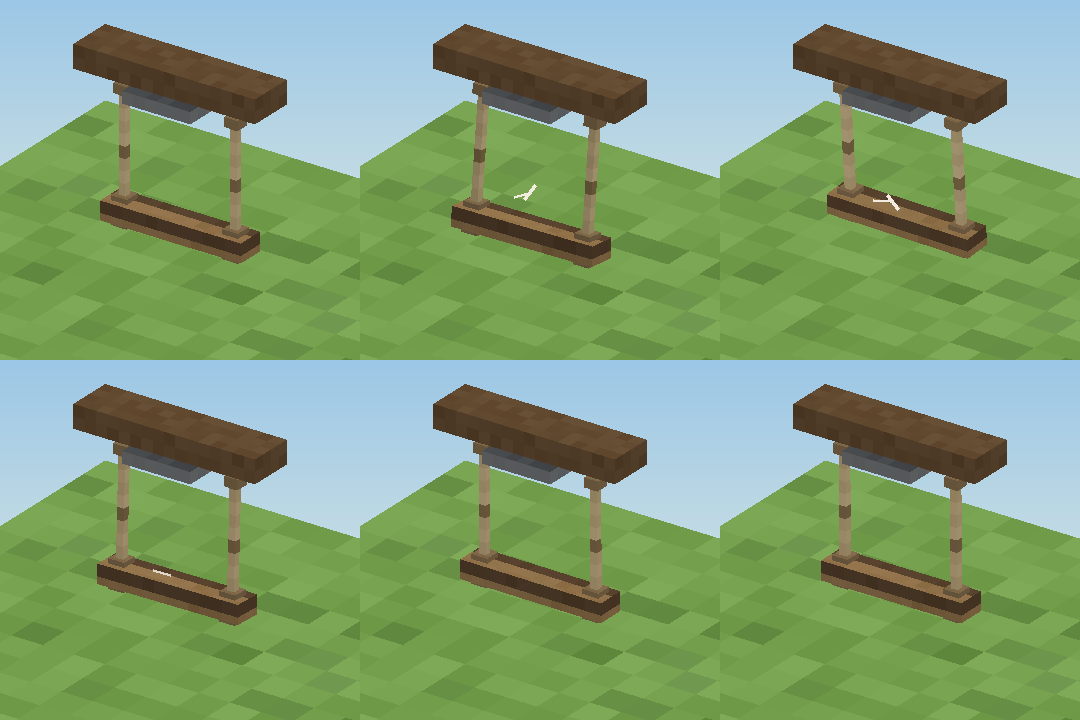
| //media.forgecdn.net/attachments/1992/133/af-birds-aviary-swing-gif.gif"_alt="aviary_hanging_perch">"> |
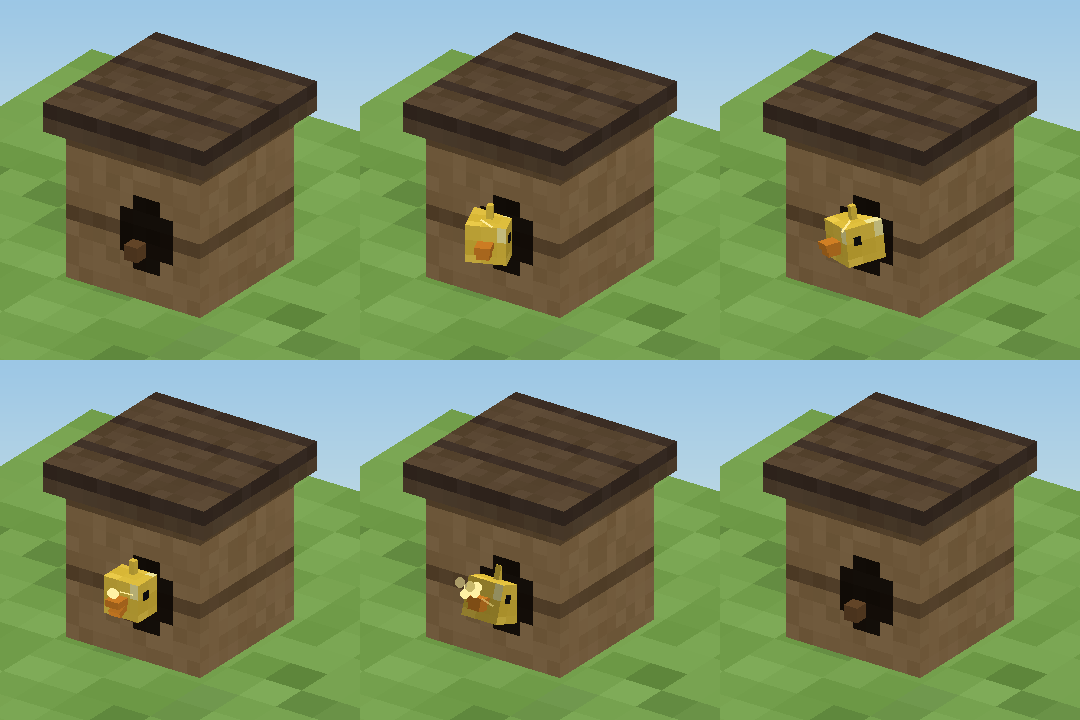
//media.forgecdn.net/attachments/1992/131/af-birds-aviary-chick-gif.gif"_alt="aviary_nest_box">"> |
|---|---|
| Aviary Hanging Perch — a rope swing hung from the block above. It faces the way you place it, swings hard when a bird hops off, and settles again. | Aviary Nest Box — after a bird settles, a chick pokes its head out of the hole, looks around and cheeps. |
| Piece | What it does |
|---|---|
| Perch Pole · Dead Snag · Cliff Ledge · Falconry Block Perch | Somewhere to land; half a heart a visit |
| Hanging Perch | A rope swing (above); half a heart |
| Nest Box | One heart, and a chick at the hole afterwards |
| Nest Platform | One heart, and a clutch of eggs that comes and goes |
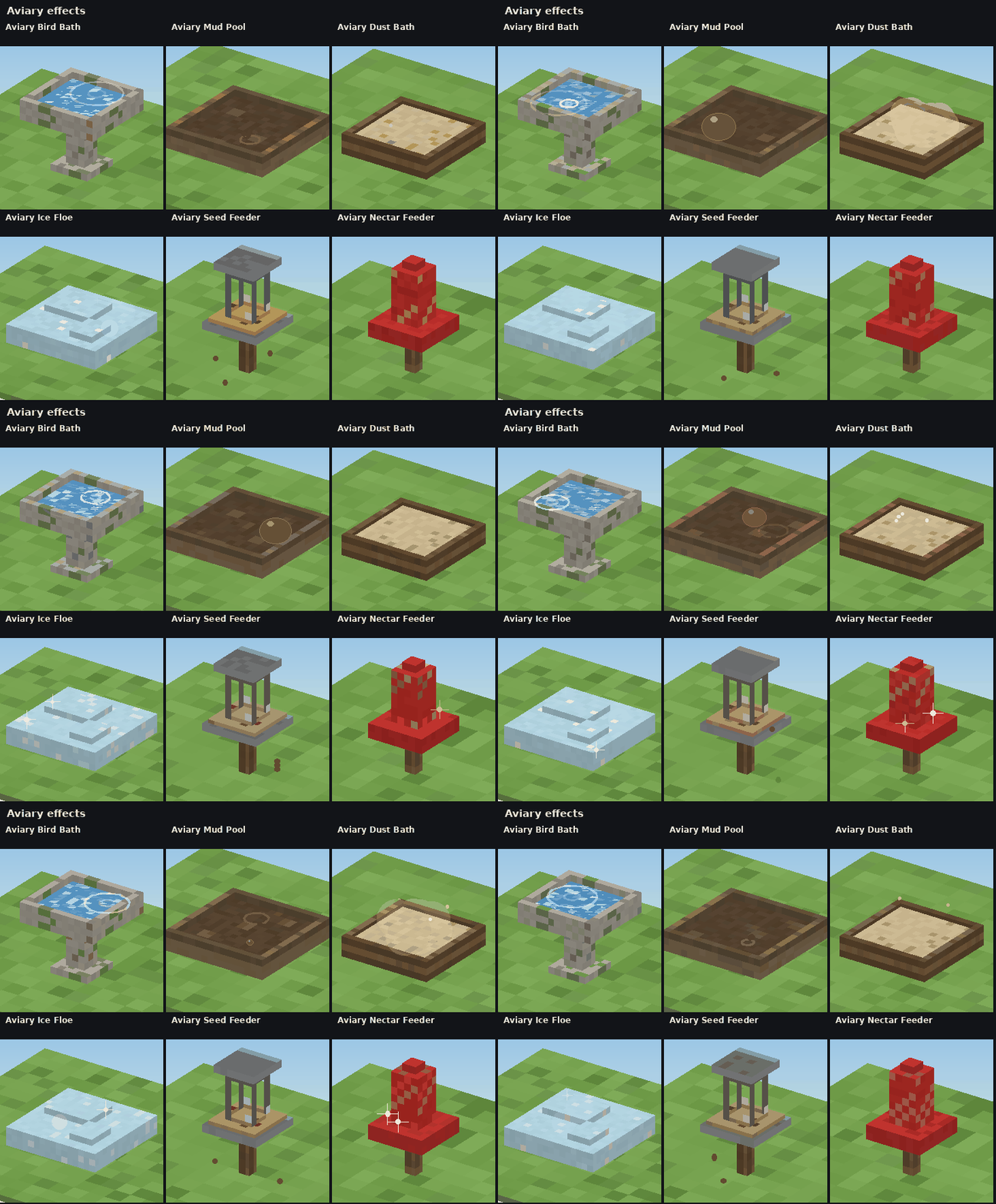
| Seed Feeder | Four meals of seed, two hearts each; seed trickles out while it is stocked |
| Nectar Feeder | Sugar, honey or berries; the nectar shimmers; a heart and a half a visit |
| Suet Cage | Raw meat or seed; four meals, two hearts each; crumbs when a bird pecks |
| Fish Bucket | Cod, salmon, tropical fish, or Fish's reef and game fish; four meals, two hearts each, and a splash |
| Bird Bath | Rippling water, a splash and half a heart, drips from the rim |
| Dust Bath | A billowing puff of dust and half a heart |
| Ice Floe | Glittering ice and cold mist, for penguins and puffins to haul out on; half a heart |
| Mud Pool | Mud that swells, pops and spatters, for flamingos and waders; half a heart |
| Mesh · Mesh Roof | Aviary walls and roof; both count as walls for the Species Placard's enclosure scan |
Every animation and particle runs on the client — the swing and the chick are small models the game animates itself, and the water, nectar, ice and mud are blended flipbook textures.
Water flows through every piece, so a floe, perch or fish bucket can stand in a pond and a mesh wall can cross a stream without damming it.
Sexual dimorphism
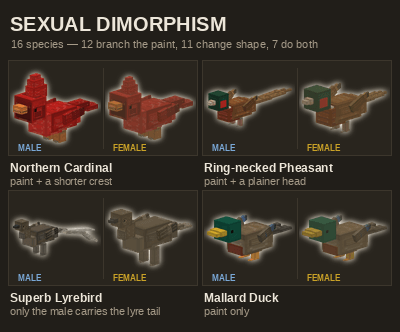
Sixteen species tell the sexes apart. Twelve branch the paint — the female wears a drab wash over the male's colors, which is what a female cardinal, goldfinch, mallard, weaver, frigatebird or hummingbird actually looks like. Eleven change shape. Seven do both.
The shape changes are the ones worth watching for: only the male Superb Lyrebird carries the lyre tail; the Northern Cardinal and Great Horned Owl females have a shorter crest and shorter ear tufts; and the female Cassowary is the larger sex with the taller casque, so hers scales up.
The Indian Peafowl male opens his train into a full fan every so often — 62 feathers in four staggered rows of eyespots, raised and spread over half a second, rattled now and then, and folded away again. The peahen never does.
Sound
124 of the 128 clips are real field recordings, cut and level-matched from CC0, public-domain and CC BY sources into thirty-two voice families. Only the Dodo's four are still generated, because the one usable recording of its nearest living relative is licensed against commercial use.
Fifteen birds have a voice nobody else uses: the American Kestrel, Barn Owl, California Quail, Common Loon, Common Nighthawk, Dodo, Giant Moa, Hummingbird, Laughing Kookaburra, Mallard Duck, Pileated Woodpecker, Ring-necked Pheasant, Atlantic Puffin, Sandhill Crane and Trumpeter Swan. The other fifty-two share eighteen families and are separated by pitch, not by clip — so a family's source recording has to still read as a bird after being shifted across its whole range. The largest families hold six: one keening call for the six eagles, hawks, falcons and the osprey, and one song for six of the small perching birds.
The two mimics genuinely mimic. The Superb Lyrebird and the Northern Mockingbird don't have a call of their own — their ambient draws at random from twelve other species' recordings in this pack, which is exactly what those two birds do in the wild.
Drops
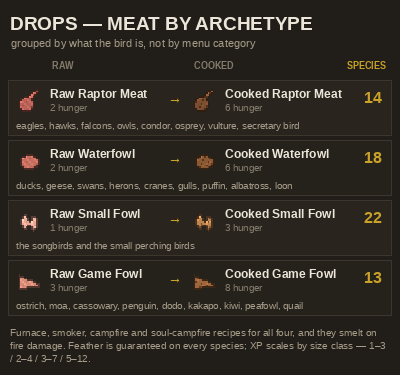
All 67 species have an experience reward and a loot table, and meat is grouped by what the bird is rather than by menu category — so an eagle and an owl drop the same thing. Each raw item has a cooked counterpart, and all four smelt in a furnace, smoker, campfire or soul campfire.
Feather is guaranteed on every species, one to five depending on size. Experience scales the same way: 1–3 for the 34 smallest, 2–4 for 24, 3–7 for the eight biggest fliers and waders, and 5–12 for the Giant Moa alone.
Taming, breeding, riding and spawning
Breeding foods are per species, not per group. Thirteen different foods across the roster, three per bird, and they follow the diet: the raptors take raw rabbit, chicken and cod; the vultures and the condor take rotten flesh; the seed-eaters take wheat seeds; the fruit-eaters take apple, melon and sweet berries; the insectivores take spider eye.
Three species are rideable by default — the Bald Eagle, the Ostrich and the Giant Moa. The Ostrich and the Moa are flightless and ride like a horse; the Bald Eagle flies. Every other bird has the tack machinery wired but switched off until an operator enables it in the menu.
Saddle one of the 52 fliers and it flies. The controls are vanilla's happy ghast: forward moves the bird the way you are looking, so you climb by looking up and descend by looking down, and jump rises straight up. Gravity comes off the moment you mount and back on the moment you get off, so a saddled bird left alone still perches.
Sneak dismounts — it cannot descend. In Bedrock the sneak button is the hardwired dismount control for every rideable; jump is the only button a mount is allowed to take. Look down and press forward to come down, exactly as you would on a happy ghast.
Temperament is set per species and adjustable. Forty-three are passive. Twenty-two hunt other animals — the raptors, the owls, the fish-eaters and the Kookaburra and Roadrunner. Two, the Canada Goose and the Cassowary, will go for a player, which is a fair reading of both. Forty-five flee when they are hit. Of the other twenty-two, twenty-one still run from their natural predators; only the Magnificent Frigatebird stands its ground.
Spawning matches the vanilla chicken. All 67 use the animal population pool with surface spawning and the surface density key, spread across 16 biome tags, in groups of one or two for most species and up to eight for the flock birds. Six spawn on a night window — the Barn Owl, Great Horned Owl, Snowy Owl, Common Nighthawk, Kiwi and Kakapo.
What the base pack's toggles control: the per-species enabled toggle gates every spawn method — eggs, /summon, the spawn menu and natural spawning. Spawn frequency and the mob caps apply to natural spawning only; a spawn with a player within 20 blocks is treated as deliberate and skips them. Anything a player caused — and anything tamed, saddled or script-bred — never despawns; naturally spawned wildlife keeps distance-despawn so the population cycles.
Commands
| Command | Notes |
|---|---|
/af:spawnbird <bird> [count] |
Tab-completing spawn command for this pack's 67 species. |
/af:spawnid <id> [count] |
Base-pack command; works for every species in every installed pack. |
/af:menu |
Base-pack menu. This pack appears as its own top-level entry with its four categories beneath it. |
/scriptevent af:soar |
Reports how many soaring birds are climbing, gliding and landing, and how many were handed back near a player. |
The pack family
| Pack | Version | Species | Role |
|---|---|---|---|
| Animal Fun - Land (base) | v1.61.1 | 96 | The brain — menu, taming, breeding, riding, spawning, drops, zoo |
| Animal Fun: Birds | v1.15.12 | 67 | this pack — plus the aviary |
| Animal Fun: Fish | v1.10.9 | 66 | Expansion — plus the aquarium |
| Animal Fun: Marine Mammals & Oddities | v1.10.4 | 28 | Expansion |
| Animal Fun: Prehistoric | v1.10.3 | 73 | Expansion |
330 species across five packs, all sharing one menu, one Field Guide and one set of rules.
Known limitations
You will notice:
- You cannot descend with sneak. Sneak is Bedrock's dismount button on any rideable and nothing overrides it, so descending means looking down and pressing forward. Vanilla has the same limitation on the happy ghast.
- A ridden flier has no ground control. The saddle groups carry the flying control stack and no ground stack at all, matching vanilla, so a mounted bird hovers rather than walks. The 15 flightless birds are ordinary ground mounts and still ride like a horse.
- Most birds fly lower than life. A flight band a bird cannot reach freezes it in mid-air, so every band stops at twelve blocks to stay reachable inside an enclosure. The twelve soarers get real altitude from the script; the other 36 do not.
- A soaring bird stops soaring when you walk up to it. Within ten blocks it hands itself back to its ordinary behavior, so only one thing is ever steering it.
- A perched bird panics on foot. Scare a bird that is resting and it runs rather than taking off.
- The swim behavior is new. The divers use an amphibious navigator, and four of them also fly; no vanilla mob both flies and swims. If a diver stops pathing properly in the air, that is the thing to report.
- Nothing builds a nest. Birds perch, preen, rest, forage and visit the aviary's nest box and platform — they do not seek a tree, build, or lay.
- This pack alone does nothing. Without the Animal Fun - Land base pack there is no menu, no taming, no breeding, no spawn control and no aviary healing.
Troubleshooting
Nothing from this pack appears in /af:menu. The base pack is not installed, not active, or its script is down. An expansion cannot show a menu of its own.
Birds never spawn naturally, but manual spawns work. That asymmetry is by design — see the toggles above. Run /scriptevent af:dump <id> to print a species' live stored config. Settings live in world dynamic properties, so a fresh test world starts everything at its defaults.
Aviary pieces place and animate but heal nothing. The base pack is older than v1.57.3. Update Animal Fun - Land.
Saddling does nothing and says nothing. Reload the world first. The tack handler lives in the base pack and prints a message on every rejection, so total silence means the base script never ran.
A bird renders as the wrong model. Check the world's world_resource_packs.json and the client-side resource-pack cache.
Two name labels show at the top of the screen. Another add-on is drawing its own look-at label — Massive Trees does by default. Set its label to Only this pack's trees, or set Animal Fun's entity tag to Plain text or Off in /af:hud.
A pack update seems not to have applied. Exit and re-enter the world. This is the first thing to rule out on any report. If running on a dedicated server, be sure to update world_resource_packs.json & world_behavior_packs.json with the correct version number. All updates are versioned so you can downgrade if you don't like an update.
Sound credits
The bird calls in this add-on are real field recordings, trimmed and level-matched for use in-game. All are used under licences that permit commercial use.
Attribution required
- Department of Conservation (NZ) (CC BY 4.0) — Boom, Moa boom, Purr — https://www.doc.govt.nz/nature/native-animals/birds/bird-songs-and-calls/
- Benboncan (Freesound) (CC BY 4.0) — Drum — https://freesound.org/people/Benboncan/sounds/66955/
- National Park Service (Public domain) — Hum, Trill — https://www.nps.gov/romo/learn/photosmultimedia/soundlibrary.htm
- Pierrot Desperes (radio aporee) (Public domain) — Bray — https://archive.org/details/aporee_62524_71950
- Keith Selmes (Freesound) (CC BY 4.0) — Wail — [https://freesound.org/people/Keith%20Selmes/sounds/397357/](https://freesound.org/people/Keith Selmes/sounds/397357/)
- spudmel (radio aporee) (CC BY 3.0) — Cackle — https://archive.org/details/aporee_69990_81522
- klankbeeld (Freesound) (CC BY 4.0) — Cackle — https://freesound.org/people/klankbeeld/sounds/187597/
- Soundholder (Freesound) (CC BY 3.0) — Groan — https://freesound.org/people/Soundholder/sounds/425375/
Public-domain dedications (CC0) — no attribution required, listed with thanks:
ken788 (Freesound), Richard Bruins (iNaturalist), Breviceps (Freesound), 5ro4 (Freesound), StuartRoland (Freesound), KiddoFish86 (Freesound), Canardo55 (Freesound), Kinoton (Freesound), TRP (Freesound), David Roach (iNaturalist), Ninjanan (Freesound), stackpool (Freesound), felix.blume (Freesound), raoul_slayer (Freesound), WavJunction.com (Freesound), Anne Parsons (iNaturalist), florianreichelt (Freesound) — all via Freesound and iNaturalist.
Animal Fun Zoo - Birds Team