Bring life to villager professions through automation
Vanilla villagers with professions trade but barely do any work. This mod gives twelve of the thirteen vanilla professions real jobs — and, more importantly, establishes supplier-customer relationships among them.
The result is a village that runs as a small economy.
📖 Full documentation: the Villagers at Work wiki
Principles
Vanilla mechanics are still there. The mechanics added are triggered by opt-in action, and the vanilla mechanics altered are restored by opt-out action. The mod never breaks existing farms and is safe to install on existing worlds.
No blocks are added. The mod uses vanilla blocks only, so it is pure server side. Anything that needs the client is in a separate, optional client jar.
The game teaches itself. Once you get the main idea, visual feedback guides you on what needs to be done or why something is not working. In single player, the mod's own advancements also guide you and encourage you to discover more of the mechanics introduced by the mod.
Getting started: the shelf
The shelf is the heart of the mod.
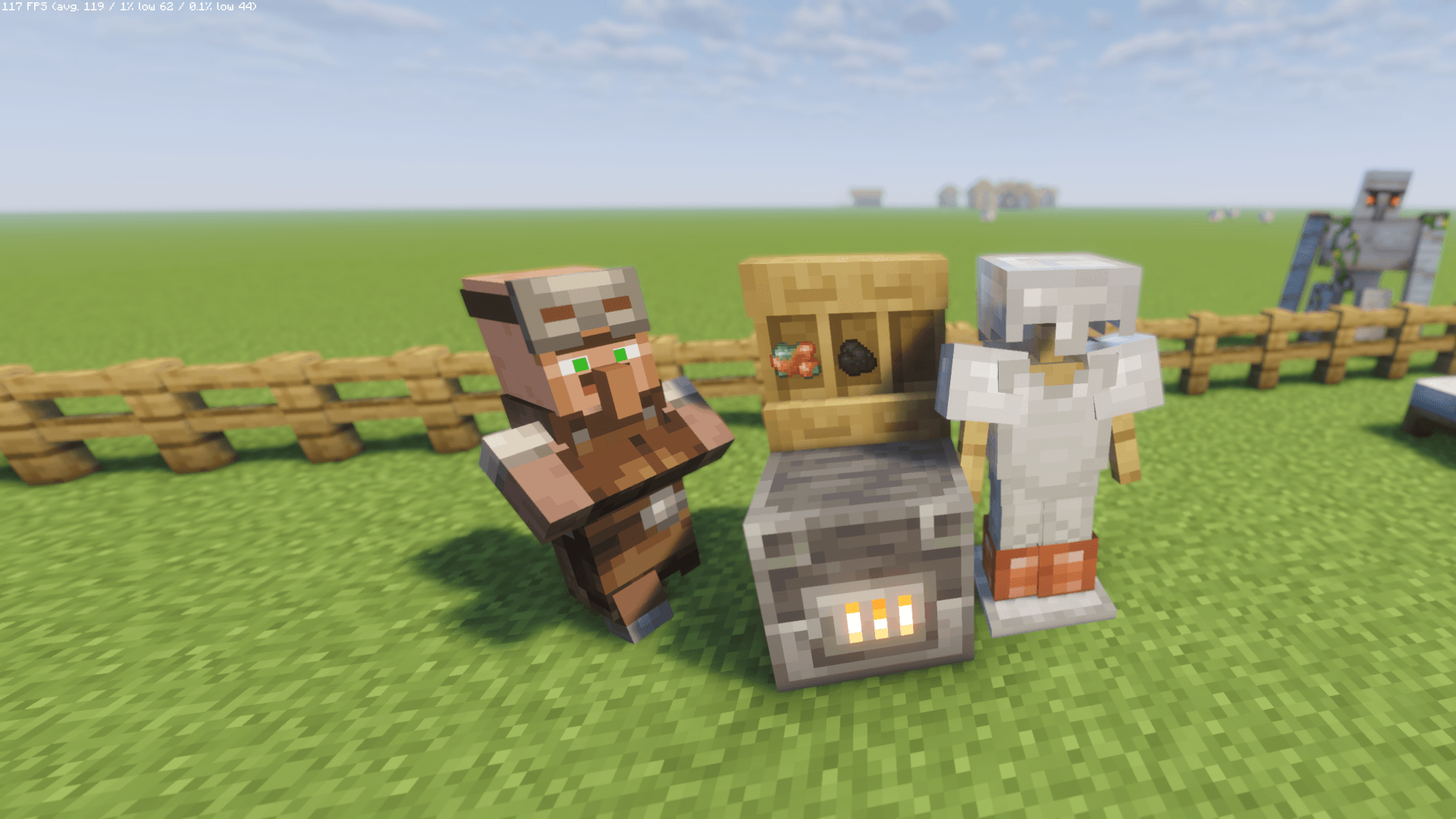
- Place a shelf touching a workstation — any of the six faces, including above and below.
- The villager that claims the workstation is now working.
- A shelf has three slots. It is where the villager gets the tools to use and the items to consume for production.
One shelf per workstation, one workstation per shelf. Three slots is deliberately tight: it pushes you to build more workstations and employ more villagers rather than running everything through one overworked smith.
A villager emits green star particles when a shelf or chest binds to its workstation. No particle means it did not bind.
The professions
| Profession |
Job |
| Farmer |
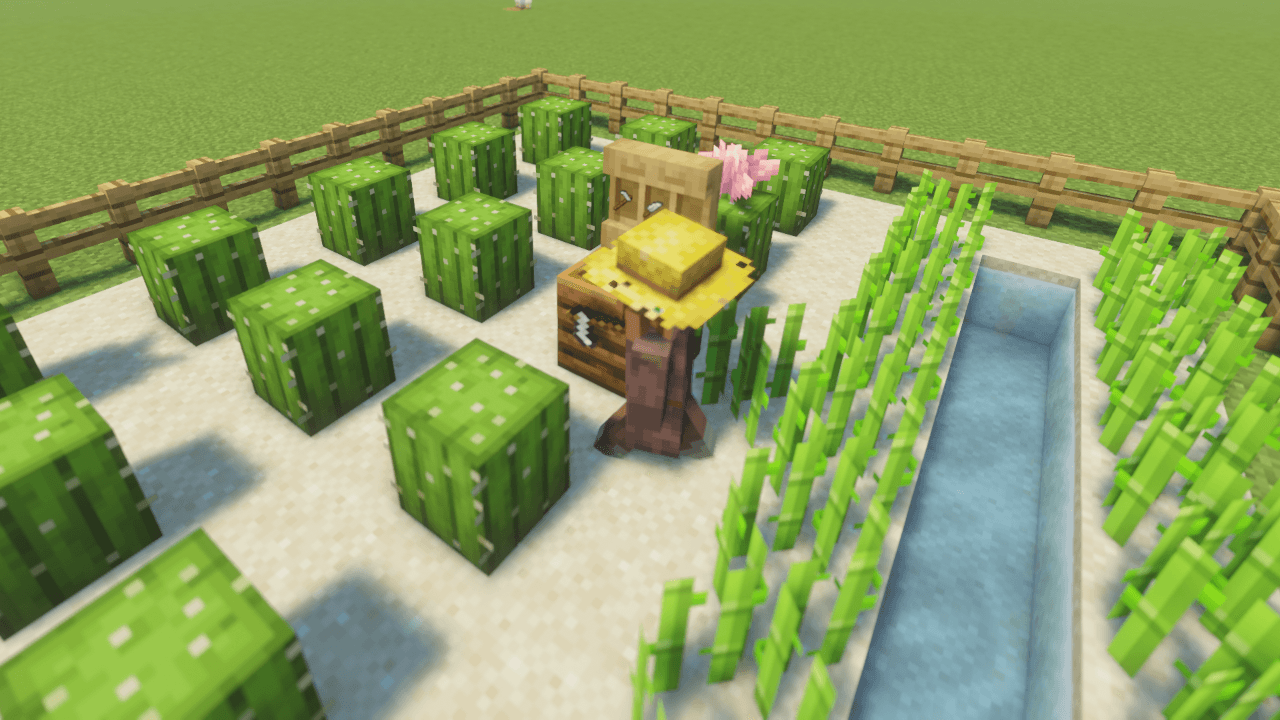
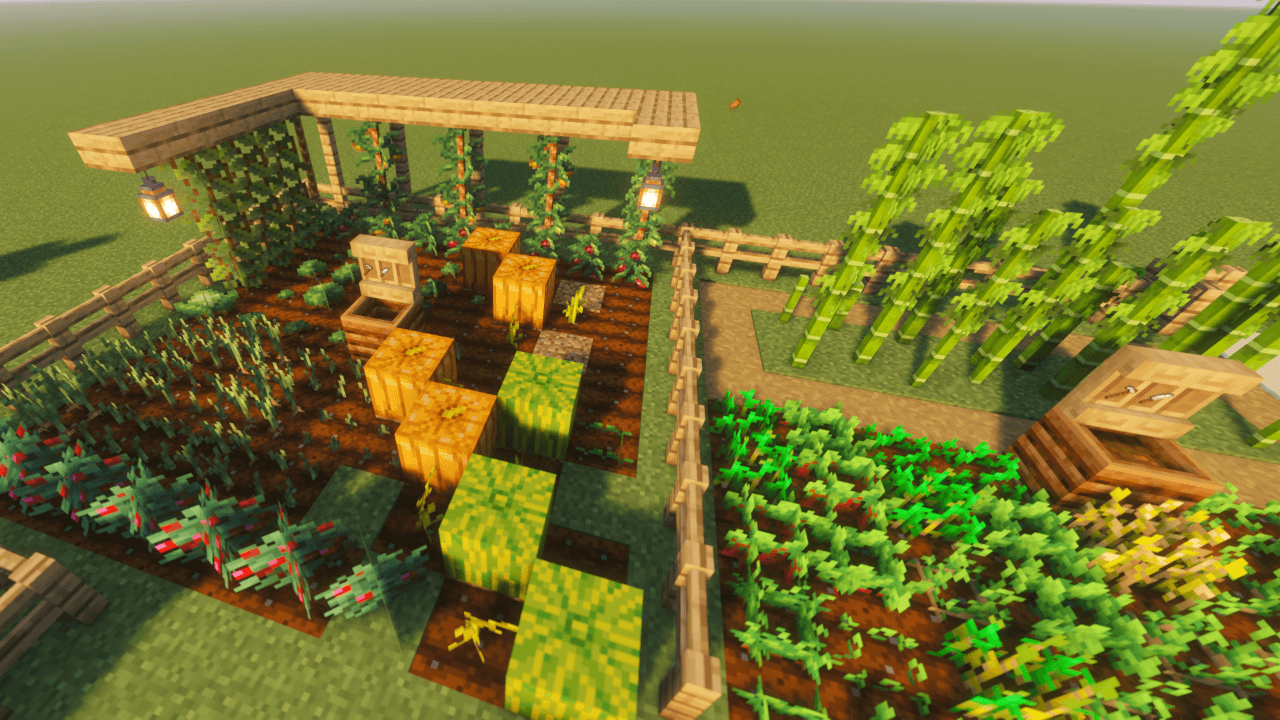
Harvests and replants in a 9×9 field around its composter, tills new ground with its hoe, and harvests melons, pumpkins, sugar cane, bamboo, cactus and berries. Plants the cane, bamboo, cactus and berries it carries to grow its field, and picks up crops lying in it. An empty plot gets the crop its neighbours grow, and a tomato row is replanted from its own tomatoes. Leaves room beside a melon or pumpkin stem for its fruit. Without a hoe it keeps the field it has but never grows it. Composts surplus seeds into bone meal. Given gold nuggets, turns its melon slices into glistering melon slices for the cleric. |
| Butcher |
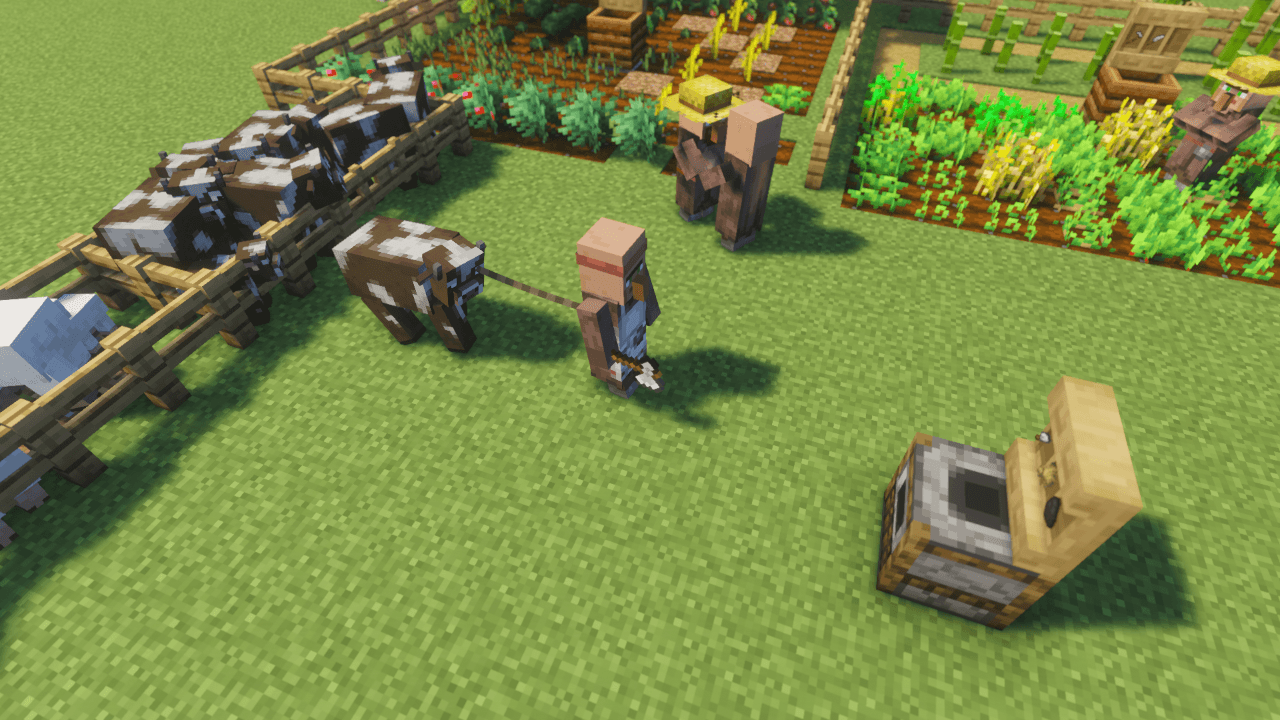
Manages a herd with an axe or a knife: breeds animals and culls the surplus, bringing each animal to its smoker. Never touches named, tamed, saddled or baby animals, or anything on your lead, and never takes a species below four. A setting makes breed-only butchers for cramming farms. |
| Shepherd |
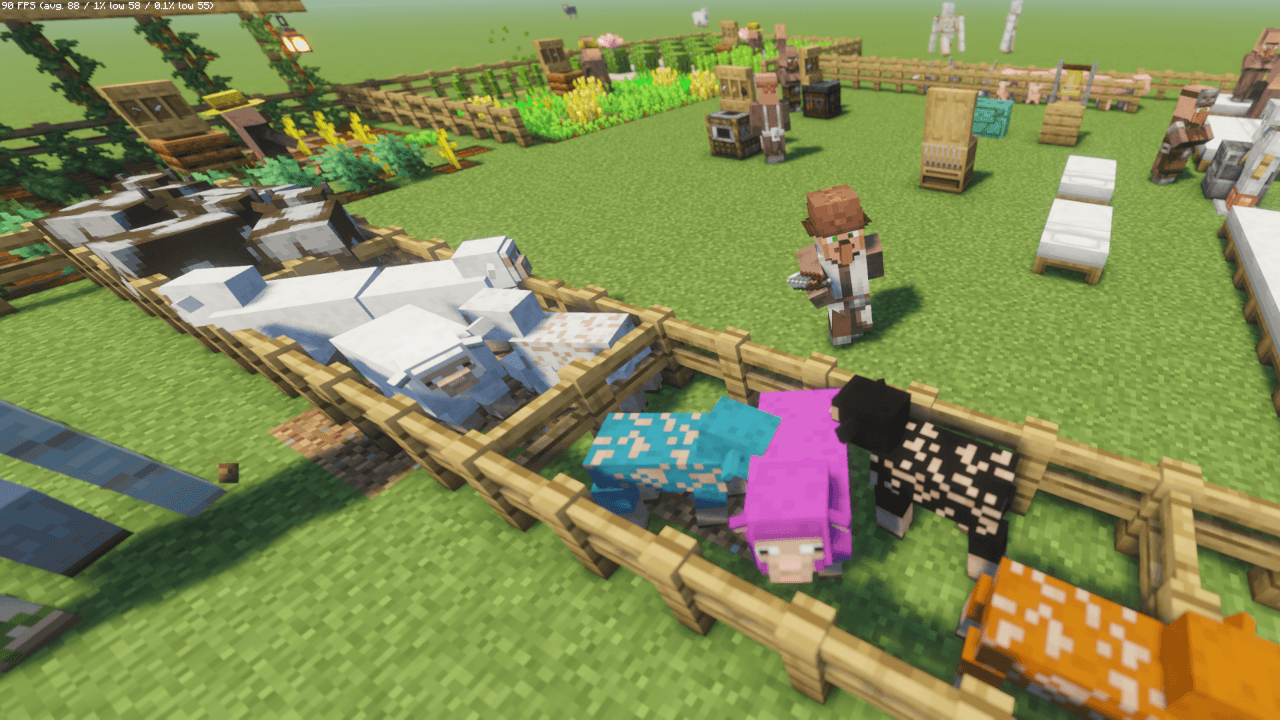
Shears uniquely coloured sheep over the fence, makes its own shears from iron, and unwinds wool into string for the fletcher and the fisherman. |
| Fisherman |
Fishes nearby water and supplies half the village from its junk: sticks, string, leather, rotten flesh and water bottles. Makes its own rods. |
| Cartographer |
Makes paper from sugar cane. |
| Cleric |
Turns rotten flesh into lapis lazuli, on demand, for the librarian — or, given the ingredients, brews potions of healing and regeneration at its brewing stand for hurt villagers. |
| Librarian |
Makes the enchanted books it is trained to sell and hands them to the makers whose work they fit, who enchant what they make. |
| Toolsmith |
Forges hoes, axes and Farmer's Delight knives on demand, from the best material stocked. A setting leaves hoes to you, so only the fields you choose grow. |
| Armorer |
Smelts raw ore at its blast furnace for the smiths and the shepherd, and makes armour and shields for its armory. |
| Weaponsmith |
Makes swords for its armory. |
| Fletcher |
Makes bows or arrows for its armory. |
| Leatherworker |
Makes leather armour for its armory, dyed if you stock dye. |
Villagers stock their own shelves first, then restock their customers', then send the surplus to storage. You can always restock a shelf yourself.
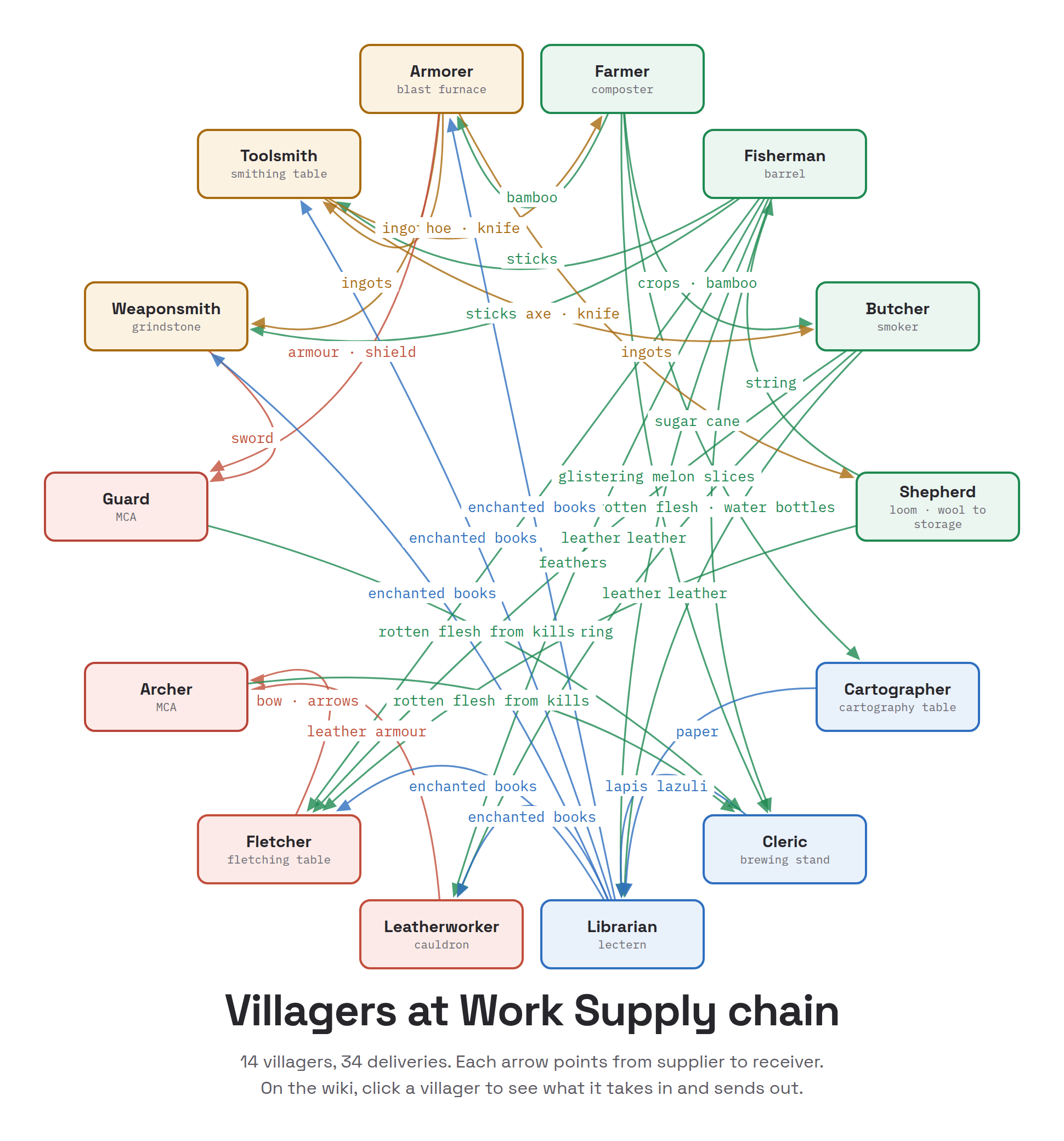
Explore the supply chain on the wiki: click a villager to see what it takes in and sends out.
An enchanted book on a maker's shelf — the toolsmith's, armorer's, weaponsmith's, fletcher's or leatherworker's — enchants the next thing it makes that the book fits.
Healing
Vanilla villagers never heal. Here, a villager at half health or below walks to the nearest brewing stand a cleric works at, drinks a potion of healing or regeneration, and gets back to work. The potions stay in the stand, so you can see from across the village how well stocked the infirmary is. Your own brewing stand is never touched.
Logistics
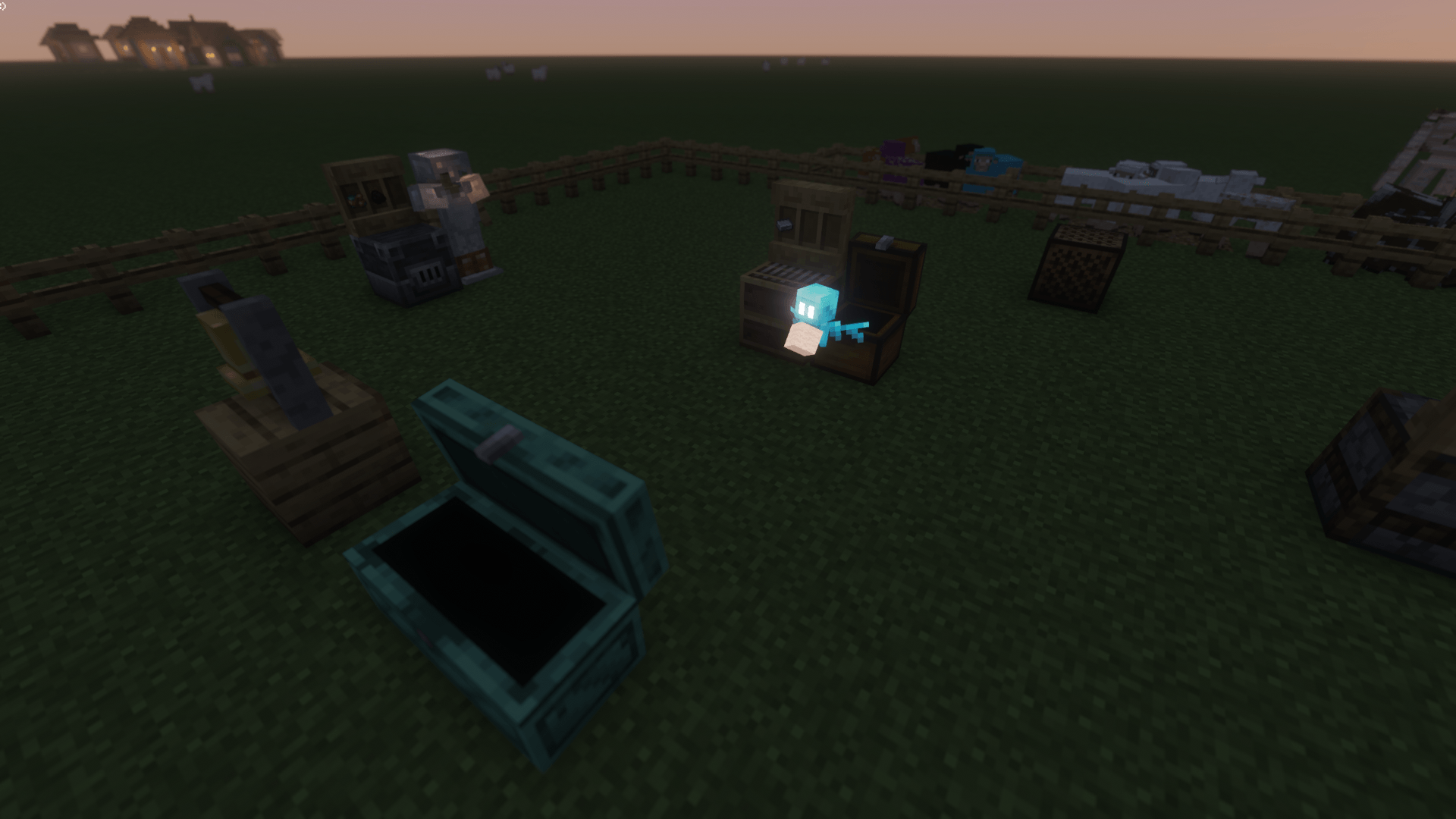
- Buffer chests — a plain chest touching a workstation is a local drop-off.
- Copper chests — village storage. One touching a workstation is a terminal: that station opts out of hauling, which is also how you hand its output to a Create belt or a pipe mod.
- Armories — a chest on the workstation of an armorer, weaponsmith, fletcher or leatherworker holds its finished gear, one piece of each, kept on display or drawn by MCA guards. Any of them can use an armor stand instead, and one stand is shared by an armour maker and a weapon maker: between an armorer and a weaponsmith it shows a swordsman's whole kit, between a leatherworker and a fletcher an archer's. The armorer can do without an armory and just smelt.
- Haulers — unclaimed allays (or, if you choose, unemployed villagers and nitwits) carry output from workstations to storage, so villagers never leave their stations. Allays park at note blocks when idle. Any allay you have given an item to stays completely vanilla.
The mod follows your world's own progression: before copper you empty the chests by hand; with copper chests and golems villagers walk their output to storage; with haulers nobody has to walk at all. Each tier removes a cost rather than adding a mechanic.
The wandering trader
Put emeralds in an empty shelf slot and that becomes a standing order. When a trader passes through, the villager walks over, buys the missing item and brings it back. The trader fills the gaps in a self-sufficient village: iron and copper, as raw ore for the armorer and as ingots for the smiths, sticks and string, flint for the fletcher, and rotten flesh for the cleric. It never supplies weapons, armour, tools or enchanted books, and a producer villager always wins over the trader.
Success and error indicators
A blocked villager shows the missing item it needs as an icon above its head, so you can spot a stuck station from across the village. A copper chest means storage is full or unreachable, a shelf means the shelf binding is ambiguous, a fish means a fisherman has no water to fish, a plain chest means a maker has no armory, and angry particles mean more than one mandatory item is missing. Errors show only during working hours.
Integrations
- Farmer's Delight — rice, tomatoes, cabbage, onions and Rich Soil for the farmer; the knife for the butcher (guaranteed leather, and Ham); knives from the toolsmith.
- Alex's Mobs and other animal mods — supported through tags, not mod-specific code. Nothing modded is sheared or culled until you opt it in.
- MCA Reborn — through the separate MCA Reborn extension: blocked villagers say what is wrong, and tell you again when you talk to them; MCA guards draw their gear from your village's armories, wear it out as they fight, and archers use the fletcher's arrows; guards say which piece they are missing, and drink a potion before gearing up when hurt; children run errands for their parents; held tools render properly; and guards earn four advancements of their own in single player.
- Human Era — with the client jar installed, two small resource packs make Human Era villagers swing the tool they work with and hold out the item they trade: Villagers at Work - Human Era Villagers Compat.
Files
| Jar |
Where |
What it does |
vaw-core |
Server (and single player) |
The mod. One jar per Minecraft release: 26.1.2, 26.2 and 26.3. |
vaw-client |
Client, optional |
Draws the tool a villager works with in its hand, arms uncrossed and swinging as it works, the item it is taking to a shelf, and the potion it is drinking. Never needed on a server. One jar per Minecraft release. |
vaw-mca |
Wherever MCA Reborn is installed: the server and every player's game |
The MCA Reborn extension, for Minecraft 26.1.2 and 26.2, the releases MCA Reborn supports. It has its own project, because it is licensed GPLv3. |
The page's Download button offers the newest file, which may be the client jar. For the mod itself, pick vaw-core from the Files tab.
Requires: Fabric Loader 0.19.5 or later, Fabric API, Fabric Language Kotlin 1.14.1 or later, and Java 25. The MCA extension also requires MCA Reborn 8.1.11 or later.
Each jar has its own options in the game's config folder, created with its defaults the first time the game or server starts.
Before you uninstall
A tool a villager has taken from its shelf is held by the mod, not in the villager's vanilla inventory, and stays with the villager until it dies. Uninstalling the mod removes those tools. An allay that was hauling keeps whatever it held in its hand; take it with an empty hand, as from any allay. Tools still on shelves, and everything else — shelves, chests, storage, your farms — stay exactly as they were.