TRMT: Reimagined (The Roads More Travelled)
- By
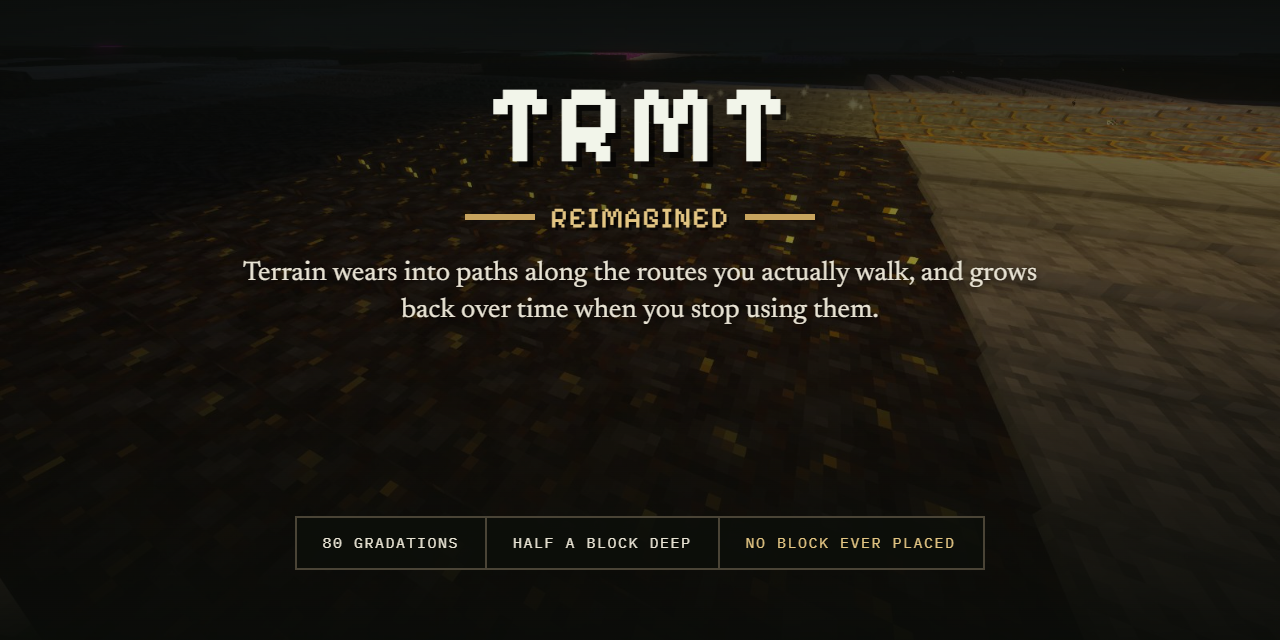
The line between your base and the mine is a path whether you built one or not. This makes it look like one, and lets it fade again once you stop using it.
This is milkucha's The Roads More Travelled, ported to Forge 1.7.10 and rebuilt underneath: wear is kept as server-side data and painted onto your client rather than written into the world as blocks. From there it was carried to 1.12.2, and to 1.16.5 on both Forge and Fabric. Same numbers, same settings file, one version number across all of them.
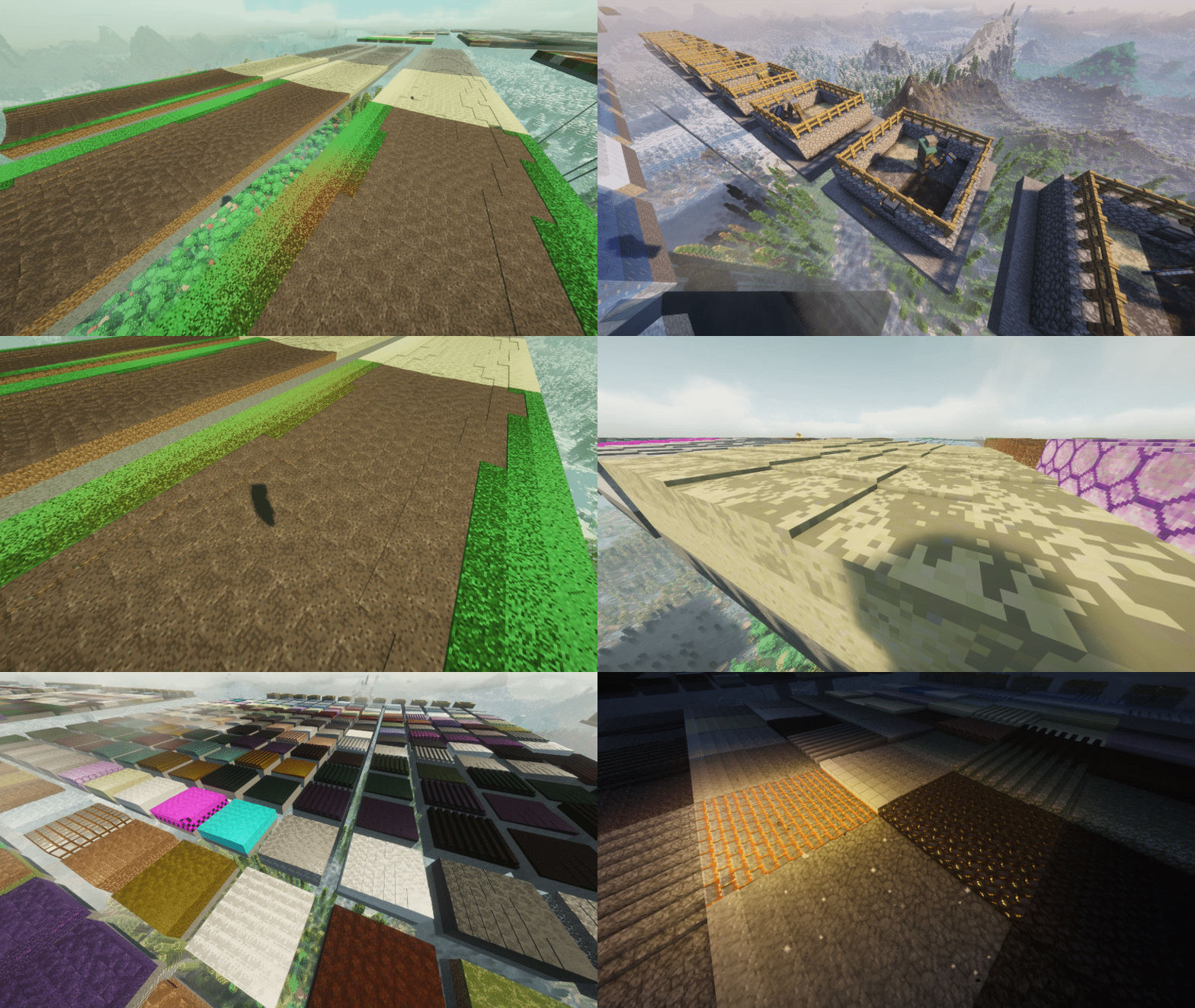
Walk a line a few hundred times and the turf scuffs, thins, goes bald, and finally sinks into a rut you can feel underfoot. Eighty gradations deep, half a block at the end of it, generated from each block's own pixels so modded ground wears in its own colours.
- Full manual, with every number and setting: https://github.com/Xeptix/TRMTR
- Also on Modrinth: https://modrinth.com/mod/trmtr
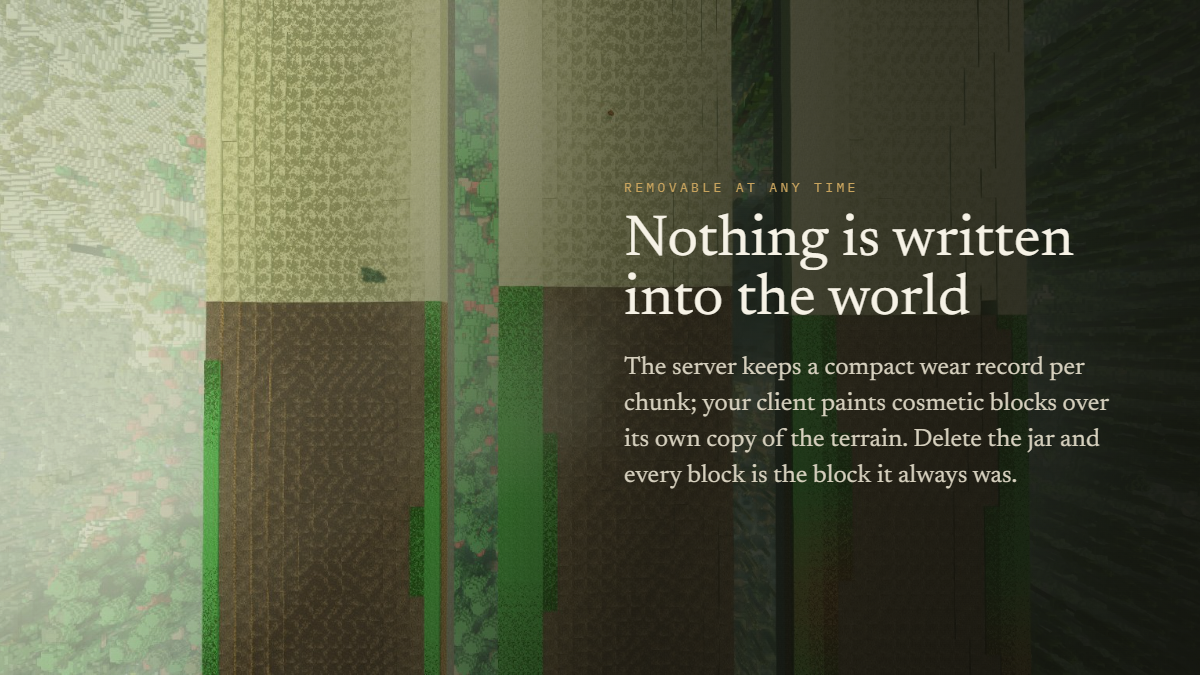
Delete the jar and your world is untouched - no eroded blocks, no holes, nothing to repair. A player can switch it off for themselves and see plain terrain while everyone else sees paths. A resource pack that retextures dirt changes worn ground too, for free.
The one thing to know before you install it on a server: it has to be on every client as well. The server registers this mod's blocks, and Forge's handshake refuses a client that is missing them.
Any block, in any pack
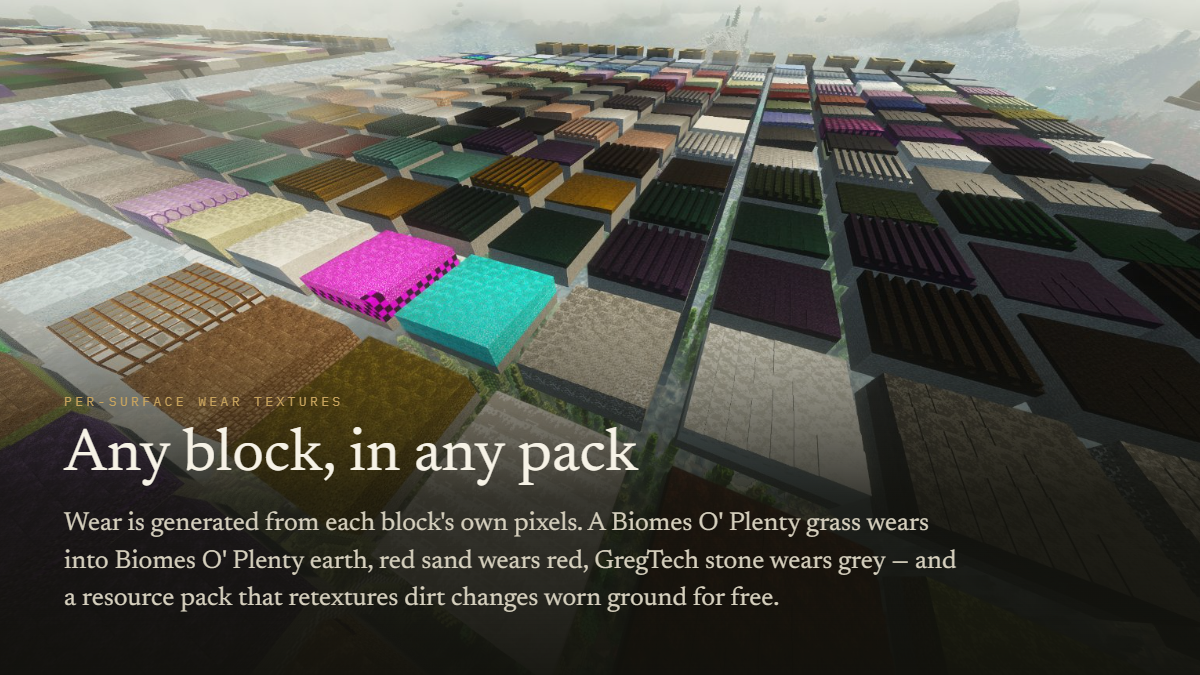
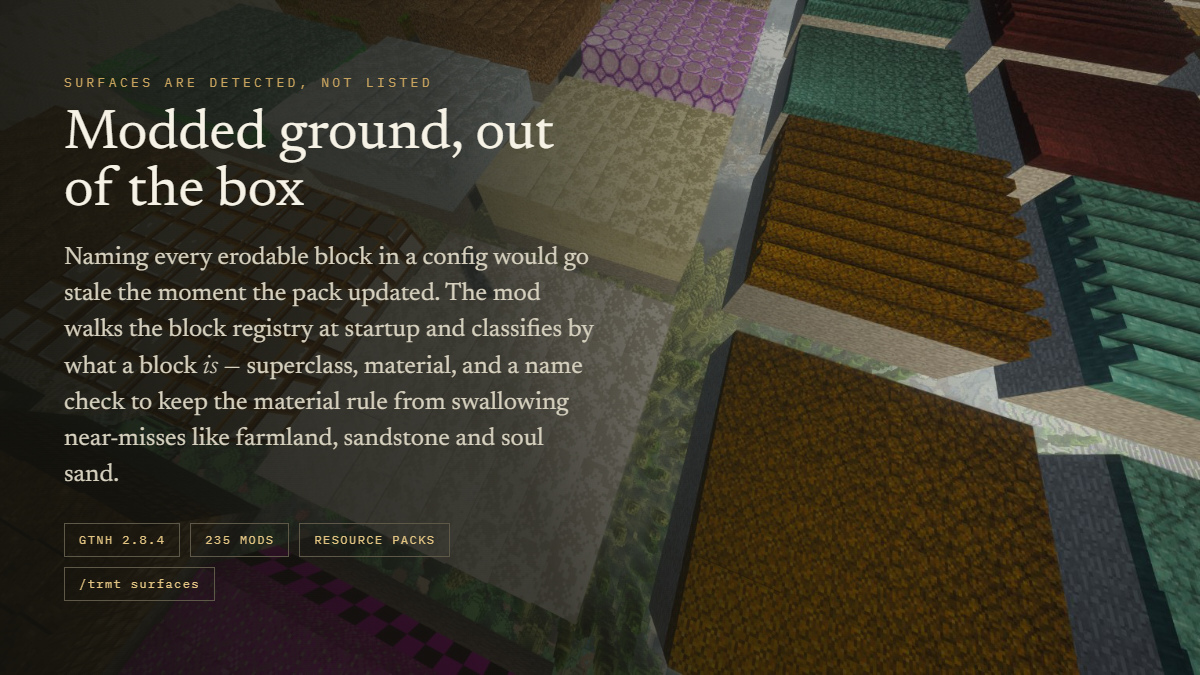
The mod walks the block registry at startup and classifies what it finds, so modded ground is handled
without anyone writing a list. What it detected is written back into the config, which makes that
list a record rather than a black box; /trmt surfaces prints it in game.
Eleven wear looks, all procedural and safe on any block at any resolution. An in-game table draws every one of them on your own blocks before you pick.
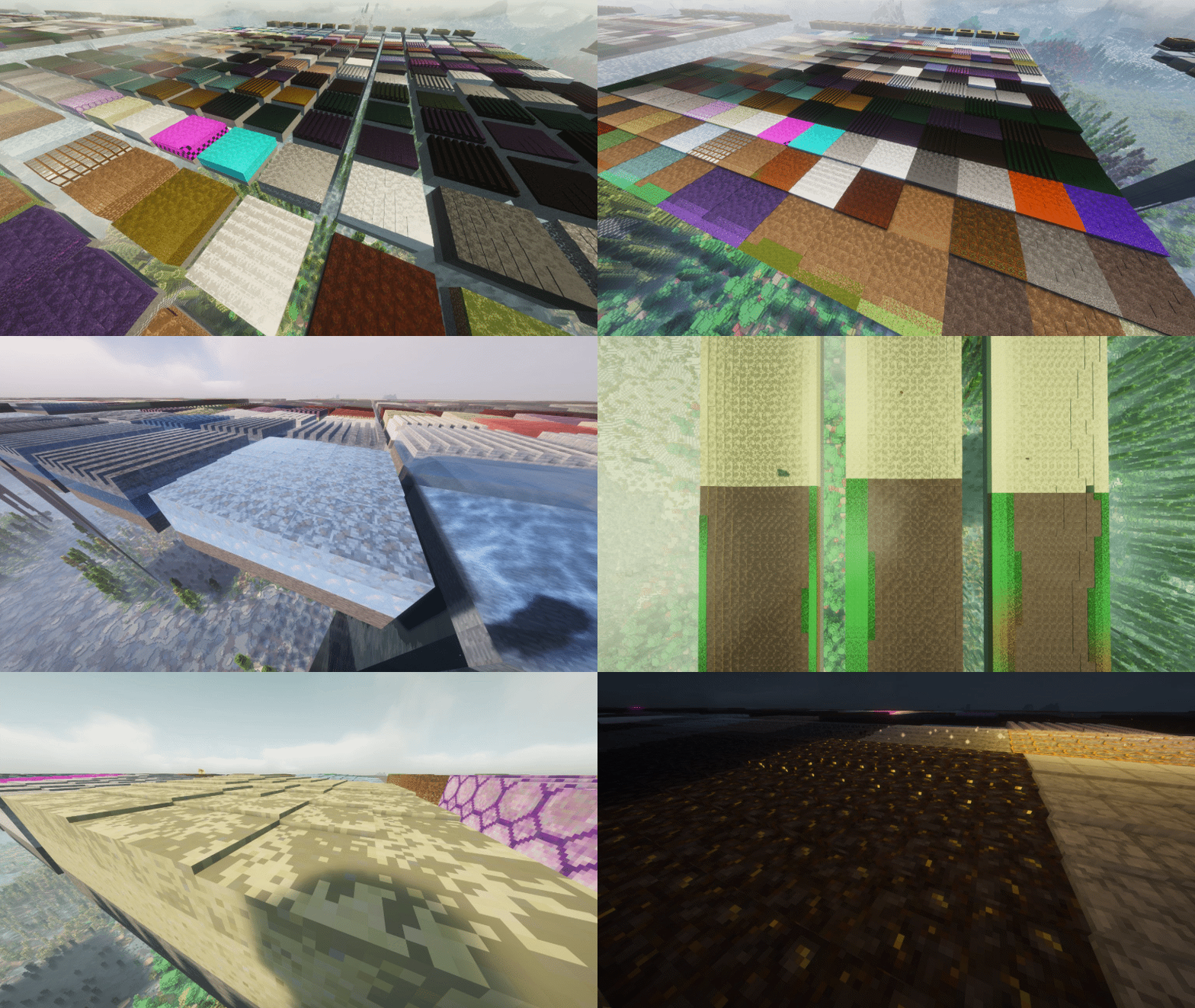
Twelve surface families, ten of which wear. A path through fresh snow reads after two or three crossings; grass takes 24 for the first visible step and 1,920 end to end; a courtyard of dressed stone takes 5,200. Recovery runs from six in-game days for snow to four hundred for end stone. Every figure is per family and editable, and the full table is in the manual.
Ruts you can walk down into
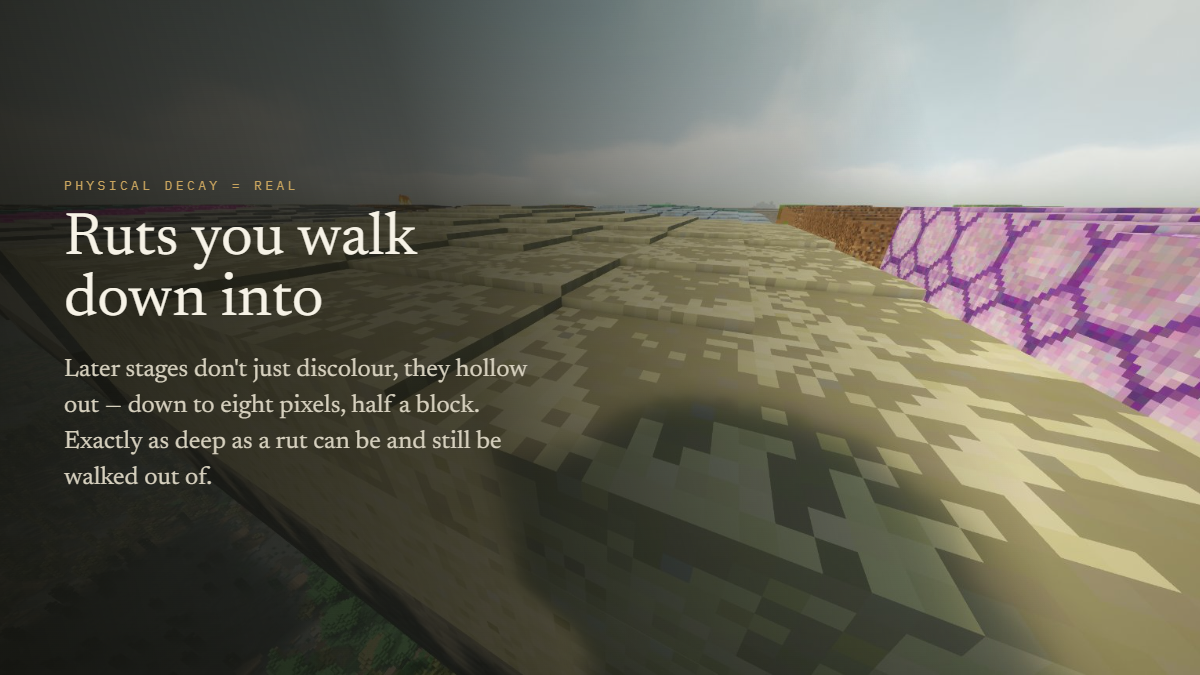
Half a block is exactly a player's step height, so a rut that deep can always be climbed out of. One pixel deeper could not, which is why it stops there.
Grass loses its cover and the rut forms in the earth beneath. general.wearThroughToOtherSurfaces
extends that to harder ground - stone to cobble to grit to earth - and ships off. If you would rather
the ruts were only something to look at, physicalDecay = visual gives you that.
And it grows back
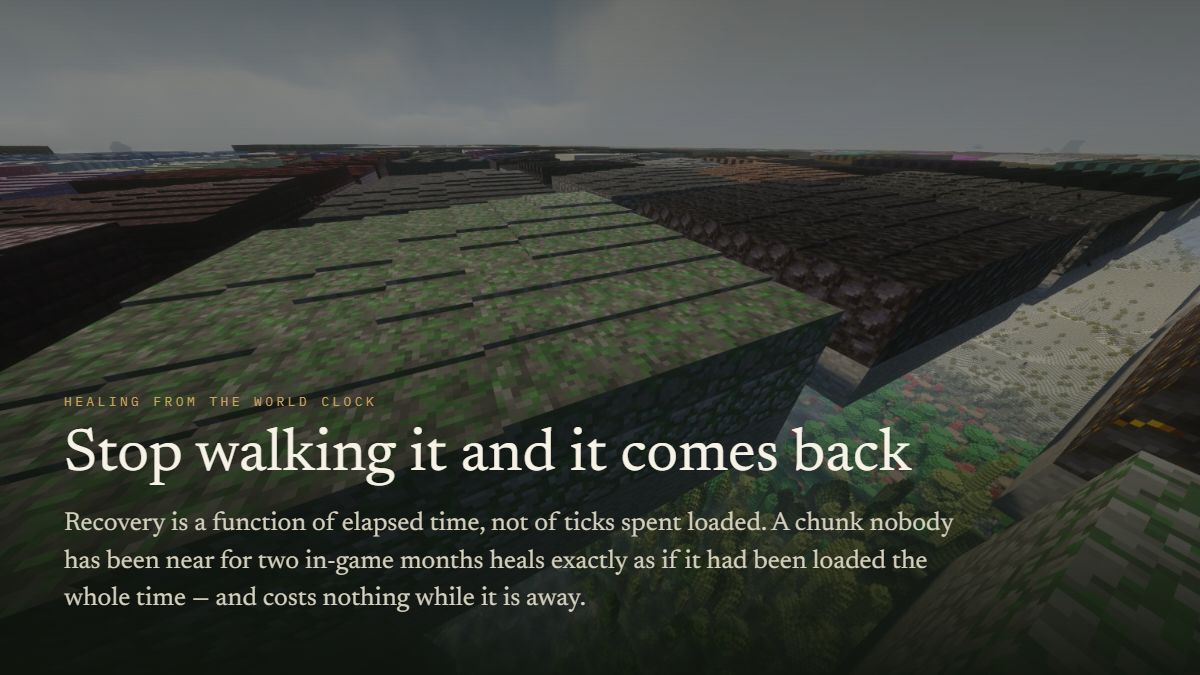
A chunk nobody has visited for two in-game months heals as though it had been loaded the whole time, in one pass when it loads. The clock stops while nobody is on the server.
Rain doubles recovery on turf, earth, sand and gravel. Snow takes the traffic first: a snowfall covers a path and the layers are trodden through one at a time. Bone meal mends worn ground, and costs a block of each kind of ground you are filling.
Tools, if you would rather not walk it
Nothing above needs you to craft anything. All of this is optional.
Tampers wear ground in, mend it back, and pin a square against both. They come in grades - iron, gold and diamond always, plus whatever metals a pack provides - and the grade list is read from the config, so a pack can add its own tiers. The Chunk Tamper does the same to a whole cube at once, resizable in world, and the Wayfarer's Tamper works any ground for nothing and never wears down.
Three enchantments, each unlocking a mode: Reinforce (three levels, blast resistance, and four times the walking to wear through), Spawn Ward (nothing spawns on the block, hostiles and passives barred separately), and Path Light (ground that glows, sixteen colours, no light source placed).
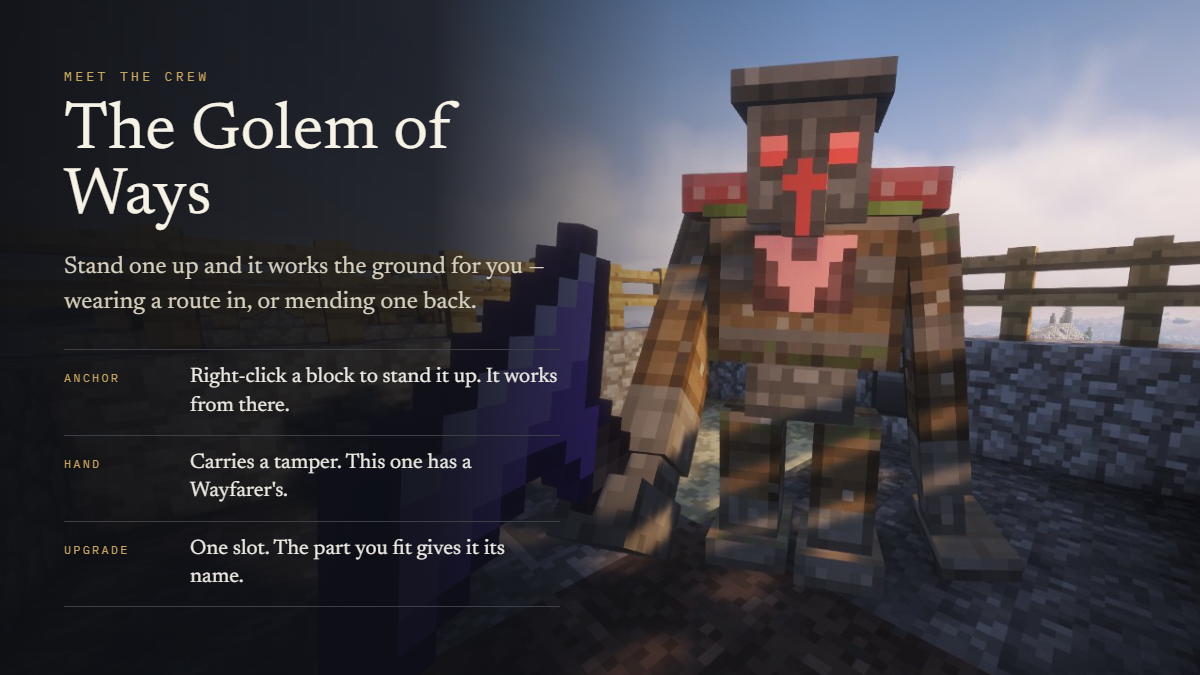
Give the Golem of Ways a stretch of ground and a wear level and it holds that road while you are elsewhere, out of its own inventory. Eleven upgrades, one slot, and the part you fit gives it its name. A hopper can keep it stocked; no hopper can take its tools.
There are also two draughts - one so you wear no ground at all, one its opposite - and four guide books that explain the lot in game and turn up in generated chests.
For pack makers
Five presets sit at the top of the config screen: quality, wear, healing, gradations and rut depth. Quality is client-side only, so it is safe to change on somebody else's server.
The config screen draws block lists with the blocks' own icons and mob lists with their heads, and an
operator can push server-owned settings to a live server from it. /trmt reload re-reads the config
and re-runs detection without a restart.
/trmt demonstrate realdemo builds a complete exhibit in the sky: a platform per detected surface
from untouched to fully worn, three stretches of real road, and a pen per golem upgrade. It is how
the mod is tested, and it is the quickest way to judge a config change against your whole pack.
Performance
Unloaded chunks cost nothing, because recovery is applied in one pass on load. The loaded-chunk sweep is bounded regardless of world size - sixty-four chunks every two hundred ticks, round-robin. Storage is a sparse per-chunk record, about 55 KB for a completely saturated chunk, with no world-level file to grow without bound. Client cost is capped independently of render distance, and the texture budget is a config figure, so a machine short of video memory turns detail down rather than the mod off.
Questions people ask
Is this the same mod as The Roads More Travelled? No. It is built on milkucha's mod and carries its licence, but it is a different piece of software: rebuilt so that nothing is written into the world, and aimed at old Minecraft versions and large packs. If you are on 1.19 or newer, go and get the original - it is the one being actively developed for those versions, and it is very good.
Will it change my world? No. Wear is data the server keeps per chunk, and your client paints it. Take the jar out and every block is the block it always was. The five settings that can touch the world are listed under "Removing it" below, and three of them ship on.
Do I need it on the server as well? Yes, and on every client. The server registers this mod's blocks, so Forge's handshake turns away a client that has not got them. A client with the mod can join a server without it and simply never sees anything happen.
Will it work with my pack's blocks?
It should. The mod reads the block registry at startup and works out what is ground, so modded dirt
and stone wear in their own colours without anybody writing a list. /trmt surfaces shows you what
it found, and anything it got wrong can be corrected in the config.
Is it heavy? Unloaded chunks cost nothing, and the loaded sweep is sixty-four chunks every two hundred ticks whatever the size of the world. The client side is the part you can tune: there is a quality preset at the top of the settings screen, and it is client-side only, so you can turn it down on somebody else's server.
Can I turn it off just for me?
Yes, unless the server is running ruts you can walk down into, in which case the ground you can fall
into stays visible on purpose. physicalDecay = visual gives the toggle back.
Why 1.7.10, 1.12.2 and 1.16.5? Because those are where the packs this was built for live. The original covers 1.19 and newer.
Works well with
Worn ground reads best in a pack that already has a lot of ground to wear: terrain and biome mods give it more to work with, and anything that has you walking the same route twice gives it a reason to. It is drawn properly under Angelica and Oculus shaders, shows up on JourneyMap and Xaero's Minimap maps, and takes its recipe tiers from GregTech when a pack has it. None of that is required.
Requirements
| Edition | Loader | Needs |
|---|---|---|
| 1.7.10 | Forge 10.13.4.1614+ | UniMixins |
| 1.12.2 | Forge 14.23.5.2847+ | MixinBooter |
| 1.16.5 | Forge 36.2.34+ or Fabric | Cloth Config; on Fabric also Fabric API, and Mod Menu to open the settings screen |
That is all. GTNH already ships UniMixins; if you are assembling a 1.7.10 pack by hand, that is the one to remember, because nothing inside the jar will tell you.
Optional, every one behind a mod-loaded check: Waila, Hwyla, Jade and WTHIT for the tooltip; JourneyMap and Xaero's Minimap; Angelica on 1.7.10 or Oculus on 1.16.5 for shaders; Chisel; GregTech on 1.7.10 or GregTech CE on 1.12.2 for pack-tuned recipes; BetterQuesting; Amazing Trophies; Et Futurum Requiem. With none of them installed the whole mod still works.
Servers
Install it on both sides. A client with the mod can join a server without it and simply never sees anything happen; the other way round needs the jar on every client, as above.
What a client is sent is reconciled rather than assumed: it subscribes to the chunks it is watching and paints with the server's own surface table, so two players on the same road see the same road. Server-owned settings are sent for the session only and never written to a player's config.
physicalDecay ships as real, where the server owns the collision and every client sees the ruts.
Set it to visual and the per-player toggle is free again.
Removing it
Delete the jar and every block is the block it always was.
Five settings are the exception, and each says so in its own help text: two trampling switches that break plants and leaves crossed too often (both ship off), one that brings a plant down with ground that drops, one that removes a square worn the whole way through, and one that removes snow layers trodden through. Those three ship on, because they only ever fire where a route has visibly formed. Turn them off and the guarantee above is unconditional.
Support
The mod is free and always will be - nothing is gated, delayed or reserved for supporters. If you would like to put something in the hat:

Attribution and licence
TRMT Reimagined is Adapted Material of The Roads More Travelled by milkucha (https://github.com/milkucha/trmt), Copyright © 2026 milkucha, licensed under Creative Commons Attribution-NonCommercial 4.0 International - CC BY-NC 4.0, full text. This version by Xep.
This is a modified work: ported from Fabric 1.20.1 to Forge 1.7.10 and re-architected so that
wear is server-side data painted client-side, with a great deal added on top, and then carried to
Forge 1.12.2 and to 1.16.5 on both Forge and Fabric. It is unofficial - not produced, endorsed or
supported by milkucha, and the reused TRMT initialism is a statement of derivation, not affiliation.
The full record of modifications is in
ATTRIBUTION.md, which ships inside the
jar alongside LICENSE.md and LICENSE_trmt.
Wear art under assets/trmtgtnh/textures/blocks/ is derived from milkucha's original textures and
remains under CC BY-NC 4.0.
You may use, modify, fork and redistribute this, including in a modpack, so long as attribution
travels with it and you add no terms that would stop the next person doing the same. You may not
sell it, or anything whose value depends on including it - that NonCommercial term is inherited
from the original work and cannot be waived here. The particulars are in
LICENSE.md.
No warranty. Provided as-is.
TRMT: Reimagined (The Roads More Travelled) Team