Surving's Enchantment & Equipment Fixes (SEEF)
Consistent enchantments, shared equipment categories, predictable XP costs and clearer protection rules.
04-enchantment-overview.png
01-protection-tooltip.png
02-enchanting-xp-costs.png
03-anvil-xp-costs.png
Description
SEEF — Surving's Enchantment & Equipment Fixes
Consistent equipment rules, clearer enchantments and predictable XP costs.
SEEF improves how enchantments work across weapons, tools, shields and armor. It is a standalone gameplay mod and a shared foundation for compatible equipment and enchantment mods.
0.3.0-alpha.1 — Curiosity 2.0: personal research, meaningful discoveries and individual rank mastery change how enchantments are learned and applied. Five paths have bespoke experiments; other paths use magical-XP research. This alpha remains in active balancing and wider integration work.
Features
Consistent equipment and enchantments
Axes count as both weapons and tools. Shared categories cover melee, archery, throwing weapons, mining tools, armor and accessories. Compatible modded items can inherit the rules through Vanilla, common c: and SEEF item tags.
The canonical native tag hierarchy now uses item/implements for weapons/tools and item/equipment for armor/accessories, with a separate block/ hierarchy for bookshelves, lighting, farming, functional blocks and storage. Existing tag paths remain compatible. A role grants only the enchantment eligibility explicitly connected through supported-items tags; it never creates an inventory slot.
Enchantment categories limit which combinations fit on an item, providing a common system that other mods can extend. Selected consolidated weapon enchantments now use the canonical weapon roles; other existing eligibility sets retain their scope.
Protection with clear choices
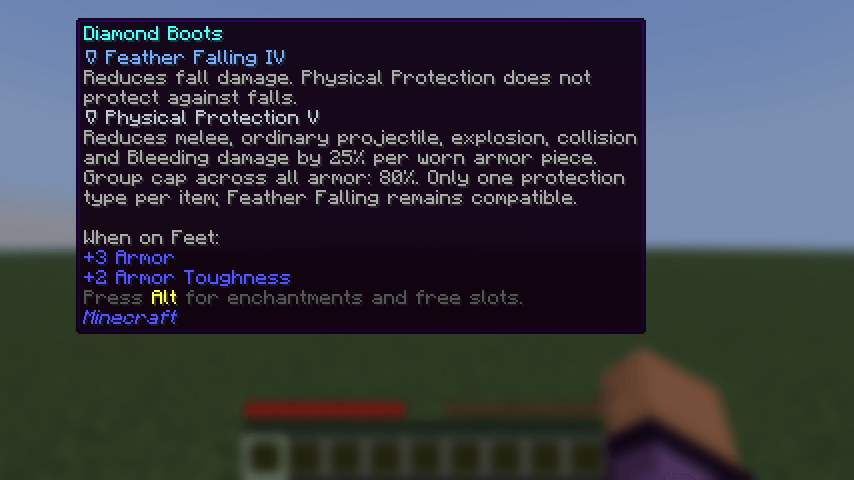
Choose up to two of Physical Protection, Magical Protection and Poison Protection per armor piece. The limits apply to each item separately.
All three have ranks I–V, granting 5% protection per rank and worn piece, capped at 80% per damage group. Feather Falling handles fall damage separately. Retired protection entries on existing items and books migrate automatically.
Weapon, archery and shield improvements
- Might combines Sharpness and Power; Fire replaces Fire Aspect and Flame. Existing equipment and personal knowledge migrate to the unified IDs.
- Bane specializations target undead, arthropods, aquatic creatures including Drowned, or terrestrial animals. Their fixed damage bonus works with melee and arrows and combines with Might.
- Quickdraw speeds up bows and crossbows; Knockback serves both melee and arrows.
- Bows and crossbows support Multishot and Piercing.
- Infinity supplies ordinary arrows without requiring a carried arrow, remains compatible with Mending, and leaves special ammunition consumption intact.
- Thrown tridents support Knockback.
- Cleave supports actual grounded melee sweeps, including axes and eligible blunt weapons, with its own research and successful-sweep training.
- Shields can receive Unbreaking directly at the enchanting table.
Conductive water
Actual electric damage can shock other mobs in water within four blocks for 25% of the incoming electric hit. Dry targets, the attacker, allies and tame companions are excluded. Secondary shocks cannot recurse. Electrical damage types are extensible through native tags; SNE supplies its electric effects.
Curiosity 2.0: Elemental Revelations
All configured enchantment research paths are available again. Fire, Poison, Soul Fire, Frost and Chain Lightning remain the five focus paths with individual insight experiments; other enchantments use their existing magical-XP discovery and expanded thematic vocabulary. Poison requires five of its 16 vocabulary words (30%); Frost requires seven of its 17 words (40%), Chain Lightning requires seven of its 16 words (40%), and each remaining prototype path requires four of its 19 words (20%) to form an anonymous idea. Poison uses three ordered insights; the other prototype paths use five. These persistent insights replace first-discovery XP, culminating in an individual world experiment and a personal themed revelation. Each discovery permanently unlocks rank I; later ranks retain actual-use training. Cooking on a campfire also supplies Fire's first insight. Existing magic and other saved research remain intact.
Varied tool research
First-discovery block research accepts wood, stone and other broken blocks. Its journal shows the base XP reward and interval explicitly. Fortune, Efficiency, Silk Touch and Unbreaking can offer two optional activities from a shared pool: strip 30 log/wood blocks with an axe, dig 20 sand/red-sand blocks with a shovel, or mine 10 ores with a suitable pickaxe. You can change tools during that research. Higher-rank training continues to require the learned magic itself.
Meaningful item discoveries
Almost every normal Minecraft item teaches related concepts when collected or directly observed, rather than only its item name. Swords suggest an edge and a strike, leather suggests flexibility and protection, and clocks suggest time and rhythm. Recognized equipment, food, blocks and common material tags also supply suitable concepts for otherwise unmapped mod items. Technical items are excluded. Research word percentages and experiential effect requirements still apply.
Research materials and shared flames
Enchanted books can be studied for clues, one unknown related word per enchantment and a non-stacking 1.5× magical XP bonus for that exact enchantment and rank. Assistance can wait for a future matching Curiosity. Studying consumes the book after confirmation. Enchanted equipment can provide the same help by losing all its enchantments and taking 10–25% maximum-durability damage, with an explicit warning if it will break. Neither method instantly unlocks magic.
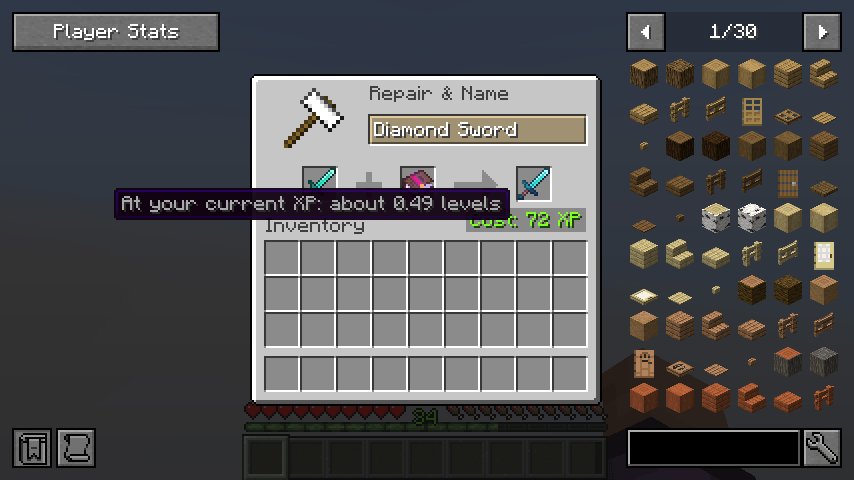
The anvil supports repairs and free renaming, preserving the left item's magic. Enchantments are applied through the table, not books or anvil combining.
Native Soul Fire on Soul Sand and Soul Soil now causes Soul Burn even without SNE. It deals 1 damage each second and persists through water and rain; normal fire resistance and fire immunity still protect. SNE reuses this shared burn.
An enchanting table that keeps your materials
Closing the table returns the equipment or book to your inventory, dropping it safely nearby if the inventory is full. Lapis Lazuli, Amethyst and catalysts remain stored in the table through saves. Material contents are shared between viewers and drop when the table is broken.
In this alpha, Amethyst Shards add +5 table power to the word-offer prototype. Research tasks do not consume the table materials. Applying learned magic spends XP points, Lapis, Amethyst and up to three configured catalyst ingredients; the server validates the complete transaction before charging.
The current table has vertical Lapis/Amethyst inputs, a spaced catalyst, optional central equipment and two tabs: Research and Enchanting. Enchanting has an item-filtered scroll list, one Apply/Train action with rank arrows, and material slots hidden safely on Research. The selected tab follows the active theme accent. Research only offers currently startable ideas and distinguishes missing ideas in general from missing ideas for the inserted item. Unfinished projects have an explicit hint; a leftover word selection without a project does not block research. It works with its native interface and can follow SGL themes when SGL is installed.
Predictable XP costs
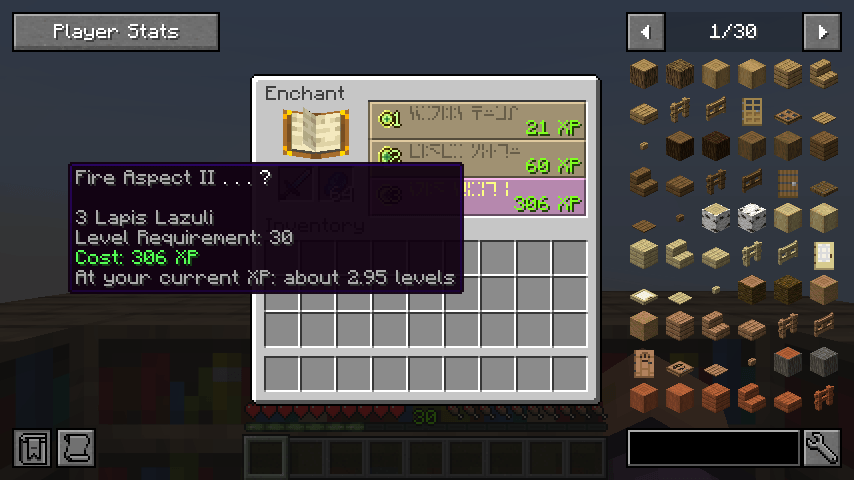
Anvils spend XP points, with cost tooltips showing the equivalent amount in levels. Targeted table application uses configurable prices selected by the registered maximum rank and chosen target rank. By default, every maximum rank costs 1,500 XP points, 32 Lapis Lazuli and 16 Amethyst Shards, plus its unchanged individual catalysts. Direct application and upgrades pay the target rank once, without rarity, treasure, existing-item or previous-rank surcharges. The GUI receives the same server quote used for payment. Anvil repair pricing is unchanged; renaming and removing custom names cost no XP.
Anvil repairs ignore accumulated prior-work penalties and the survival Too Expensive cap. The anvil no longer combines or transfers enchantments.
Material-based durability
Material Measures adjusts weapon and tool durability using their original maximum and the amount of main material: shovels 50%, swords/hoes 75%, pickaxes/axes 100%, clubs 125% and hammers 150%, rounded upward. Iron examples are 125/188/250/313/375; netherite examples are 1016/1524/2031/2539/3047. Modded equipment keeps its own original material value. Unknown equipment retains its original maximum until explicitly classified. Armor, Elytra, unbreakable items and recognized energy equipment are excluded.
Enchantment 2.0: knowledge becomes power
Learn words through lived experiences, visible creatures and attributed victories. Directly aiming at a working adult Villager within eight blocks teaches its profession; proximity alone is insufficient and trading is not required. Profession names are translated in English/German and use the existing discovery notice. The bundled vocabulary contains 220 concepts, including all 90 Vanilla mob types and 13 working Villager professions. A table offers up to 3/4/5 compatible known concepts according to table power. An optional item filters research to suitable enchantments. Each path requires all core words and a configurable share of its concepts, normally 60%.
Choosing a word commits to one persistent hidden-enchantment project. Its main activity earns personal magical XP; optional one-time challenges speed progress but are never required. Rank I uses relevant observations and ordinary experiences. Higher ranks require a verified contribution from the previous active, mastered magic for every main or optional task, started from the table's Enchanting tab. Reaching the goal permanently teaches that rank. Equipment stays unchanged: applying or upgrading its stored enchantment still uses the table and its normal costs. Effort and prices remain provisional.
Unknown enchantments on equipment and books show a neutral name without rank, descriptions or synergy details. Their effects stay inactive for that player. A research-managed enchantment works only when its full stored rank is mastered; otherwise that enchantment stays inactive. For example, Fire Aspect II does not become Fire Aspect I when only I is learned. The stored item stays unchanged, and known higher ranks are marked inactive until learned. Normal item damage, material armor and other ordinary properties remain intact; mobs retain their magic.
The Magic page lists learned enchantments and mastered ranks. Choose a spell and learned rank, provide suitable equipment plus Lapis, Amethyst and its catalyst ingredients, and apply it. Existing enchanted items can receive compatible additions or upgrades. Failed, invalid, unaffordable or repeated attempts consume nothing. Books provide research assistance and explain this in their tooltips; anvils provide repairs and free renaming.
Found enchanted equipment is still valuable: explicitly Investigate it in the table's Research page to record clues, including paths otherwise restricted to treasure finds. This grants no mastered rank and reveals no unknown identity. The word/core requirements and research tasks still apply.
Press C (rebindable) to open or close the optional SGL Curiosity Journal with current research and tasks; vocabulary and learned magic have their own pages. The Magic page lists each unlocked enchantment, its mastered rank and saved training experience. The journal highlights the current project XP, relevant activity and optional paid bonuses. Fully mastered single-rank enchantments have no further training project. Without SGL, use /seef curiosity, /seef vocabulary and /seef magic. New words, optional challenge rewards and learned ranks use individual popups at the upper right. With the new optional SGL HUD API, three messages show at once and further messages queue; countdowns remain distinct icon/seconds timers. Broken is learned from actual equipment durability breaks and is a required core word for managed Unbreaking research. The native table provides Research and Enchanting; vocabulary stays in the journal or /seef vocabulary. Completed projects are marked clearly and their tasks disappear from the journal without losing saved progress.
Compatibility fallback: an enchantment without a valid nonempty research.words path stays readable and works at its full stored rank, even when personal mastery restrictions are enabled. Newly installed mod enchantments therefore keep working until individually configured. An automatically exported empty profile does not opt them into research. Their native sources and equipment restrictions still apply; an ordinary unconfigured spell is also available through the table, while treasure spells are not granted a new source. Restart the world/server after adding or clearing a path. Catalyst quantities scale with the requested rank, normally 1/2/3 items at I/II/III. Up to three distinct ingredients can have their own quantities and starting ranks; all three table slots persist. Legacy research.catalyst settings migrate automatically.
Per-enchantment research profiles live in config/seef/enchantments/<namespace>/<path>.json: starting words, core_words, required_words_percent, task_word, hidden question and application catalysts. Existing explicit values are preserved. Enchantments without a configured word path do not acquire an invented research route.
Operator tools: /seef words fill/reset manage vocabulary. /seef research fill/reset [player] fill or reset personal mastery, clues and active research for testing. Existing basic knowledge migrates to rank I, never automatically to maximum rank.
The enchanting table filters out fully applied and conflicting enchantments, while retaining compatible upgrades and training choices.
Fortune I–V combines mining yield and mob loot for eligible tools and melee weapons. Existing Looting items and research migrate to Fortune, keeping the higher stored rank; Silk Touch remains incompatible.
Getting started
Learn concepts, select one at the table and follow the Curiosity Journal. Once rank I is researched, open Magic to apply it or start research for the next rank. Hold Shift over readable enchanted equipment for current usable-rank descriptions; hold Ctrl to reveal the components of a known active synergy.
Configuration
config/seef/research.json controls table research (enabled), personal effect/visibility restrictions (mastery_restrictions, default true), and application price tables (base_costs.tables) with optional per-enchantment rank exceptions (base_costs.overrides). The legacy xp_cost, lapis_cost and amethyst_cost fields are retained for compatibility but no longer price targeted table application. Set mastery_restrictions to false to restore unrestricted equipment effects and readable enchantments without deleting progress. enabled: false disables table research/application independently. Restart the world/server after edits. Matching versions are required on server and clients.
Client-side config/seef/client.json is created automatically. show_durability defaults to true and adds remaining/maximum durability to damageable item tooltips, including modded equipment and pristine items. Set it to false to remove SEEF's extra line; native advanced tooltips remain available. Restart the client after editing. Unbreakable and non-damageable items receive no misleading durability value. The displayed maximum follows the server's durability rules. Remaining durability is green above 50%, yellow at 50% or below, orange at 25% or below and red at 10% or below.
Durability profiles live in config/seef/durability.json. Item overrides, ordered type-tag rules and exclusion lists control material amounts; factors are capped at 50–150%. Changes require restarting Minecraft/the server. The server synchronizes resolved profiles to clients; install this SEEF build on both sides. Tag membership can be changed by data packs, including the additive seef:durability/excluded tag. Invalid config is preserved and disables this feature safely.
Existing stored damage is kept as an absolute number, not converted to a percentage. A heavily worn item whose new maximum is below its damage is exhausted under the new rules and may break on its next use. Anvil, crafting-grid and grindstone repairs use the adjusted maximum without multiplying it again.
Server-owned files under config/seef/enchantments/<namespace>/<path>.json collect general settings and book routes for loaded Vanilla and mod enchantments, including weight, treasure status, maximum rank, native costs, acquisition sources and editable enchantment classes. Global switches remain in config/seef/enchantments.json; older configs migrate with backups.
Treasure enchantments are always excluded from the enchanting table, even when their table-source setting is enabled. The configuration normalizes that setting to false on world/server startup; trading and loot remain independent.
Global and per-enchantment switches can disable standard enchantment effects while retaining stored enchantment data for later reactivation. Restart the world or server after changing these settings.
Book discovery routes live in the same per-enchantment files, with dimension, structure and loot-table IDs, rank ranges and optional exclusive acquisition. Existing book entries use configured enchantment weights; no independent per-enchantment book drops are added. Use /seef lootbox [seed]
for a complete native chest-loot sample. Rules apply to newly generated loot, including unopened loot-table chests in existing worlds. Existing books and filled containers remain unchanged. Exceptional sources without a general book entry and opted-in Vault lists are controlled through config/seef/book_pools.json.
Compatibility and integrations
Built-in tooltips show readable enchantment descriptions, usable-rank values, symbols and colors; unknown magic remains concealed when mastery restrictions are enabled. Hold Shift to reveal descriptions.
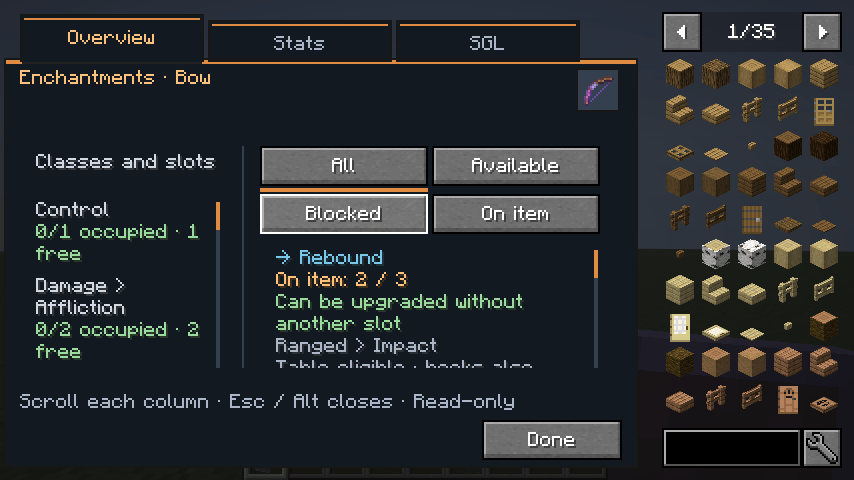
With optional SGL installed on the client, press Alt on a relevant item to inspect possible enchantments, free and occupied category slots, conflicts, upgrades and synergies already active on the inspected item. SEEF also contributes protection totals and additional server-backed values to SGL's Player Stats.
Optional Jade support displays remaining ordinary burning time.
With optional Farmer's Delight Refabricated, Backstabbing joins damage/physical and personal research. Discover it through Silence and Blade vocabulary; train higher ranks with successful rear attacks. Its native ID, knife eligibility and 40/60/80% rear-attack bonuses remain owned by Farmer's Delight. Configure its profile in config/seef/enchantments/farmersdelight/backstabbing.json. SEEF also supplies research for both Vanilla curses. Existing custom profiles remain authoritative.
Optional Field Guide 1.22.4–1.22.x imports matching words from personal server-side guide discoveries. Without it, directly aim at a creature within eight blocks to learn its word. With the integration active, creature words follow guide knowledge; Villager professions retain direct observation because this guide version tracks biome variants rather than jobs. Existing vocabulary is preserved. Configure the integration and extra word mappings in config/seef/field_guide.json.
With optional Trinkets Updated 4.2.x, SEEF supplies an Elytra slot alongside chest armor and a Totem slot that leaves both hands free. Their empty slots show dedicated grayscale wing and totem glyphs. Existing native flight, durability, enchantments, rendering and death protection are used; no separate Elytra/Totem compatibility add-on is required. Configure enabled, elytra_slot and totem_slot in config/seef/trinkets.json (all default to true); restart Minecraft/the server after edits. Missing slots return equipped items through Trinkets, with ground drops when the inventory is full.
Requirements and installation
Minecraft 26.3 · Fabric · Java 25 · Fabric API
Install SEEF on the server and participating clients for multiplayer.
- SEEF works independently. Its gameplay, station interfaces and tooltips do not require SGL.
- SGL is optional, belongs on the client and enables the shared menus and themes.
- SNE requires SEEF. SEEF does not require SNE.
- Trinkets Updated is optional and must be present on server and clients to use its accessory slots. SEEF starts normally without it.
SEEF intentionally changes gameplay rules. Item tags provide compatibility categories; accessory slots use the optional Trinkets integration or their owning equipment mods, while custom attack mechanics remain supplied by the corresponding equipment mods.
Native enchantment effects and the matching SNE build use the shared personal-mastery rules. Foreign mods that bypass native processing or cache their own searches may need an adapter. This is gameplay progression, not protection against a client inspecting raw item data.
Mods can use SEEF's shared countdown API and enchantment effect for translated, combined ability timers without requiring SGL.
Newly discovered words show a four-second notice in the existing countdown area: one word is named, while multiple words learned in the same server tick produce a single count. Already known and initial words do not repeat notifications; operator vocabulary fill stays silent.
Surving's Enchantment & Equipment Fixes (SEEF) Team