MyNpc
- By
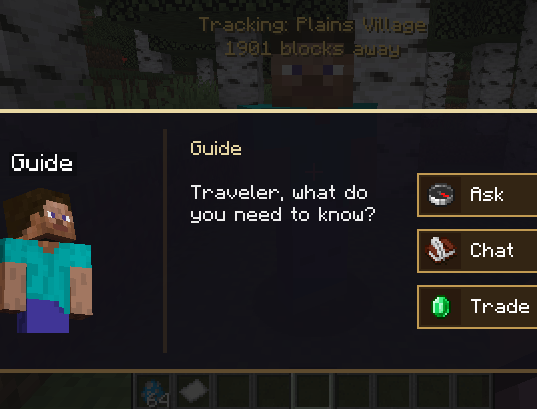
MyNPC adds customizable guide NPCs that help players find structures, receive direction hints, and obtain teleport scrolls for exploration.
MyNPC
# MyNPC 1.1 User Guide
## Requirements
- Minecraft `1.20.1`
- Forge `47.x`
- MyNPC `1.1`
## Installation
1. Put the MyNPC jar into your instance `mods` folder.
2. Start the game once.
3. The mod will create config folders automatically.
Important folders:
- `config/npc_types` stores NPC definition JSON files.
- `config/mynpc_custom_assets/textures` stores custom NPC skin textures.
- `config/mynpc_custom_assets/sounds` stores custom NPC sound files.
- `config/mynpc_custom_assets/lang` can be used for extra language entries.
## Default Guide NPC
The built-in guide NPC is `village_guide`.
By default, the guide:
- Spawns in vanilla villages.
- Has a 100% spawn chance when the village spawn check succeeds.
- Spawns at most one guide per village area.
- Knows a random set of structures.
- Can sell structure location help and teleport scrolls.
- Can fight hostile mobs, retaliate when attacked, and avoid creepers.
- Stays near its home village instead of wandering freely.
If the default config was already generated before updating, delete `config/npc_types/village_guide.json` and restart the game to regenerate the latest default version.
## NPC Manager
Press `H` in game to open the NPC manager.
Main actions:
- `+` creates a new NPC from the default template.
- Select an NPC from the left list to edit it.
- Use the small box beside NPC entries for multi-select.
- `Save` saves current changes.
- `Copy` duplicates the selected NPC. The copy keeps most settings but gets a unique id.
- `Cancel` discards the current edit session.
- `Delete` removes selected NPC definitions after confirmation.
- `Reset` restores selected NPCs to the built-in default guide settings.
Tabs:
- `Look`: skin, name, entity id, and sounds.
- `Behavior`: spawn structures, spawn chance, and min/max spawn count.
- `Structure`: known structures and structure hint behavior.
- `Trade`: teleport scroll trades and custom item trades.
- `Chat`: random chat lines and structure-related dialogue.
## Custom Skins
1. Put PNG skin files into `config/mynpc_custom_assets/textures`.
2. Open the NPC manager with `H`.
3. Select an NPC.
4. Go to `Look`.
5. Use the custom skin button to choose a texture.
6. Save the NPC.
The skin should use the normal Minecraft player skin layout.
## Custom Sounds
1. Put sound files into `config/mynpc_custom_assets/sounds`.
2. Open the NPC manager with `H`.
3. Select an NPC.
4. Go to `Look`.
5. Choose sounds for interaction, hurt, death, or ambient slots.
6. Use the preview button to test sounds.
7. Save the NPC.
## Structure Selection
Structure lists support:
- Search by keyword.
- Clicking the structure name for single selection.
- Clicking the small box for multi-selection.
- Scrolling when the list is longer than the panel.
Structure names use language keys where available. Unknown structures fall back to a readable id-based name.
## Trading
NPCs can offer:
- Teleport scroll trades for known structures.
- Structure location hint trades.
- Custom item trades.
For each structure trade, you can configure:
- The structure name.
- The item used as currency.
- The required item count.
- Whether the structure trade is disabled.
## Chat And Hints
NPCs can have general chat lines and structure-specific hint text.
Structure hint text can use:
- `{structure}` for the translated structure name.
- `{direction}` for the direction text.
Example:
```text
If my memory serves, {structure} lies somewhere to the {direction}.
```
## Spawn Eggs
Spawn egg NPCs use the same base initialization as naturally spawned NPCs:
- Default known structures can be generated.
- Home position is set when spawned.
- Random equipment can be assigned.
- Combat behavior is enabled.
## Troubleshooting
If a custom skin shows as missing texture:
- Check that the file is inside `config/mynpc_custom_assets/textures`.
- Make sure it is a valid PNG.
- Reopen the selector and save the NPC again.
If a custom sound does not play:
- Check that the file is inside `config/mynpc_custom_assets/sounds`.
- Use the sound preview button in the `Look` tab.
- Restart the game if the asset pack was just created for the first time.
If the default guide settings look old:
- Delete `config/npc_types/village_guide.json`.
- Restart the game.
- The mod will regenerate the latest default config.
__________________________________________________________________
# MyNPC 1.2 Update Guide
This guide covers the main new workflows added or changed in MyNPC 1.2.
## Opening the NPC Manager
- Press `H` to open the custom NPC manager.
- Use the NPC list on the left to select an NPC.
- Use the search box under the NPC list to filter NPCs.
- Use the `+` button beside the search box to create a new NPC.
- The selected NPC now appears pressed in the list, matching the selected page tabs.
## NPC Ids and Defaults
- The built-in guide NPC still uses the display name `village_guide`.
- Its internal id is now `npc`.
- New custom NPCs use ids like `npc1`, `npc2`, and `npc3`.
- Reset restores the shared default guide settings while keeping a safe unique id for the edited NPC.
## Spawn Eggs
- MyNPC spawn eggs are now placed in their own creative tab.
- Use `/mynpc egg <npc_id>` to create a spawn egg for a specific NPC.
- The command supports suggestions, so you can type part of an NPC id and pick it from the command list.
## Commands
### `/mynpc egg <npc_id>`
Gives the player a spawn egg for the selected NPC definition.
Examples:
```mcfunction
/mynpc egg npc
```
Gives the default guide NPC spawn egg.
```mcfunction
/mynpc egg npc1
```
Gives the spawn egg for the custom NPC with the id `npc1`.
The command supports Minecraft-style suggestions. Type part of an NPC id, then use the command suggestion list to choose the correct NPC without typing the full id.
This is useful when a pack contains many custom NPCs and you do not want every spawn egg mixed into the normal creative inventory workflow.
## Appearance Page
- Set the NPC display name and entity id.
- Choose a custom skin from the custom asset folder.
- Reset the skin back to Steve when needed.
- Configure interaction, hurt, death, and ambient sounds.
## Behavior Page
- Use `Spawn Structures` to edit where an NPC can naturally spawn.
- Each spawn rule contains:
- Structure id
- Minimum spawn count
- Maximum spawn count
- Spawn chance
- Use the search field and `+` button in the spawn rule screen to add structures.
## Structure Page
The Structure page is now simplified.
- `View Known` opens the known-structure rule list.
- `Random known max` controls the maximum number of known structures selected for a naturally spawned NPC.
- `Random known min` controls the minimum number of known structures selected for a naturally spawned NPC.
Known-structure rules can be used to control which structures an NPC can know about and how likely each structure is to be selected.
## Trade Page
- Use the custom trade list to add and manage normal item trades.
- Custom trades are shown before scroll trades in the right-click trade GUI.
- Use the teleport scroll price list to configure structure scroll trades.
- Item id fields can be typed manually or selected with the item icon button.
- Trade text can be customized for before-trade and after-trade messages.
## Chat Page
- The old separate `Add Text` button has been removed.
- Use `View Text` to manage chat lines.
- In the text list editor, add, edit, or delete chat lines from one place.
- Use the structure text tools to configure structure-related dialogue.
## Structure Guide
- Press `G` to open the structure guide.
- When the player reaches a tracked structure, the guide entry is marked as visited.
- The guide can show the tracked structure name and distance using the config options.
## Custom Assets
Custom skins and sounds are loaded from the custom asset folders under the MyNPC config area.
- Put textures in the texture folder.
- Put sounds in the sound folder.
- Reopen the relevant picker screen to refresh and select the asset.
## Notes for Modpack Authors
- Existing NPC JSON files are not deleted automatically.
- New installs use `npc.json` for the default guide definition.
- Older `village_guide.json` files remain compatible.
- For large NPC packs, use the `/mynpc egg` command and the dedicated MyNPC spawn egg creative tab to avoid clutter.
The MyNpc Team


Owner