Immersive Jewelry
- By
Immersive Jewelry adds many Curios supported jewelry items to the game which are fully modular and grant a variety of buffs, along with an immersive means of producing them in an engaging way involving mini-games.
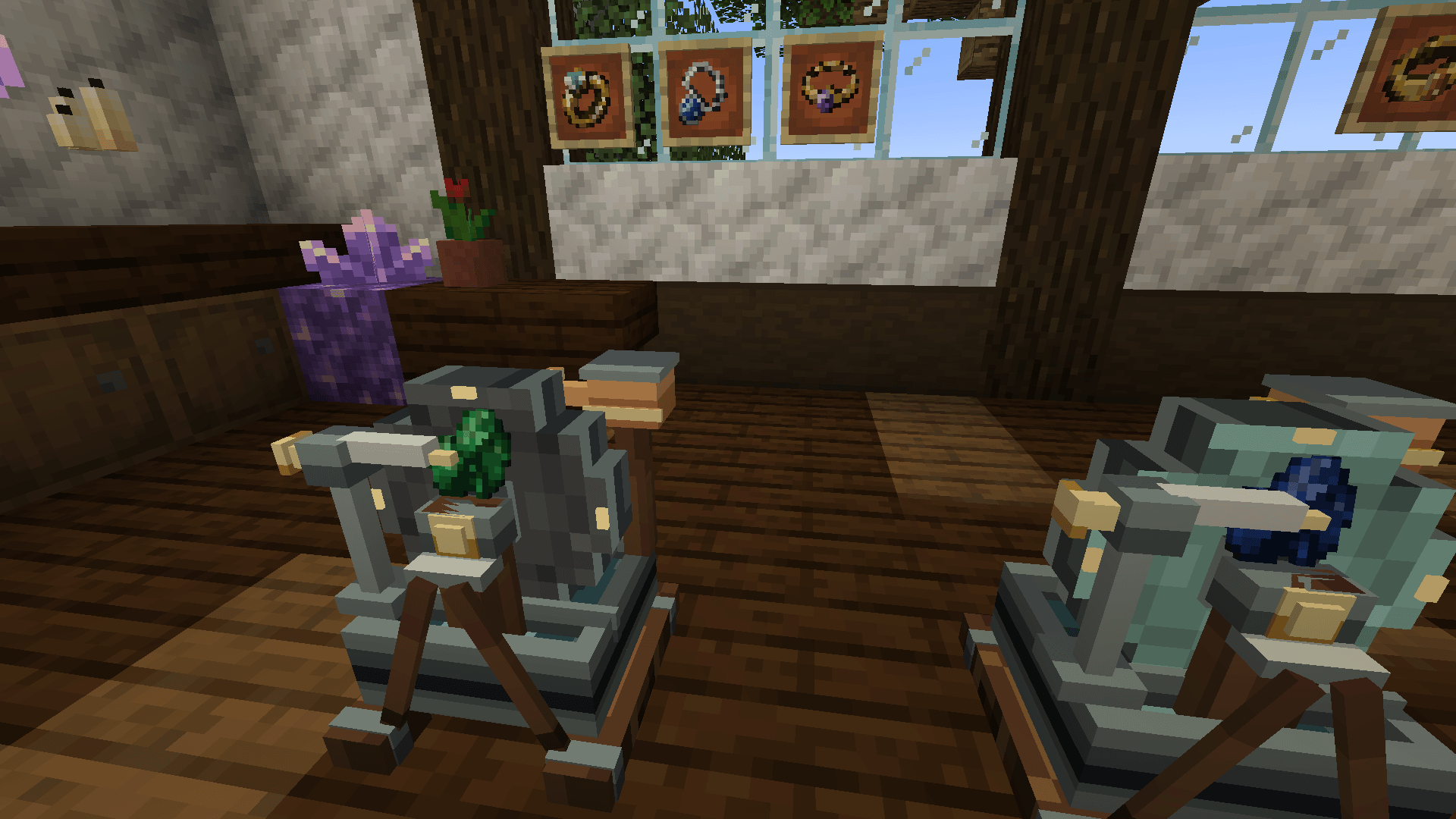
01-lapidary-wheels-and-workshop.png
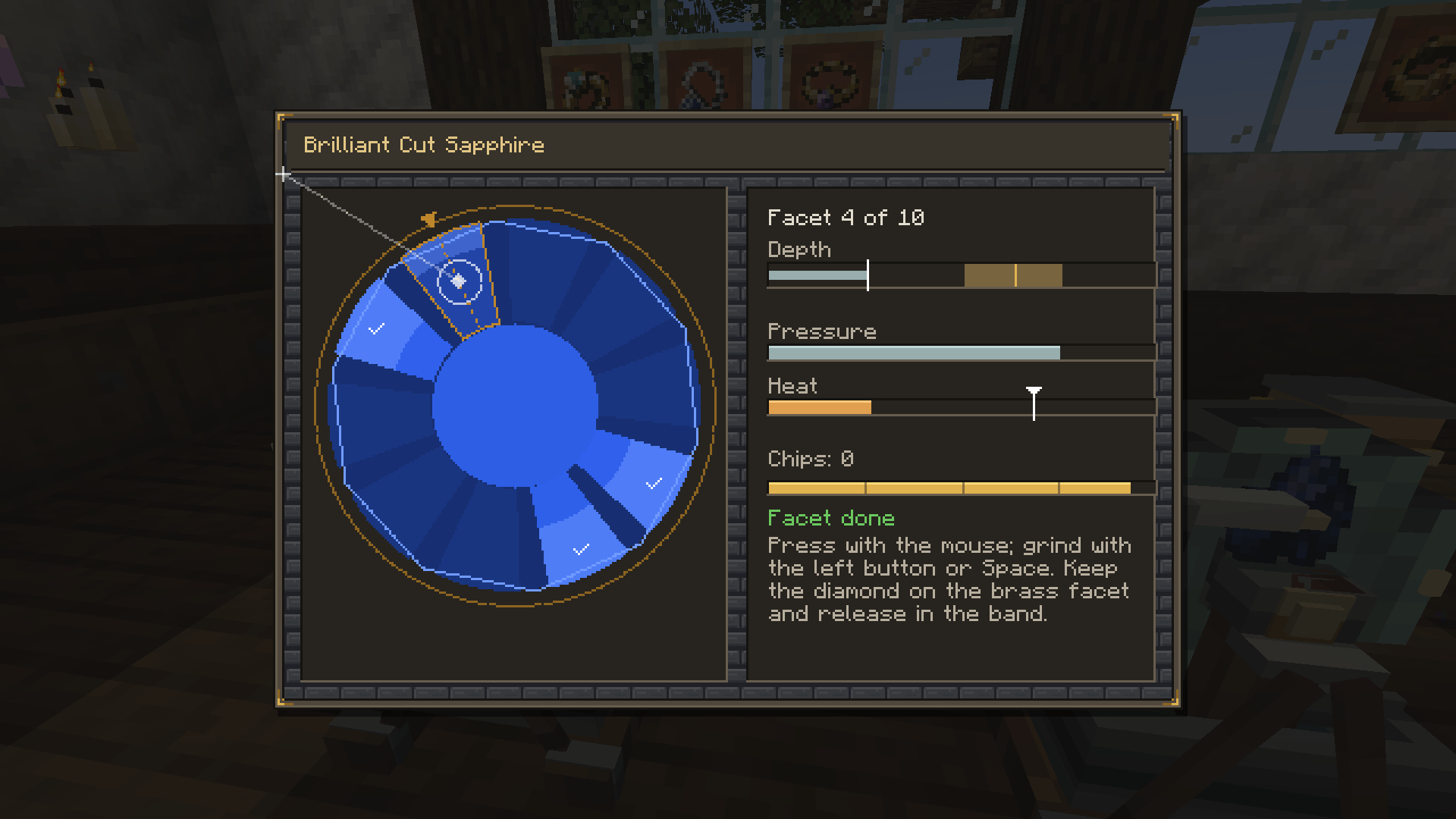
02-gem-cutting-minigame.png
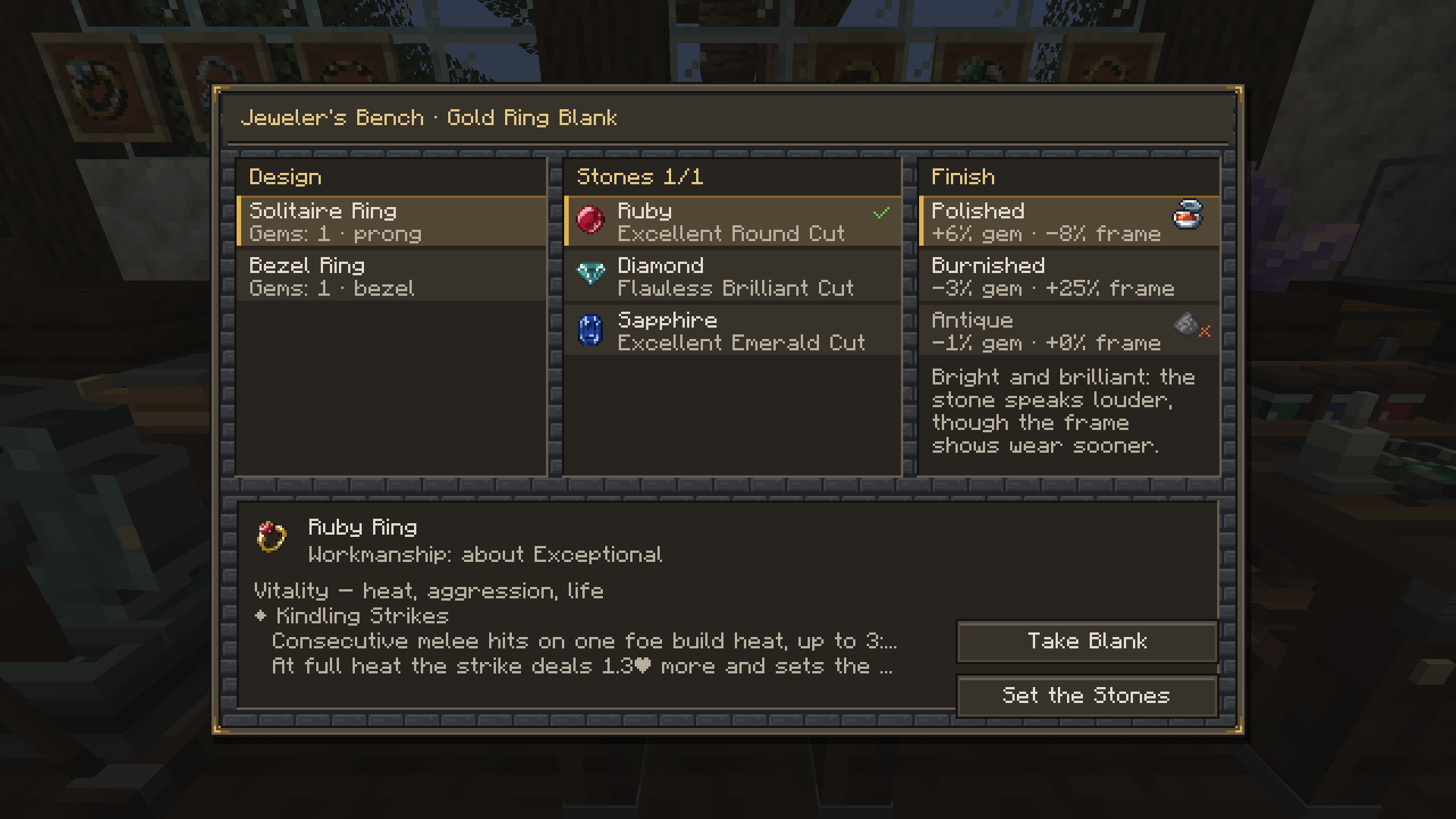
03-jewelers-bench-design.png
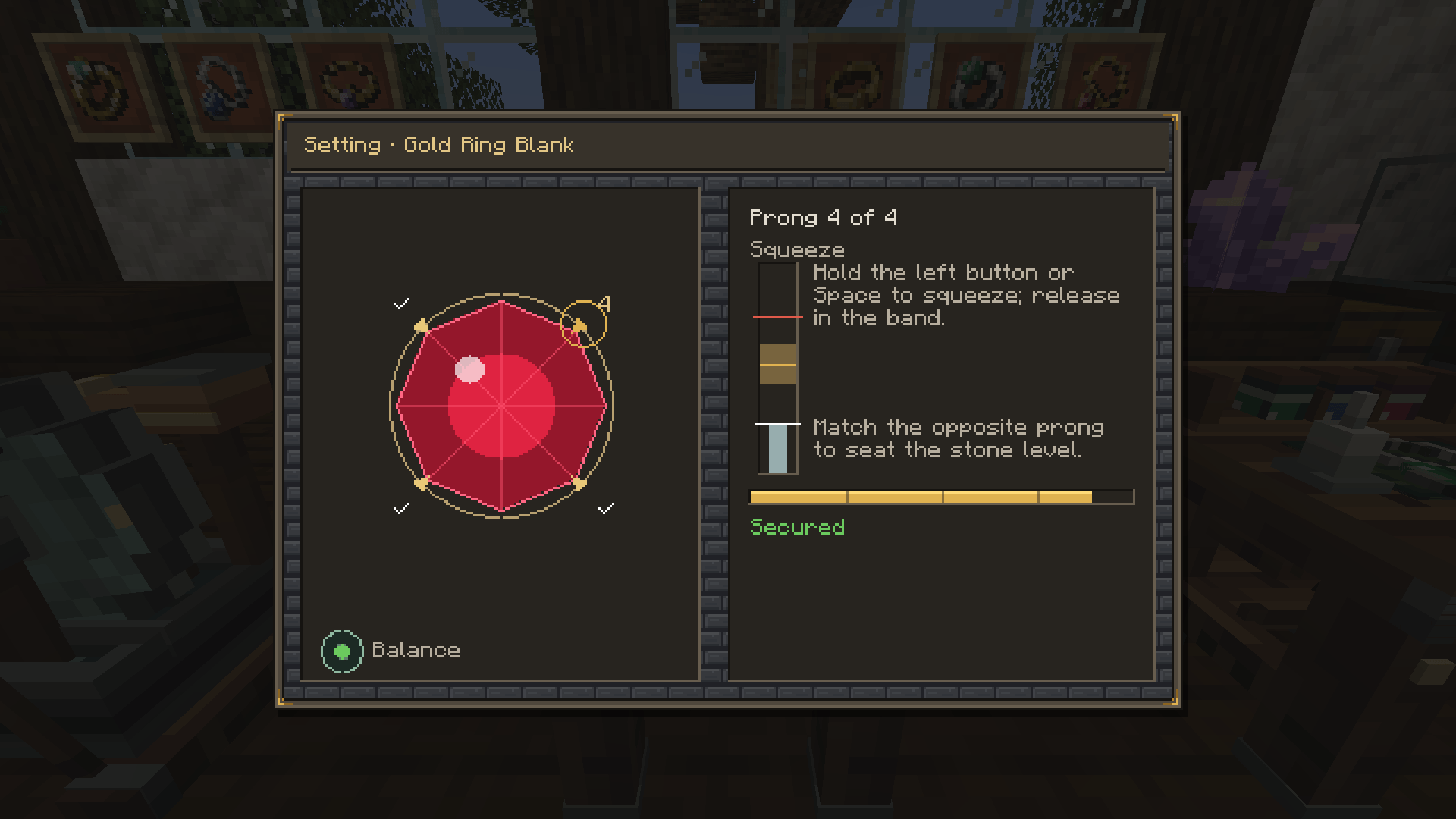
04-stone-setting-minigame.png
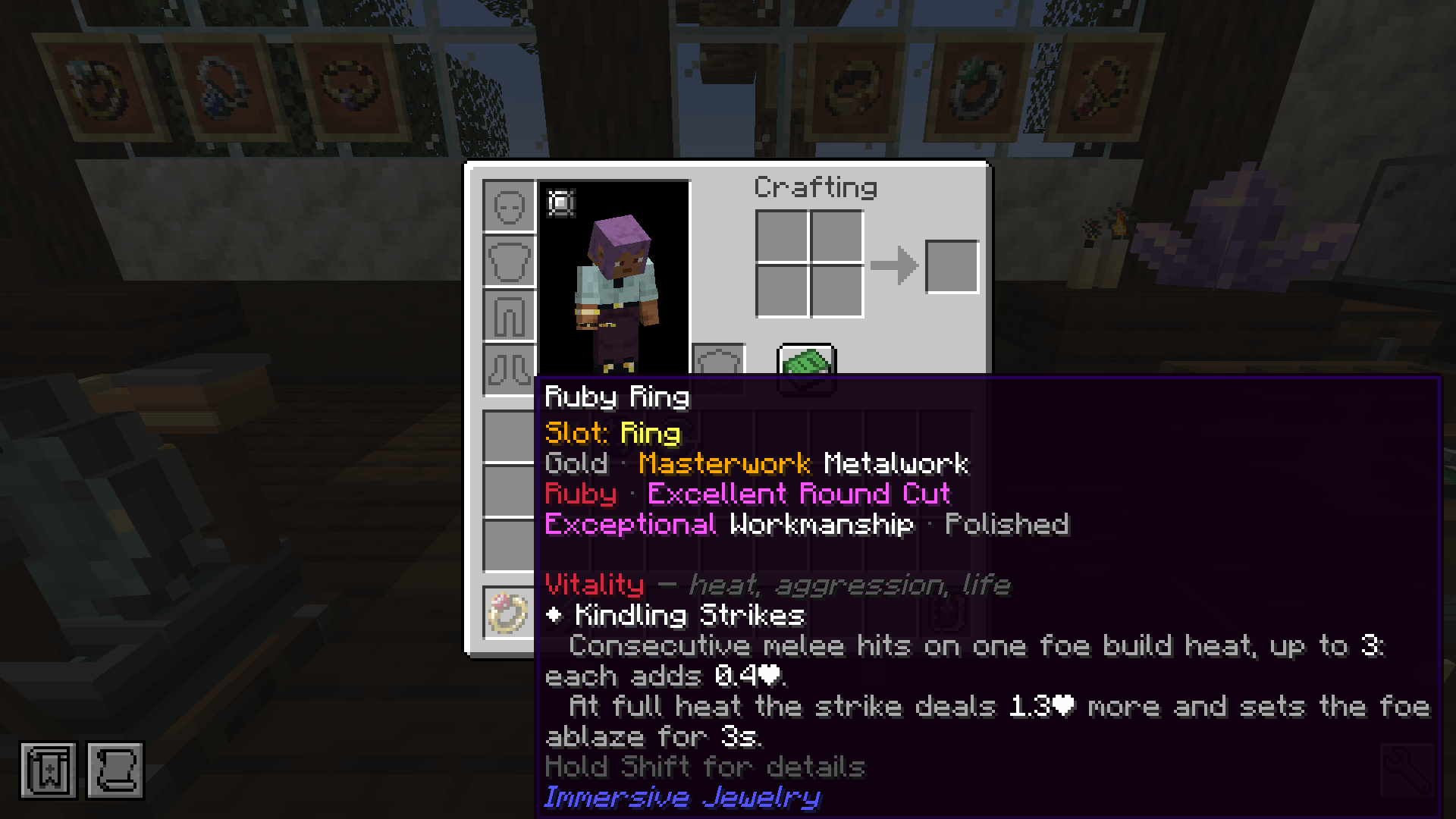
05-ruby-ring-tooltip.png
Description

Immersive Jewelry
Jewelry is made, not crafted.
Immersive Jewelry turns rings, amulets, bracelets, and circlets into a full hands-on crafting profession for Minecraft. Instead of combining a metal and a gemstone in a crafting grid, you prepare the metalwork, cut the stone, set it by hand, choose a finish, and create a piece whose abilities reflect what it is actually made from.
Every finished piece can be different.
Its identity comes from:
- the jewelry form
- the metal
- the gemstone
- the gem cut
- the quality of the metalwork
- the quality of your cut
- the quality of your stone setting
- the final finish
The result is a jewelry system built around craftsmanship, material choice, and short interactive work rather than recipe spam.
Immersive Jewelry is the reworked successor to Jewelcraft Reforged and is designed to fit naturally alongside the other Immersive crafting mods.
The Core Idea
Making jewelry is a process.
A typical piece looks something like this:
- Obtain or forge a metal blank or frame.
- Find a gemstone worth working with.
- Cut the gem on the Lapidary Wheel.
- Place the blank on the Jeweler's Bench.
- Choose a design.
- Set the gemstone into the piece by hand.
- Choose a finish.
- Wear the completed jewelry and use the abilities created by its materials and workmanship.
A gold ruby ring and an iron ruby ring are not simply recolors of the same item. The metal changes how the piece behaves. A Brilliant Cut ruby is not identical to a Cabochon ruby. A rushed setting is not equal to careful work. A polished piece is not the same as a burnished one.
The goal is to make jewelry feel like something you actually produced.
Getting Started
Your main tools and workstations are:
- Lapidary Wheel for cutting gemstones
- Jeweler's Bench for designs, stone setting, finishing, repair, and reworking
- Jeweler's Pliers for setting and removing stones
- Fine Pliers for more forgiving precision work
- Emery Lap and Diamond Lap for upgrading the Lapidary Wheel
- Jeweler's Handbook for an in-game explanation of the full process
If JEI is installed, Immersive Jewelry also provides dedicated information for gem cutting, jewelry designs, finishing, and reworking.
Gemstones
Gemstones are more than ingredients.
When a stone enters the jewelry system, it has its own character. Stones can differ in things such as:
- size
- clarity
- inclusions
- cutting difficulty
- brittleness
- retained size after cutting
- final cut quality
Two stones of the same type can therefore produce noticeably different pieces.
Built-In Gem Support
Immersive Jewelry includes dedicated behavior for:
- Ruby
- Sapphire
- Emerald
- Diamond
- Amethyst
- Topaz
- Onyx
- Lapis
- Quartz
Vanilla diamonds, emeralds, amethyst, lapis, and quartz can enter the system as gemstones.
Ruby, sapphire, topaz, and onyx can appear as rough stones through Immersive Jewelry's progression systems, including treasure and Jeweler trades.
Automatic Modded Gem Support
Immersive Jewelry can automatically recognize many modded gemstones that use standard Forge gem tags.
If another mod provides a gemstone under a normal forge:gems/... tag and no custom Immersive Jewelry definition exists for it, the mod can treat it as a generic cuttable gem automatically.
These automatically detected gems use a neutral Resonance identity by default, so they still have useful jewelry effects instead of becoming cosmetic-only materials.
Modpack authors can replace that generic behavior with custom gemstone definitions when they want deeper integration.
The Lapidary Wheel
The Lapidary Wheel is where rough stones become usable cut gemstones.
Place a gemstone on the wheel, choose a compatible cut, and work through the facets.
The cutting minigame asks you to control contact, pressure, position, and depth. You are trying to keep the actual contact point inside the correct facet area while grinding only as far as needed.
Good cutting rewards precision.
Poor cutting can cause:
- scratches
- overcut facets
- lost stone size
- lower cut quality
- chips
- reduced maximum quality
By default, mistakes are meant to hurt the result rather than simply delete an expensive gem. Catastrophic shattering can be enabled by server configuration, but it is disabled by default.
Hard stones take more work to grind. Brittle stones punish excessive pressure more severely. Included stones are less forgiving. Better equipment gives you more control.
Heat Matters
Grinding builds heat.
If you keep pushing too hard for too long, the stone becomes more likely to chip. Releasing pressure lets it cool.
This makes cutting a balance between speed and care rather than a simple progress bar.
Lap Upgrades
The wheel can be fitted with better laps.
Emery Lap
A practical upgrade that improves the cutting experience with faster, steadier grinding and better control.
Diamond Lap
A stronger high-end option with faster cutting, wider usable facet areas, better stability, and improved heat management.
Laps wear down as they are used, so they are equipment rather than permanent one-time upgrades.
Gem Cuts
The initial jewelry system includes four main cuts.
Cabochon
The most forgiving cut.
- four broad passes
- low cutting difficulty
- excellent stability
- suited especially well to opaque stones
- keeps a relatively large amount of the original gem
- slightly gentler effect strength
Cabochon is a good choice when you care more about reliability and keeping the stone intact than maximum power.
Round
The balanced general-purpose cut.
- six facets
- moderate difficulty
- balanced effect strength
- balanced stability
- works well for many stones
Round is the safe middle ground.
Emerald
A more technical step cut.
- eight facets
- good size retention
- strong stability
- slightly lower raw amplification than Brilliant
- excellent for pieces where consistency matters
Emerald Cut pieces tend to favor steadiness and retained material.
Brilliant
The high-risk, high-reward cut.
- ten facets
- highest difficulty of the core cuts
- strongest raw gem amplification
- lower size retention
- slightly less stability
A well-made Brilliant Cut can produce the strongest expression of a gem, but it asks more from the jeweler and removes more material.
Not every stone supports every cut. For example, opaque stones such as onyx and lapis favor simpler cuts, while diamonds do not use Cabochon by default.
Cut Quality
Your cutting performance becomes part of the gem permanently.
Cut quality can range through:
- Ruined
- Chipped
- Acceptable
- Fine
- Excellent
- Flawless
Better quality means a better final piece.
A poorly cut or chipped stone is not necessarily wasted. It can be placed back on the Lapidary Wheel and recut. Recutting gives you another chance, but the gem becomes smaller in the process.
Jewelry Forms
Immersive Jewelry focuses on four core wearable forms.
Rings
Rings lean toward precise, triggered, offensive, or utility effects.
By default, up to two rings can be active at once.
Amulets
Amulets lean toward defense, recovery, survival, protection, and sustained passive effects.
By default, one amulet can be active.
Bracelets
Bracelets lean toward movement, physical action, tool use, mobility, gathering, and practical utility.
By default, one bracelet can be active.
Circlets
Circlets lean toward magic, perception, knowledge, experience, resource control, and supernatural effects.
By default, one circlet can be active.
Slot limits are configurable.
Jewelry Designs
The form tells you what kind of jewelry you are making, while the design determines how the stones are mounted and how difficult the setting work will be.
Basic Designs
Available without a Design Sketch by default:
- Solitaire Ring
- Bezel Ring
- Pendant Amulet
- Locket Amulet
- Cuff Bracelet
- Simple Circlet
These cover both prong and bezel-style settings.
Bezel designs use more setting points but give the gemstone additional protection.
Advanced Designs
Advanced designs are learned from Design Sketches by default:
- Trilogy Ring
- Halo Amulet
- Link Bracelet
- Diadem
These designs use three matching stones and provide a more elaborate piece for players who want to invest more materials and work.
Design Sketches can be found in treasure or purchased from Jewelers.
Servers and modpacks can disable the sketch requirement and make every design known automatically.
The Jeweler's Bench
The Jeweler's Bench is the center of jewelry assembly.
Place a jewelry blank or frame on the bench, then use Jeweler's Pliers to begin working.
At the bench you can:
- choose a jewelry design
- select prepared gemstones
- perform the stone-setting interaction
- choose a finish
- remove stones from old jewelry
- repair worn frames
- refinish finished jewelry
- prepare pieces for reworking
The bench also serves as the workstation for the Jeweler villager profession.
Stone Setting
Cutting a gemstone is only half the job.
Once the stone is prepared, it still needs to be mounted correctly.
Stone setting uses a pressure-based interaction. You work around the setting points and press the metal into place while trying to keep the stone balanced.
The target changes depending on the opposite side of the setting, so blindly squeezing every point to the same amount is not the best approach.
Poor setting can result in:
- loose stones
- bent prongs
- crooked alignment
- scratched metal
- chipped gemstones
- lower overall workmanship
A successful setting rewards balanced pressure and careful sequencing.
Better pliers make the pressure windows more forgiving.
Workmanship
Finished jewelry remembers how well it was made.
The final workmanship combines three main stages:
- metalwork quality
- gem cut quality
- setting quality
By default, overall workmanship is weighted approximately as:
- 35% metalwork
- 35% gem cutting
- 30% stone setting
Pack authors can rebalance these values.
Player-facing workmanship grades include:
- Faulty
- Common
- Fine
- Exceptional
- Masterwork
The important part is that quality is not just cosmetic. Better workmanship improves the effectiveness of the finished piece.
A Masterwork item is something the player earns by doing the work well. Even the Jeweler villager's highest-level finished jewelry is intentionally capped below true Masterwork quality.
Metals Matter
The metal frame changes the character of the jewelry.
It can affect:
- effect potency
- structural integrity
- enchantability
- responsiveness
- affinity with offense, defense, utility, mobility, or magic
- special material bonuses
A few examples:
Gold
Gold favors magical jewelry.
It offers strong enchantability and increased magical affinity, but it is less structurally durable than tougher metals. Gold jewelry also keeps the usual piglin-friendly behavior.
Iron
Iron is sturdy and defensive.
It provides strong structural integrity but is less favorable for magical amplification.
Copper
Copper is responsive and utility-focused.
It favors utility and mobility while trading away some raw durability and potency.
Netherite
Netherite produces extremely durable, powerful frames with strong offensive and defensive tendencies.
Silver
When silver is available through another mod, Immersive Jewelry can give it a protective identity with strong enchantability, defensive affinity, and extra protection against undead attackers.
Modded Metals
The system supports many standard modded metal families when the required materials exist in the pack.
Included data covers examples such as:
- bronze
- electrum
- nickel
- platinum
- steel
- tin
- aluminum
- rose gold
- manasteel
- elementium
- terrasteel
- mithril
Immersive Jewelry does not need to add all of these metals itself. It recognizes compatible material families supplied by other mods and can use them for jewelry when their items are present.
Immersive Smithing Integration
Immersive Smithing is optional, but it provides the intended full metalworking experience.
When Immersive Smithing is installed and integration is enabled, jewelry frames are forged as small metalwork jobs.
You create forms such as:
- ring blanks
- amulet frames
- bracelet blanks
- circlet frames
The quality of the smithing work carries directly into the jewelry.
That means a carefully forged frame gives you a better foundation for a high-quality finished piece.
Immersive Jewelry does not duplicate Immersive Smithing's forge and anvil systems. Smithing makes the metalwork. Immersive Jewelry handles the gemstones, assembly, setting, finishing, wear, and effects.
Without Immersive Smithing
The mod can still work on its own.
By default, fallback recipes let you craft jewelry blanks from compatible metals. These crafted blanks receive middling metalwork quality instead of rewarding smithing skill.
Modpacks can:
- keep the fallback recipes
- disable the fallback recipes
- force Immersive Smithing to be required for jewelry progression
Finishes
A finish is the final tuning step.
It changes both appearance and behavior.
Polished
A bright, gem-focused finish.
- increases gemstone potency
- reduces frame integrity somewhat
- requires Polishing Compound
Choose Polished when you want to push more power out of the stone.
Burnished
A tougher, steadier finish.
- increases structural integrity
- improves effect stability
- slightly reduces gem potency and enchantability
Choose Burnished when durability and consistency matter more than maximum output.
Antique
A darker, magic-friendly finish.
- strongly improves enchantability
- slightly favors magical effects
- uses a darker recessed appearance
- requires gunpowder as part of the finish
Choose Antique for enchantment-heavy or magic-focused jewelry.
Finished jewelry can be refinished later.
What Jewelry Actually Does
Jewelry effects are built compositionally.
The gemstone provides the theme. The jewelry form decides how that theme is expressed. The metal, cut, finish, and workmanship then modify the result.
This means the same gem behaves differently depending on what you make with it.
Below are the built-in identities.
Ruby: Vitality
Ruby focuses on heat, aggression, survival, and momentum.
- Ring: builds offensive momentum through repeated attacks and can finish with extra damage and ignition
- Amulet: provides an emergency survival response at low health with fire protection, recovery, absorption, and extinguishing
- Bracelet: rewards sprinting into combat with a charge attack
- Circlet: can support fire spell power when compatible magic attributes are present, with a built-in fallback behavior otherwise
Sapphire: Clarity
Sapphire focuses on precision, water, ranged control, and magical resources.
- Ring: rewards highly charged, precise attacks
- Amulet: supports underwater exploration with breathing and vision
- Bracelet: improves bow and crossbow draw speed
- Circlet: can improve mana-related attributes from supported magic mods, with a status-immunity fallback
Emerald: Verdancy
Emerald focuses on growth, recovery, gathering, and sustainability.
- Ring: improves bonemeal-style growth
- Amulet: provides periodic recovery outside combat
- Bracelet: can restore food and saturation through harvesting
- Circlet: can slowly restore hunger while in sunlight
Diamond: Purity
Diamond focuses on resilience, precision, amplification, and clean power.
- Ring: strengthens critical attacks
- Amulet: provides a rechargeable absorption shell
- Bracelet: improves mining when using the correct tool
- Circlet: strengthens other worn jewelry and protects against selected vision-impairing effects
Amethyst: Warding
Amethyst focuses on magical protection, resonance, sensing, and control.
- Ring: marks targets so they can take increased follow-up damage
- Amulet: can cleanse harmful effects and reduce magical damage
- Bracelet: muffles vibration-based activity
- Circlet: can improve compatible spell-power attributes, with hostile sensing as a fallback
Topaz: Fortune
Topaz focuses on luck, speed, mobility, and quick reactions.
- Ring: can improve loot outcomes from defeated enemies
- Amulet: grants an emergency burst of speed and jumping ability at low health
- Bracelet: rewards sustained sprinting and reduces fall damage
- Circlet: can support spell cooldown reduction where compatible, with a kill-triggered haste and speed fallback
Onyx: Shadow
Onyx focuses on concealment, endurance, draining attacks, and defensive escape.
- Ring: can siphon health from melee damage
- Amulet: reduces damage from projectiles and explosions
- Bracelet: can trigger a short escape window of speed and invisibility after a hard hit
- Circlet: makes creatures less likely to notice you from as far away
Lapis: Insight
Lapis focuses on experience, adaptation, water, and learning.
- Ring: increases experience gained from defeated enemies
- Amulet: learns from incoming damage and temporarily resists repeated harm from the same type of attacker
- Bracelet: improves swimming and underwater mining
- Circlet: increases experience gain
Quartz: Radiance
Quartz focuses on light, range, fire resistance, and ranged combat.
- Ring: improves projectile-focused attacks
- Amulet: reduces fire and lava damage
- Bracelet: increases block reach
- Circlet: grants vision support in very dark areas
Automatically Detected Gems: Resonance
Generic modded gems use the neutral Resonance trait unless a datapack gives them a custom identity.
- Ring: luck
- Amulet: extra maximum health
- Bracelet: reduced fall damage
- Circlet: increased experience gain
The strength of these effects still depends on the rest of the piece.
Magic Mod Compatibility
Some circlet effects can recognize attributes from popular magic mods.
Current built-in definitions include support for compatible attributes from:
- Iron's Spells 'n Spellbooks
- Ars Nouveau
When those attributes are available, the jewelry can interact with them directly.
When they are not available, the affected jewelry uses built-in fallback effects instead of becoming useless.
Wearing Jewelry
Immersive Jewelry supports two equipment approaches.
With Curios
If Curios is installed and the equipment system is set to automatic, jewelry uses Curios slots.
Typical defaults are:
- two ring slots
- one necklace or amulet slot
- one bracelet slot
- one head or circlet slot
Amulets are also compatible with the charm-style slot used by older Jewelcraft Reforged setups.
Without Curios
Curios is not required.
Immersive Jewelry includes its own built-in jewelry equipment screen. You can open it from the inventory button or the configurable jewelry keybind.
This means the mod remains fully usable in packs that do not want Curios.
Wear, Damage, and Repair
Jewelry does not behave like a sword with ordinary durability.
Instead, each frame has Integrity.
Routine combat does not constantly wear your accessories down. Only severe hits can damage worn jewelry when the wear system is enabled.
A heavily worn piece can eventually risk damage to its gemstones as well.
This keeps upkeep meaningful without turning jewelry into another item that constantly needs repairs.
Repairing Frames
A worn frame can be repaired at the Jeweler's Bench using the appropriate metal material.
Repairs restore Integrity, although repeated reworking gradually reduces how perfect the same frame can remain forever.
Removing Stones
Stones can be carefully removed with Jeweler's Pliers.
The stones are returned to you rather than being destroyed, but opening and reworking the frame costs some Integrity.
Recutting Stones
A chipped or poor-quality stone can be recut on the Lapidary Wheel.
You lose some size, but you get another chance to improve the result.
This creates a real reworking loop instead of making every imperfect item disposable.
The Jeweler Villager
A villager who claims a Jeweler's Bench can become a Jeweler.
Jewelers can trade things such as:
- rough gemstones
- cut gemstones
- Jeweler's Pliers
- Fine Pliers
- Emery Laps
- Diamond Laps
- Polishing Compound
- Jeweler's Handbooks
- Design Sketches
- high-level finished jewelry
Higher-level Jewelers gain access to rarer stones and more advanced supplies.
Master-level Jewelers can sell good finished jewelry, but their workmanship is deliberately capped below player-made Masterwork quality.
The best jewelry is still something you make yourself.
Villager trades can be disabled through configuration.
Treasure and Exploration
Immersive Jewelry can add rough gemstones and Design Sketches to treasure.
This gives exploration a place in jewelry progression. A rare stone or advanced design can become a reason to visit dungeons, strongholds, temples, and other valuable loot locations instead of treating jewelry as a purely workstation-based system.
Treasure gem generation can be disabled or scaled by server configuration.
Advancements
The mod includes progression advancements that guide players through the profession.
Examples include:
- building a Lapidary Wheel
- cutting your first facet
- producing a Flawless stone
- forging or crafting a jewelry blank
- building a Jeweler's Bench
- setting your first stone
- making Fine jewelry
- creating a Masterwork piece
- recovering a stone from jewelry
- learning a new design
- repairing a worn frame
These provide a natural path through the mod without requiring you to read every system before beginning.
JEI and Jade Support
JEI
With JEI installed, Immersive Jewelry exposes useful categories and explanations for:
- gem cutting
- jewelry designs
- finishing
- reworking
- blank creation
- tools and workstations
JEI can also explain which cuts, stones, and processes belong together.
Jade
With Jade installed, workstation overlays can show useful information such as:
- the stone mounted on a Lapidary Wheel
- the installed lap and its remaining wear
- the piece on a Jeweler's Bench
- current setting progress
- workmanship
- frame Integrity
Accessibility
The crafting minigames are meant to reward attention, not exclude players.
Client options include:
- reduced motion
- adjustable screen shake
- larger target areas
- slower minigame assistance
- colorblind-safe colors
- high-contrast minigame visuals
- larger markers
- optional timing cue sounds
- adjustable cue volume
- particle density controls
- gemstone sparkle controls
- workstation animation controls
Servers can choose whether the larger-target and slower-minigame assists are allowed.
The server also includes timing tolerance and latency compensation so multiplayer input does not have to be frame-perfect.
Configuration
Immersive Jewelry is highly configurable for both regular worlds and modpacks.
Important options include:
Crafting and Integration
- enable or disable Immersive Smithing integration
- require Immersive Smithing
- enable or disable fallback blank recipes
- adjust fallback metalwork quality
- blacklist unwanted metal families
- choose Curios or built-in equipment slots
- enable or disable automatic modded gem detection
Minigames
- gem cutting difficulty
- stone setting difficulty
- time allowed per facet
- time allowed per setting point
- accessibility assists
- workstation interaction distance
- latency tolerance
Quality
- catastrophic gem failure
- severity of cutting mistakes
- cut-quality thresholds
- weighting of smithing, cutting, and setting
Jewelry Effects
- global jewelry power
- active ring count
- active amulet count
- active bracelet count
- active circlet count
Wear and Reworking
- jewelry wear
- gemstone damage
- severe-hit threshold
- Integrity loss
- reworking cost
- repair amount
Progression
- Design Sketch requirements
- Jeweler villager trades
- maximum quality of villager-made jewelry
- treasure gemstone generation
- treasure frequency
- experience rewards from cutting and setting
Modpack and Datapack Support
Immersive Jewelry was built to be expandable.
Much of the system is data-driven, including:
- gemstones
- cuts
- jewelry forms
- finishes
- traits
- effect expressions
- metal behavior
- jewelry designs
That means pack authors can create new gemstone identities, alter metal behavior, add compatible materials, rebalance cuts, change finishes, or build new designs without rewriting the core mod.
Automatic Forge gem detection also means many content mods can participate with little or no custom compatibility work.
Jewelcraft Reforged Migration
Immersive Jewelry is the successor to Jewelcraft Reforged.
Legacy conversion support is included for existing worlds and can be enabled or disabled in configuration.
The purpose of the migration system is to make moving into the new jewelry framework easier without forcing every older piece to be abandoned.
Dependencies and Compatibility
Minecraft: 1.20.1
Mod Loader: Forge
Java: 17
Required
- Minecraft Forge
Optional Integrations
- Immersive Smithing for the full forged metalwork progression
- Curios API for Curios-based jewelry equipment slots
- JEI for recipe and process information
- Jade for workstation overlays
- compatible magic mods such as Iron's Spells 'n Spellbooks and Ars Nouveau for selected attribute-based effects
Curios and Immersive Smithing are not required for the mod to load.
In Short
Immersive Jewelry is for players who want accessories to feel crafted rather than generated by a recipe.
You find the stone.
You judge whether it is worth working.
You cut it.
You prepare the frame.
You set the stone.
You choose the finish.
You live with the result.
And when the work is good enough, the finished piece is not just "a ruby ring."
It is your ruby ring, made from a particular stone, in a particular metal, with a particular cut, finish, and level of workmanship.
That is the point of Immersive Jewelry.
The Immersive Jewelry Team


Owner