Absolute Frogs
- By
Find, tame and ride six species of giant frogs: charged leaps, swimming, diving, breeding and a field guide.
DelinkedDE | Absolute Frogs
Create a server, get 25% off your first month



Version 1.0 out now
Out now: six species of giant frogs · tame them with a snack · charged leaps up to four blocks high · swim, float and dive · saddle, blanket and bags · colour variants · from spawn to tadpole to grown frog · a field guide that fills in as you explore
Somewhere in the swamp, something the size of a cow is watching you.
It sits at the water's edge, throat pulsing, and it does not run. Bring a snack. Come back with three more. Then put a saddle on it.
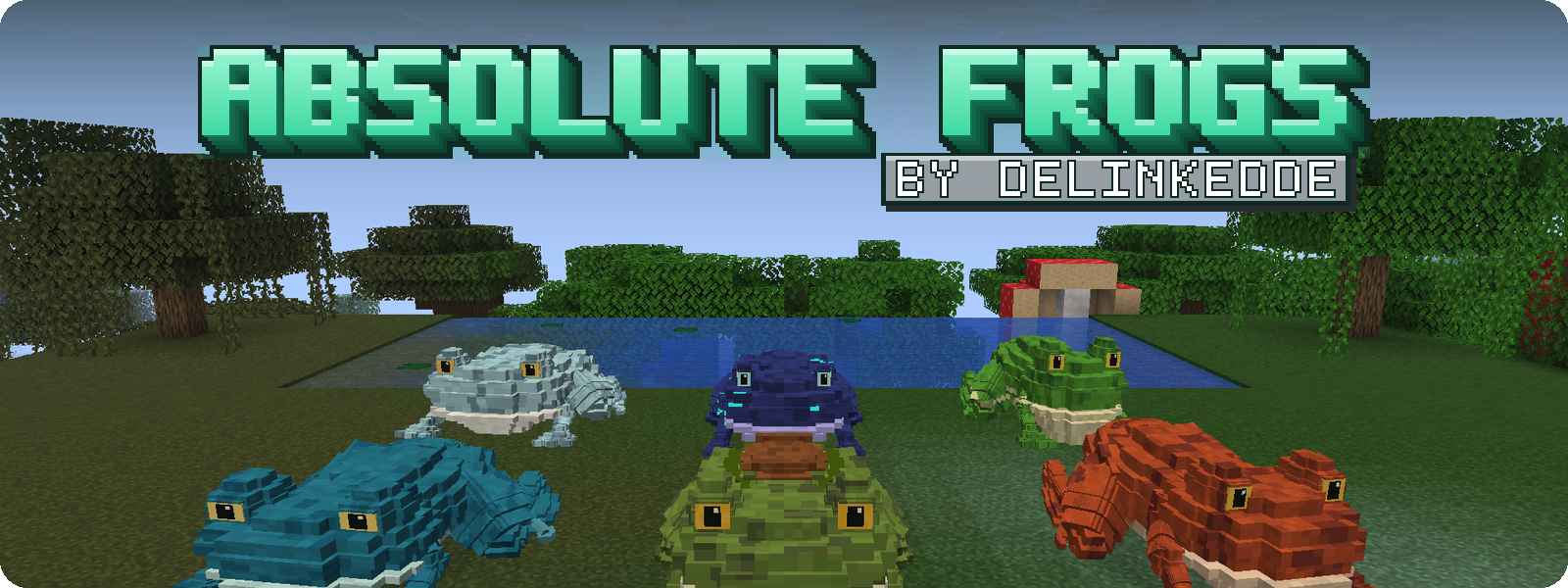
Absolute Frogs adds six giant frogs to the world, each with its own home, its own build and its own way of moving. They are not monsters and not livestock: they are mounts with character, built cube by cube and animated by hand, from the crouch before a leap to the slow kick of their legs under water.

Six species, six ways to travel
| Species | Home | What it is good at |
|---|---|---|
| Mireback | Swamps, muddy banks | The patient all-rounder. 120 stamina, forgives mistakes. Your first frog. |
| Mangrove Leaper | Mangrove swamps | The longest leaps of all, from root island to root island. |
| Lily Glider | Rivers, wide calm water | The fastest swimmer, with a water thrust on its own key. Slow on land. |
| Mist Hopper | Jungles | The highest jumps of all. The fewest hit points. |
| Cavern Glowfrog | Lush caves | Glowing spots that light up in the dark, a quiet hollow call. |
| Frost Frog | Frozen rivers, snowy taiga | The most hit points, and the cold does not touch it. |
Every species comes in three colour variants – Reed Green, Peat Brown and the rare Lichen Pale for the Mireback, Indigo, Night Violet and the rare Pearl Spots for the Glowfrog, and so on. Purely cosmetic, and some of them you will have to look for.
Taming without dice
A Swamp Snack is one green (kelp, seagrass, lily pad or sugar cane), one seed and one binder (slime ball, spider eye or glow berries) – four snacks per craft, from whatever grows where the frogs live.
Four snacks, a few seconds apart, and the frog is yours. No random chance, no endless feeding. Green sparks show each step, and while you are feeding it nobody else can steal it from under you. Hit it and it loses trust.
Riding
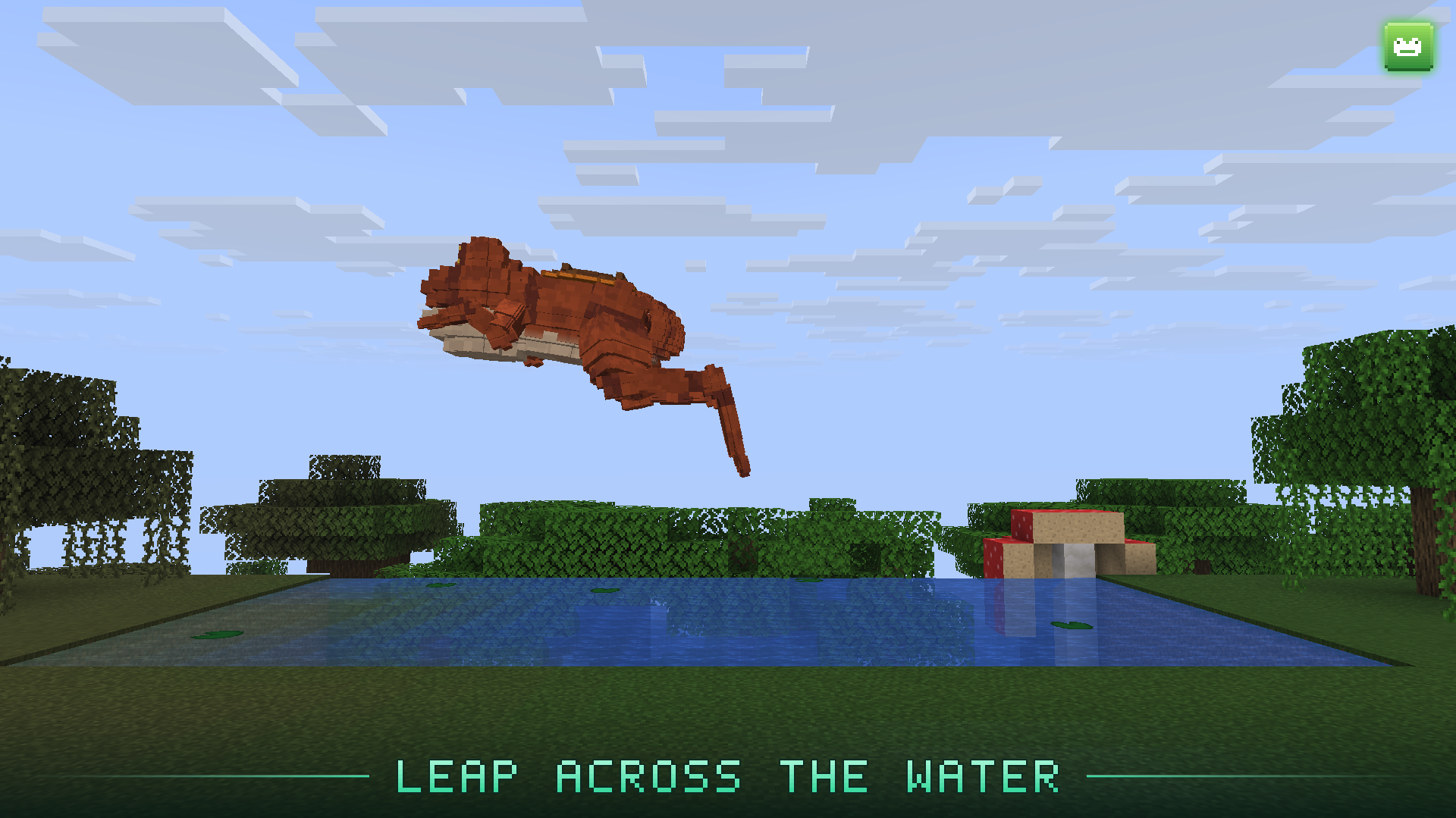
Hold jump to charge, release to leap. The body sinks, the legs fold, and the frog takes off – a small hop costs almost nothing, a full leap costs stamina. A row of bolts above the frog's hearts shows what is left; while you charge, the bolts the leap will cost blink, and when there is not enough left for a full leap they crack and turn red.
Falls of up to five blocks do no harm. When you get off, the frog looks for a safe side – never into lava, fire or a drop.
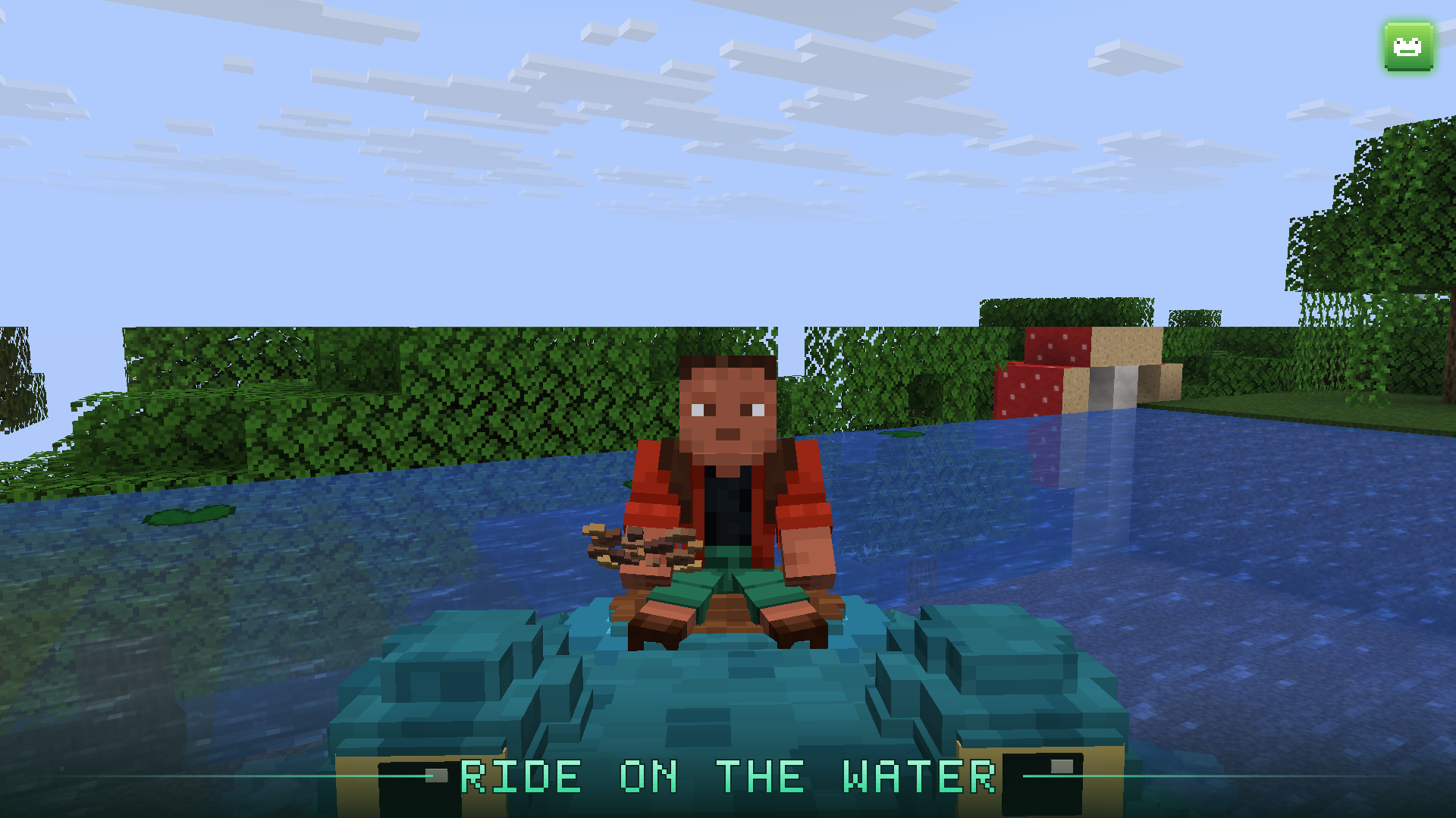
On water the frog floats calmly on a fixed waterline instead of bobbing up and down. Look down and swim forward to dive, let go and it rises again. A jump from the water launches it onto the bank. The species action key (R by default) gives the Lily Glider a burst of thrust, and the others their call.
Companion and gear
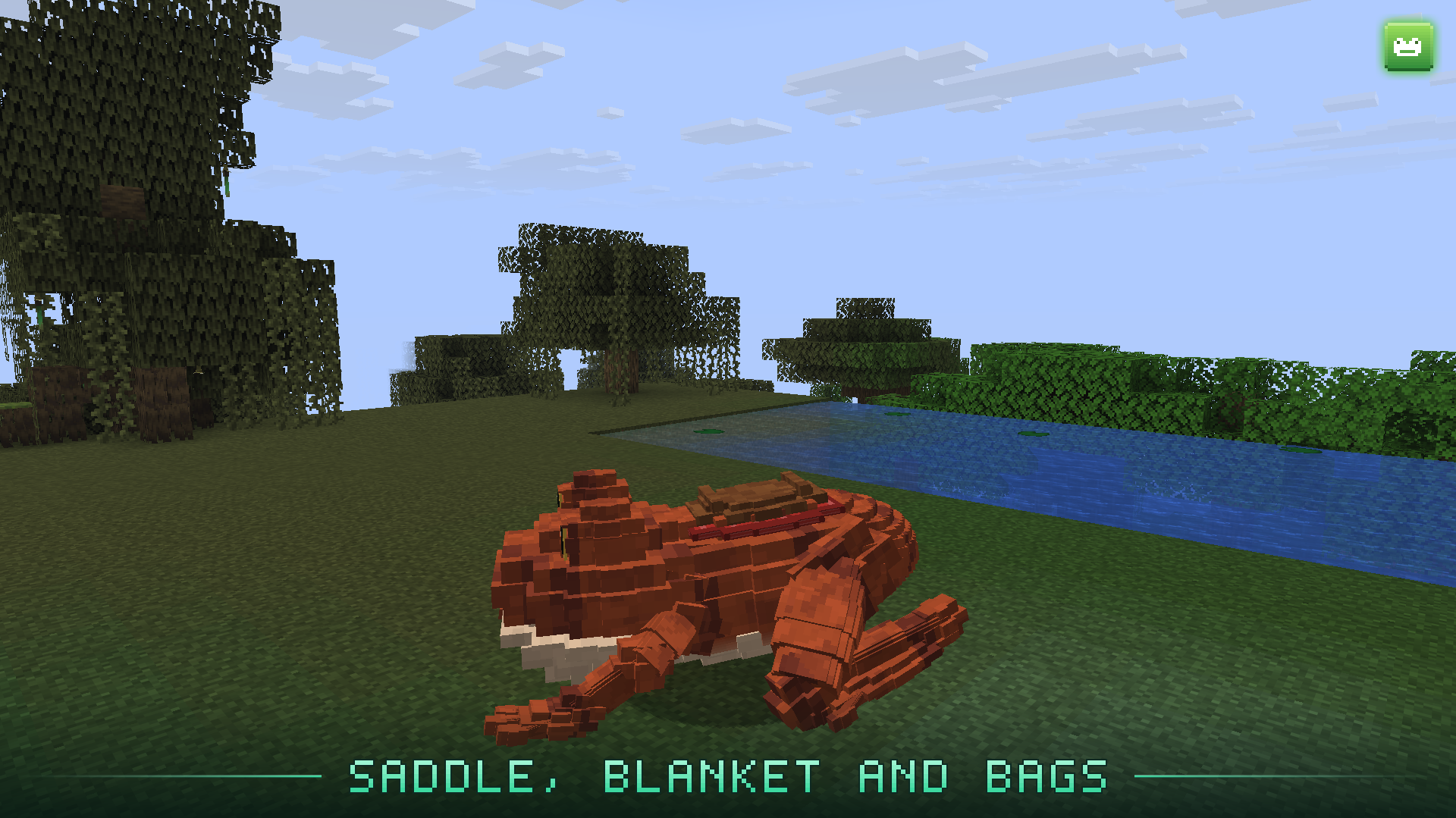
Sneak and right-click with an empty hand – or press the inventory key while riding – to open the owner menu:
- Follow, Stay, or Roam within sixteen blocks of where you left it
- Saddle – the normal Minecraft saddle
- Saddle blanket – any wool carpet, in sixteen colours
- Frog saddlebags – six slots of storage, at the price of a slightly shorter leap
Tamed frogs heal slowly in water and rain. Hurt wild frogs flee into the nearest water.
Breeding: the whole life cycle
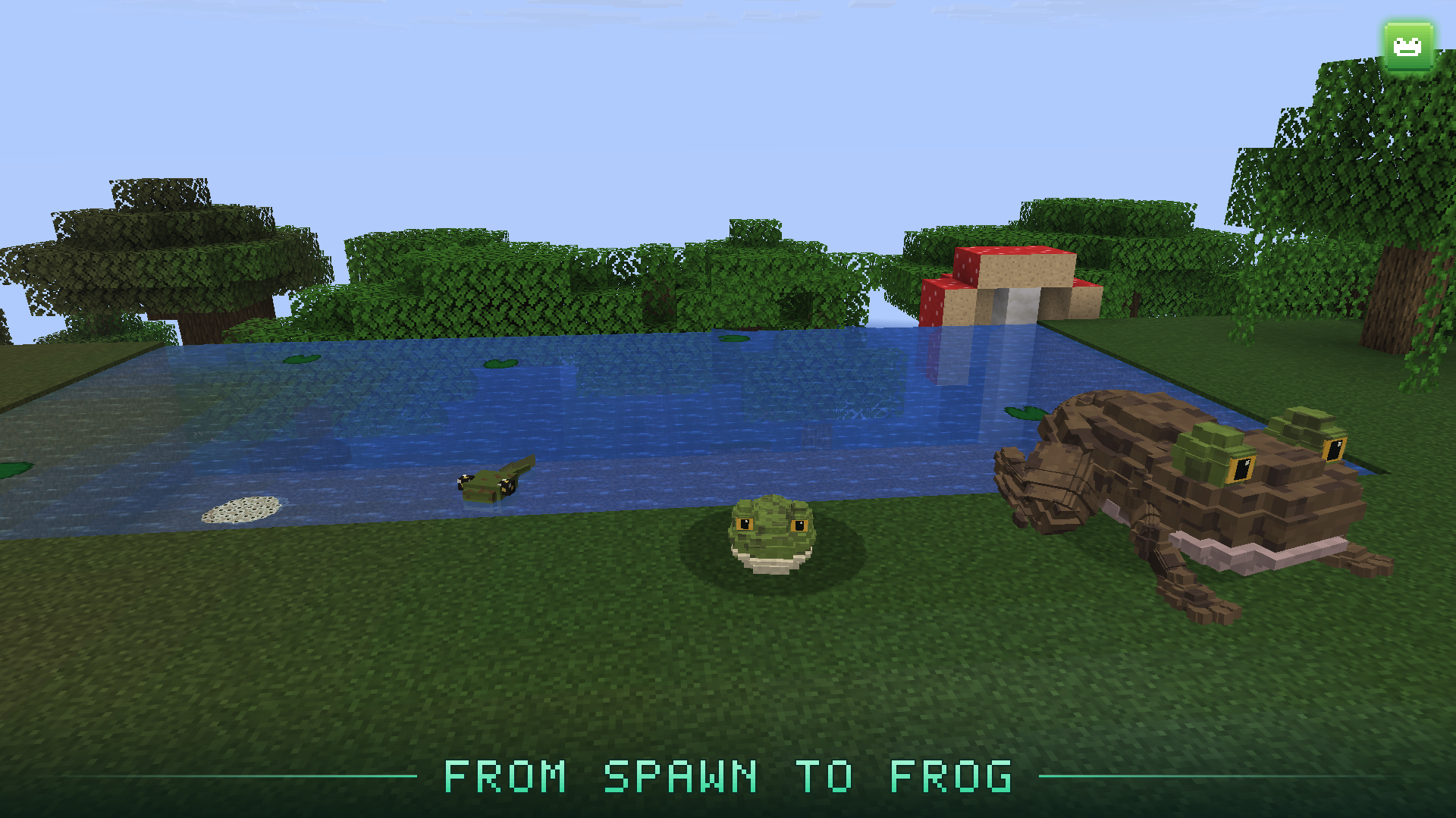
Feed two tamed frogs of the same species while sneaking. They call to each other, and a moment later frogspawn lies on the nearest water. Five minutes later one giant tadpole hatches – catch it in a water bucket if you want to take it home. Fifteen minutes after that it becomes a young frog, with a big head, big eyes and short legs, and twenty minutes later it is grown. Its colour comes from one of its parents, and every now and then it is a new one.
A frog you bred is yours: once it is grown, a single snack from you tames it.
The field guide
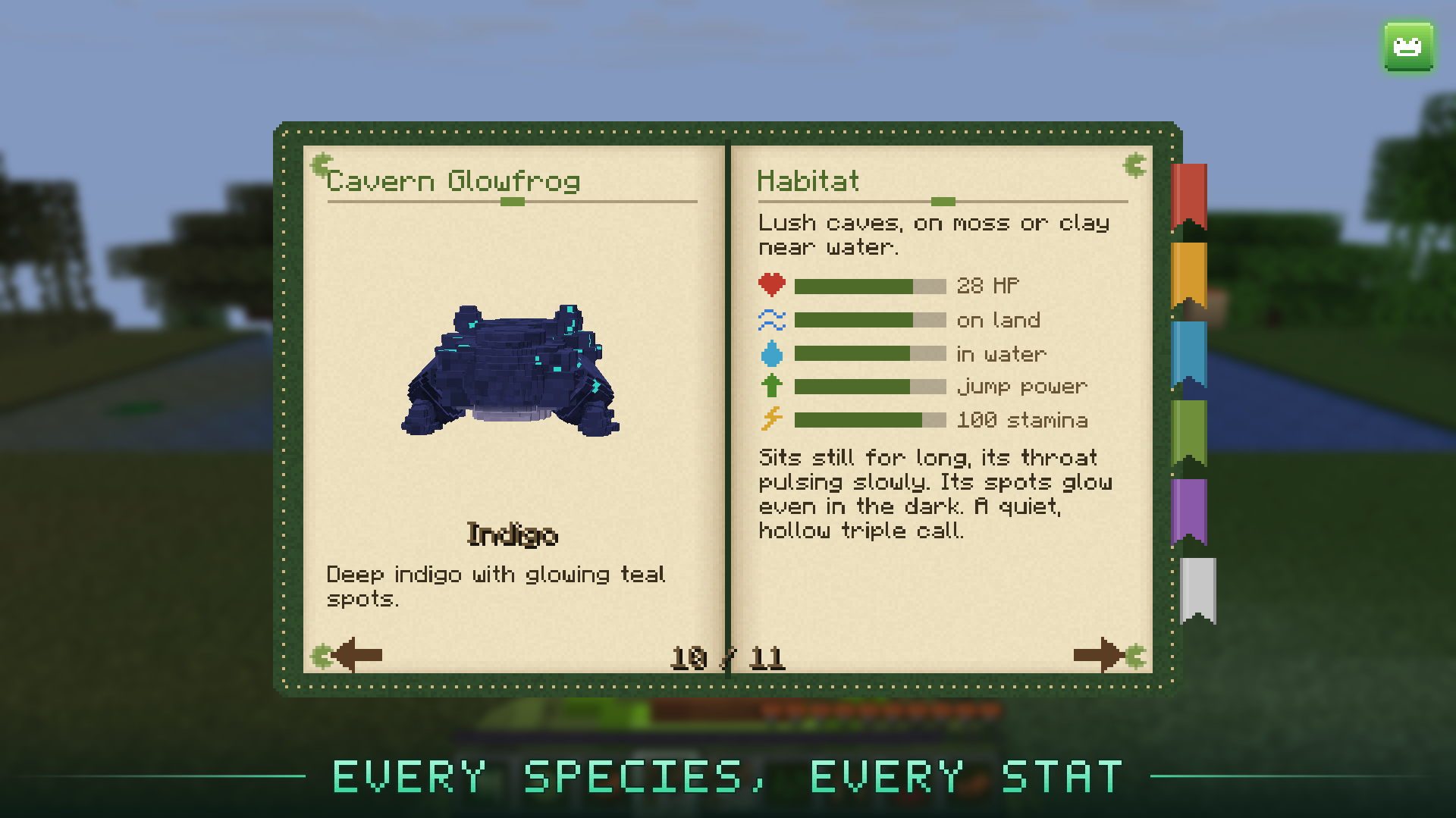
See your first giant frog and a field guide lands in your inventory. Not a wall of text in a vanilla book: a leather-bound guide with parchment pages, ribbons to jump between chapters, recipes, and live frogs turning slowly on the page. Each species gets its own spread with its colour variants, its habitat, its strengths and a set of stat bars – but only once you have seen it with your own eyes. Until then: a question mark and a hint where to look.
Seven advancements in their own tab go with it, from From the Bank to Six Voices and Little Big Frog.
Where they live, and how many
Giant frogs settle when new land is generated, in small groups at banks and pools that suit them – never on leaves, never next to lava, always with room for their body. Later they only trickle in, and only where there are few of them: at most three wild giant frogs within 64 blocks, and one of each rare species.
Built to stay smooth
A giant frog is a detailed model. Beyond 48 blocks it switches to a simplified one with a fifth of the cubes – animations, saddle, blanket and glow keep working. Zoom in and the full detail comes back, because the switch follows how big the frog is on your screen, not just the distance.
Settings
Server settings, also editable in the mod list: breeding on or off, how long parents rest, whether offspring are reserved for the breeder, how often frogs call and how loud.
Requirements
- Minecraft 26.2, NeoForge 26.2.0.88 or newer
- GeckoLib 5.5.6 for NeoForge 26.2
- Needed on both server and client
Coming later
Own young-frog models for every species, own calls for each species instead of deep-tuned frog sounds, and sharing your frog's bags and saddle with friends. Tell me in the comments what you want next.
| Minecraft | Forge | NeoForge | Fabric |
|---|---|---|---|
| 1.20.1 | soon | – | soon |
| 1.21.1 | soon | soon | soon |
| 26.1 | – | soon | soon |
| 26.2 | – | ✔ | soon |
| 26.3 | – | soon (beta) | soon |
All Rights Reserved. Models, textures and animations are original work. GeckoLib is not bundled and keeps its own licence.
Absolute Frogs Team