LanguageMarker
- By
Adds language flags to chat and tooltips so you can quickly identify what language other players speak.

ChatFlag.png
MarkMenu.png
Description
LanguageMarker
LanguageMarker adds language flags to player chat messages, tooltips, and Looking for Group results, helping you quickly identify which language may be most suitable for communication.
Players can be marked manually, detected from language-specific chat patterns, learned from other LanguageMarker users, or assigned through guild-language rules. Language assignments are stored persistently, so known players remain recognizable when you encounter them again.
Supported languages
- German
- Spanish
- French
- Russian
The addon interface is localized for English, German, Spanish, French, and Russian WoW clients.
Features
- Display language flags in channel, guild, party, raid, instance, say, and yell chat
- Display flags and language names in player tooltips
- Display known group leaders’ flags in Looking for Group results
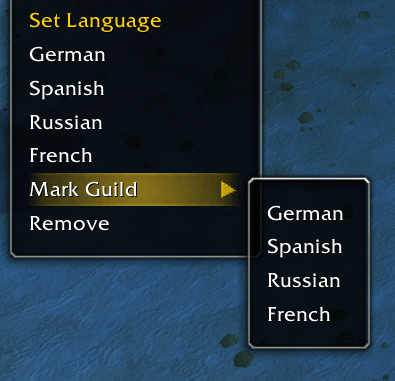
- Assign, change, or remove player languages through the right-click context menu
- Add and manage players directly from the addon settings
- Search known players by partial player name or realm
- Detect languages automatically from chat keywords and writing patterns
- Add custom detection keywords for every supported language
- Recognize selected localized Questie announcements
- Detect languages from guild names
- Detect a hunter’s language from localized pet names
- Synchronize known language entries through guild, party, raid, and instance addon channels
- Share your selected language with nearby LanguageMarker users
- Assign languages to entire guilds
- Apply saved guild assignments when previously unknown members are encountered
- Store player-language and guild-language assignments persistently
- Provide focused detection, synchronization, tooltip, and database diagnostics through
/lmdebug
Automatic language detection
LanguageMarker checks messages from public channels, parties, raids, and instance groups for recognizable language signals.
Detection uses:
- Built-in language-specific keywords
- Custom keywords added by the user
- Selected localized Questie announcements
- Cyrillic writing
- The Spanish
ñ - Localized guild names
- Localized hunter pet names
Weighted matching, standalone-word checks, and tie handling help reduce ambiguous matches and common substring false positives.
The built-in keyword lists remain active at all times. Custom keywords extend these lists instead of replacing them.
Automatic detection only assigns a language to players who do not already have one. Existing manual, synchronized, or guild-derived assignments are not overwritten.
Guild-name and pet-name detection are enabled by default and can be disabled separately in the addon settings. Pet-name detection applies the detected language to the identified hunter owner, not to the pet itself.
Detection feedback and diagnostics
Normal automatic-marking notices remain short and unobtrusive.
When /lmdebug is enabled, detections from chat additionally show:
- The chat source or channel
- The exact WoW chat event
- The message that triggered the detection
LanguageMarker processes supported chat events independently of which chat tab is currently visible. These diagnostics can therefore help identify detections caused by messages shown only in background chat tabs.
Synchronization
LanguageMarker users can exchange known language entries through:
- Guilds
- Parties
- Raids
- Instance groups
Received synchronization data only adds previously unknown players. Existing local assignments are never overwritten.
When another LanguageMarker user is encountered, the addon can request that player’s selected language directly. Your own language can be selected manually or determined automatically from your WoW client language.
Guild and group synchronization are enabled by default and can be configured separately.
Guild assignments
A language can be assigned to an entire guild through a player’s context menu or managed directly in the addon settings.
Known guild members can be marked in bulk. Saved guild assignments are also applied automatically when previously unknown members are encountered.
Existing player assignments are preserved instead of being continually overwritten by the guild rule. Cross-faction guild assignments can be stored even when a normal WHO lookup is unavailable.
Persistent language memory
Player-language and guild-language assignments are stored between sessions.
The known-player settings page supports live filtering by partial player name or realm, making large language databases easier to manage. Pressing Escape clears the search and restores the complete list.
Automatic deletion of older player-language records is currently paused, so previously learned assignments are retained. /lmdebug records can be used to display database and cache statistics.
Display options
Language flags can be configured separately for:
- Chat messages
- Player tooltips
- Guild chat
- Looking for Group results
The guild-chat display setting is stored per character. Other language data and general settings are shared across the account.
Commands
/lmor/languagemarker— open the addon settings/lmdebug— view or toggle performance diagnostics/lmdebug test— run the built-in automatic-detection tests/lmdebug records— display stored-record statistics/lmdebug tooltip— trace tooltip processing/lmdebug sync— trace synchronization activity
Important
LanguageMarker is not a translation addon.
It does not translate messages and cannot determine with certainty which languages a player speaks. Manual assignments and automatic detections should be understood as practical language hints.
Its purpose is to answer one simple question as quickly as possible:
“Which language should we probably use here?”
The LanguageMarker Team