Wasteland-NewLife
- By
Can you survive in a wasteland world with the lack of resources and food, works with Create Power Grid and is the part of the NecroSteam Projekt
Screenshot_3.png
Screenshot_1.png
Description
Wasteland Revamp
Wasteland Revamp is a modern reconstruction and expansion of the classic Wasteland experience for Minecraft 1.21.1 using NeoForge.
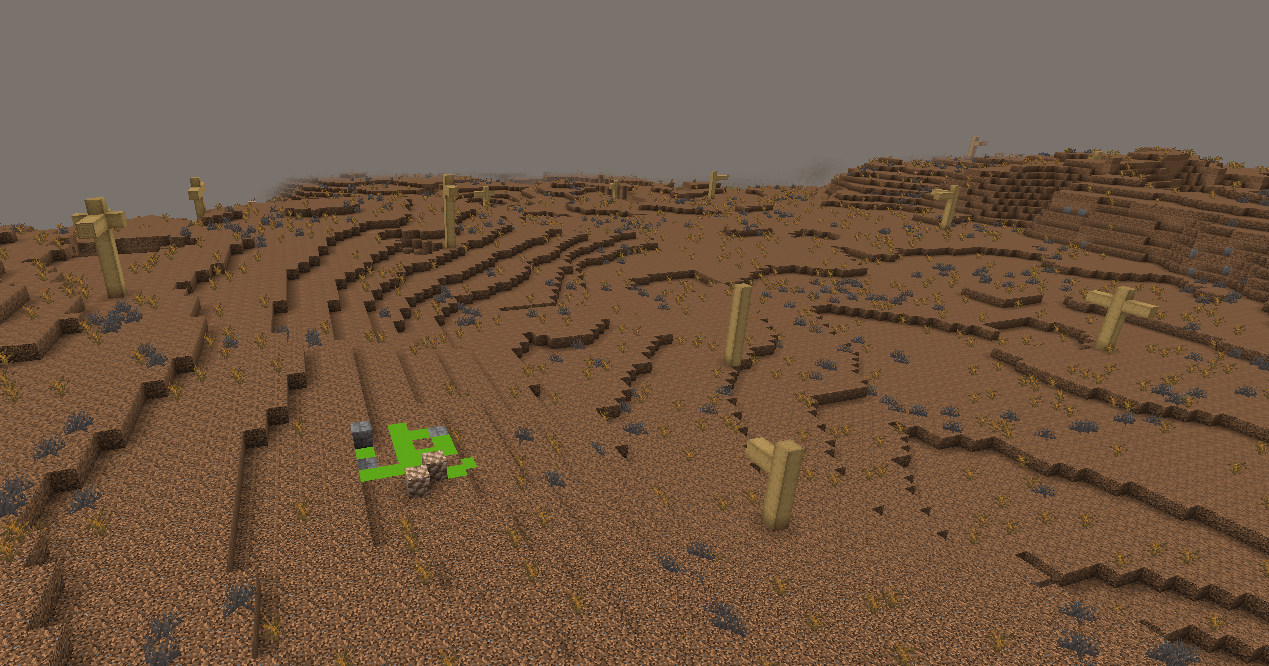
The mod transforms the Overworld into a harsh post-apocalyptic environment filled with connected survivor settlements, abandoned roads, broken electrical infrastructure, radioactive contamination, scarce supplies, and the remains of a collapsed civilization.
This is not simply an empty world covered with random debris. Wasteland Revamp generates a structured landscape where roads have destinations, settlements form meaningful infrastructure nodes, and the ruins of the old world follow a consistent environmental logic.
Wasteland World Preset
The mod adds a dedicated Wasteland world preset to the Create World screen.
For dedicated servers, use:
level-type=wastelands:wasteland
Creating a new world is strongly recommended. Existing chunks will not be regenerated, so new terrain features will only appear in previously unexplored areas.
Five Post-Apocalyptic Regions
The world uses Minecraft 1.21.1’s modern multi-noise biome system and contains five distinct regions:
- Apocalyptic Wasteland — the central devastated landscape.
- Wasteland Desert — dry, exposed terrain with extremely rare oases.
- Dead Forest — lifeless woodland filled with dead trees and abandoned remains.
- Wasteland Mountains — elevated, hostile terrain with damaged infrastructure.
- Ruined City — heavily contaminated urban remains containing valuable salvage.
Each region has its own terrain character, environmental hazards, decorations, and radiation level.
Seed-Driven Road Network
Settlements are not placed randomly and roads do not terminate in meaningless locations.
Wasteland Revamp generates a deterministic infrastructure network based on the world seed:
- every large world cell contains a settlement node;
- neighbouring settlements are connected;
- the complete network remains continuous across the world;
- road paths are curved using multi-scale Perlin noise;
- major highways and secondary roads have different profiles;
- roads lead toward actual generated settlements;
- roadside objects follow the road direction;
- debris is concentrated around inhabited and abandoned locations instead of covering the entire landscape.
The same world seed always produces the same settlements and road network.
More Realistic Roads
Road generation includes:
- damaged asphalt;
- faded centre markings;
- worn edge markings;
- gravel shoulders;
- dirt embankments;
- shallow roadside drainage;
- potholes and repaired sections;
- terrain cuttings;
- raised road foundations;
- smoother curves;
- controlled road slopes;
- different widths for highways and local roads.
Roads are designed to follow the landscape rather than simply painting flat lines across the surface.
Roads Do Not Generate Inside Water
Normal road surfaces never replace water or other fluids.
When a route encounters water, the generator attempts to:
- shift the road onto nearby dry terrain;
- find a valid dry corridor;
- build a bridge over a narrow river;
- reject the crossing if the body of water is too wide.
Bridges use a separate generation mode with:
- elevated stone decking;
- road markings;
- damaged iron guardrails;
- structural supports extending toward solid ground.
Lava and other unsafe fluids are never crossed by ordinary bridges.
Survivor Settlements
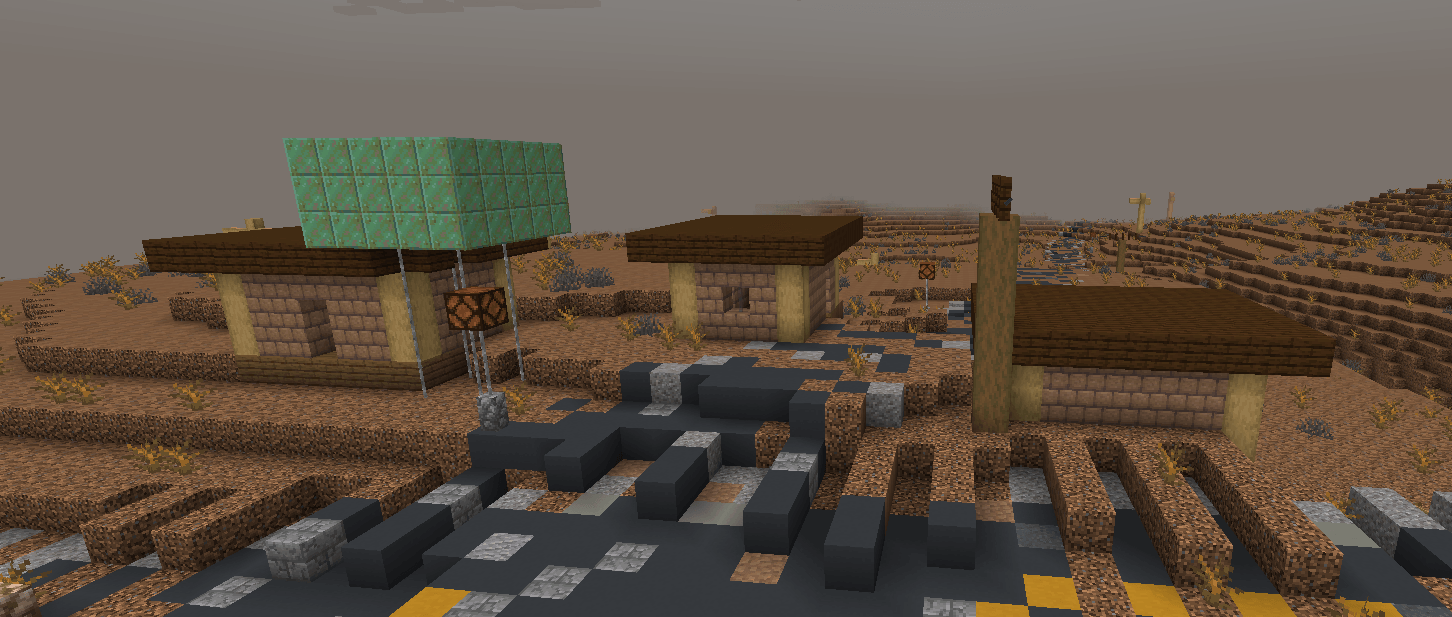
Roads connect procedurally generated survivor settlements containing:
- residential buildings;
- central road junctions;
- small town squares;
- storage containers;
- salvage supplies;
- crafting stations;
- water towers;
- road signs;
- broken streetlights;
- damaged power infrastructure;
- small survivor populations.
These locations are not isolated decorative ruins. They form part of the world’s infrastructure network and can be reached by following the roads.
Abandoned Infrastructure
Along roads and inside settlements, players can discover:
- destination signs;
- settlement names;
- offline power warnings;
- non-functional streetlights;
- leaning utility poles;
- broken electrical lines;
- hanging cables;
- abandoned water towers;
- damaged road junctions;
- local salvage piles;
- collapsed industrial structures.
The power grid is permanently offline. Streetlights and transmission lines remain only as evidence of the civilization that once occupied the world.
No Netherrack or Eternal Surface Fires
The old approach of scattering netherrack and permanent fire across the surface has been removed.
Wasteland Revamp does not generate:
- random netherrack fields;
- eternal fire patches;
- Nether-themed surface destruction;
- endless debris in every chunk.
The post-apocalyptic atmosphere is based on ruined human infrastructure, environmental damage, abandonment, and contamination.
Radiation System
Players accumulate persistent radiation while exploring hazardous areas.
Radiation is stored using NeoForge Data Attachments and persists:
- after leaving the world;
- between sessions;
- after player death;
- while travelling between regions.
Radiation increases when:
- exposed to the sky in dangerous Wasteland regions;
- exploring the Ruined City;
- entering heavily contaminated areas;
- standing near radioactive waste;
- directly touching radioactive materials.
Radiation slowly decreases while sheltered underground or outside hazardous Wasteland regions.
A full set of leather armour provides limited improvised protection.
Radiation Effects
| Radiation Level | Effect |
|---|---|
| 25+ | Weakness |
| 50+ | Slowness |
| 70+ | Hunger |
| 90+ | Poison |
Creative and Spectator players are exempt from environmental radiation.
New Survival Items
Geiger Counter
A handheld radiation detector that reports:
- current player radiation;
- nearby environmental danger;
- contaminated blocks in the surrounding area.
Rad-Away
A medical injector that removes a significant amount of accumulated radiation.
Purified Water
Clean drinking water that restores food and removes a small amount of radiation.
Canned Survival Ration
A durable, high-value food source intended for long-distance exploration.
Filter Canister
An industrial filtration component used in radiation-related crafting.
Scrap Metal
A reusable salvage material found in settlements, damaged infrastructure, containers, and scrap piles.
New Blocks
- Scrap Pile — a recoverable source of metal and industrial salvage.
- Radioactive Waste — a hazardous block that causes radiation exposure.
These blocks also appear naturally in appropriate locations throughout the Wasteland.
Original Item Textures
The main survival items use dedicated original pixel-art textures:
- Geiger Counter;
- Rad-Away;
- Purified Water;
- Canned Survival Ration;
- Filter Canister;
- Scrap Metal.
These items no longer reuse temporary vanilla icons.
Starter Bunker
The first player entering a new Wasteland world can receive a protected underground starter bunker.
The bunker may contain:
- a secure spawn position;
- a bed;
- basic supplies;
- storage;
- initial survival equipment;
- protection from the exposed surface.
The bunker location is stored persistently with the world.
Commands
/wasteland status
Displays:
- whether the Wasteland preset is active;
- the current biome;
- starter bunker coordinates;
- current radiation level.
/wasteland bunker
Teleports an administrator to the starter bunker.
/wasteland radiation get
/wasteland radiation clear
/wasteland radiation set <0..100>
/wasteland radiation add <-100..100>
Administrative commands require permission level 2.
Configuration
The mod creates:
config/wastelands-common.toml
Configurable options include:
- settlement spacing;
- road network generation;
- road width;
- road curvature;
- road slope limits;
- shoulder width;
- water avoidance distance;
- bridge generation;
- maximum bridge length;
- streetlight spacing;
- utility pole spacing;
- road signs;
- survivor spawning;
- oasis rarity;
- dead-tree rarity;
- radioactive-site rarity;
- radiation intensity;
- radiation recovery;
- starter bunker behaviour.
Requirements
- Minecraft: 1.21.1
- Mod Loader: NeoForge
- NeoForge: 21.1.235 or compatible 21.1 build
- Java: 21
Forge and Fabric are not supported.
Installation
- Install NeoForge for Minecraft 1.21.1.
- Place the Wasteland Revamp JAR inside:
.minecraft/mods
- Start Minecraft.
- Create a new world.
- Select the Wasteland world preset.
The mod must be installed on both the client and server.
Dedicated Server Setup
Add the mod to the server’s mods directory and configure:
level-type=wastelands:wasteland
Delete or rename the existing world before starting the server if it was previously generated with another world type.
Stability Fixes
The current version fixes a server-thread deadlock caused by updating generated road signs while their chunks were still entering the fully loaded state.
That issue could cause the world simulation to stop while the client continued rendering.
Symptoms included:
- items refusing to drop;
- spawn eggs apparently doing nothing;
- mobs freezing;
- entity AI stopping;
- redstone no longer updating;
- game time no longer advancing.
Road signs are now processed through a bounded post-load queue after the surrounding chunks are fully available.
Follow the broken highways, discover isolated settlements, restore supplies from the ruins, and survive in a world where civilization is gone—but its roads still remember where it once led.
The Wasteland-NewLife Team