The Missing Link
- By
The Missing Link is a customizable, frequency-based Minecraft portal system built around flexible construction, persistent world data, server-authoritative configuration, and animated, color-customizable visuals.
# The Missing Link — Technical Overview and System Architecture
## Overview
The Missing Link is a Minecraft portal mod built around a frequency-based linking system. It provides customizable, persistent teleportation across dimensions and enormous coordinate distances while maintaining server-authoritative configuration and world-save persistence.
Rather than relying on fixed destination coordinates or vanilla portal mechanics, the mod allows authorized players to configure named frequencies that connect pairs of portals. Each portal's destination is resolved through a centralized registry, while the server validates configuration changes and the world save preserves established connections.
The architecture combines flexible frame construction, dynamic content loading, animated transparent portal rendering, 24-bit RGB color customization, persistent configuration, and controlled administrative access. It is designed to operate in singleplayer, LAN multiplayer, and dedicated-server environments.
## 1. Frequency-Based Portal Architecture
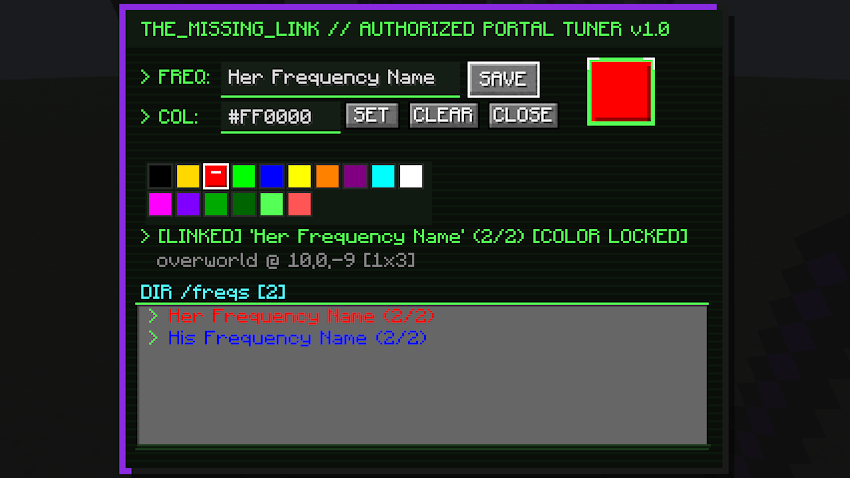
At the core of The Missing Link is a frequency-based portal registry. Players can assign a custom name to a frequency, making connections identifiable by their intended purpose rather than by destination coordinates or arbitrary identifiers.
Each frequency supports a maximum of two portals. When a second portal joins an existing frequency with a matching color, the connection becomes active and both portal surfaces illuminate. The registry resolves the destination using the frequency and its stored portal data rather than requiring each portal block to maintain a hardcoded destination.
The system supports portals across Minecraft dimensions and at extreme coordinate distances. Testing has demonstrated reliable linking across distances of up to 58 million blocks.
### Portal Frame Geometry
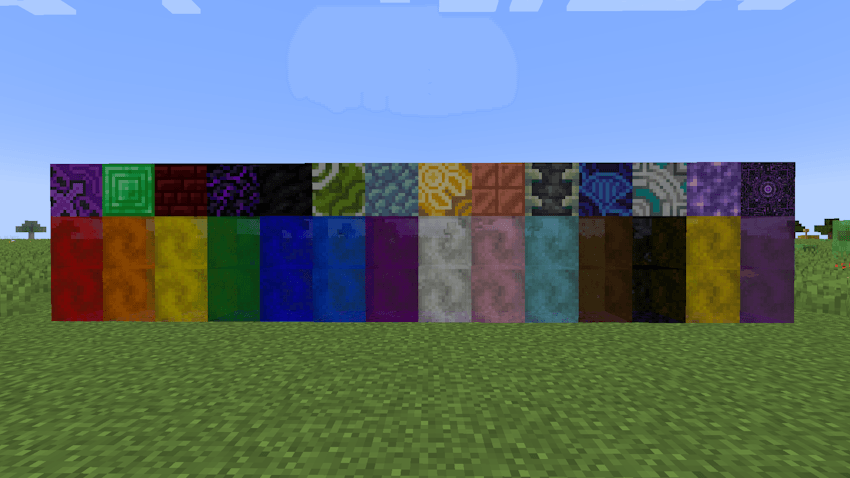
The current portal design uses a frame measuring 1 block wide and 4 blocks tall, with two air blocks in the middle forming the passage. This narrow profile allows portals to be placed directly beside one another, including configurations in which adjacent portals share boundaries. Each portal can maintain its own frequency and color, allowing dense arrangements without requiring gaps between every portal.
The exit-positioning logic accounts for the destination opening's geometry and the surrounding environment. Players arrive centered within the opening, with their exit orientation determined by the portal's surroundings and the available exit space. This provides predictable positioning without arbitrarily placing players against a wall.
## 2. Flexible Frame Construction and Dynamic Creative Tab
The Missing Link does not require one prescribed frame material. Instead, it supports a configurable collection of valid frame blocks, including mixed materials within a single frame and across the two portals of a connection.
Dedicated validation logic excludes unsuitable blocks, such as air, liquids, and prohibited portal-related blocks, while permitting eligible building materials. Modded blocks can also be supported through the configurable palette.
The system reads block definitions from "config/themissinglink/palette.json". This configuration populates a dedicated Creative Tab containing 250+ valid built-in frame-block options, with additional modded blocks available when configured and supported. Because the palette is data-driven, administrators can expand or restrict the available selection without requiring a separate item registration for every block.
The dynamic Creative Tab bridges the configuration file and Minecraft's registered block content, keeping available construction materials searchable and organized while reducing maintenance overhead.
### Palette Configuration and Live Reloading
**Singleplayer:** Add the desired modded block identifiers to "config/themissinglink/palette.json", then run "/missinglink loadpalette" to reload the palette and update the available frame-block selection.
**Dedicated server:** Edit the server's "config/themissinglink/palette.json" while the server is running, then execute "/missinglink loadpalette". The server reloads the configuration and broadcasts the updated palette to connected players without requiring a server restart or client relog.
The server's palette is authoritative for connected clients, eliminating the requirement for each client to maintain an identical local palette file. Actual frame validation must also respect the server's allowed-block configuration.
## 3. Portal Colors and Animated Rendering
The Missing Link supports the complete 24-bit RGB color range, from "#000000" through "#FFFFFF", providing 16,777,216 possible colors.
Its graphical interface combines a color picker, preset selections, and hexadecimal color input. This allows players to choose exact colors rather than being restricted to a small predefined palette. True black ("#000000") is a valid selection, as is pure white and every representable RGB color between them.
Supporting black required correcting a sentinel-value collision in which the integer zero represented both black and the absence of a selected color. The implementation now distinguishes valid color values from missing data through explicit validity or presence checks rather than assuming that a nonzero integer indicates a selection.
Color state passes through the configuration and synchronization pipeline, including remembered GUI selections, network messages, "PortalRegistry", portal block entities, and client-side tinting. Both ends of a linked frequency can consequently display the same selected color, with established portal colors preserved through the relevant save and reload operations.
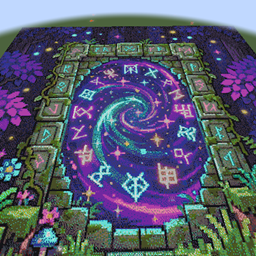
The visual effect combines animated swirling textures with transparency, allowing the selected RGB color to show through the moving portal surface. This separates the portal's visual identity from its underlying connection logic and provides extensive visual customization without requiring separate textures for every color.
## 4. Portal Animation and Collision Behavior
Visual rendering and teleportation behavior are handled as separate concerns. The animated surface provides the wormhole effect, while dedicated entry-detection and travel logic determine when transportation occurs.
The entry-detection logic was refined to prevent players from being transported merely because they walk near a portal or pass alongside its frame. Instead, teleportation depends on entering the portal's actual occupied area under the movement conditions defined by the mod.
This distinction improves usability in confined spaces and allows players to stand beside a portal without being unintentionally transported. The exit logic accounts for the destination opening and checks the available space for a safe player position. Exit orientation is determined by the surrounding geometry, allowing wall placement to influence which direction the player faces after arrival.
## 5. Authorized Portal Tuner and OP Level 4 Security
Portal configuration is controlled through a dedicated item: the **Authorized Portal Tuner**.
The tuner grants authorized users access to portal-management operations, including configuring frequencies, changing colors, and clearing connections. Ordinary players can travel through established portals without possessing the tuner. This separates the authority to manage a portal network from the ability to use it.
Sensitive configuration changes are enforced on the server. Server-side authorization checks determine whether a requesting player possesses the required item or qualifies for an explicitly implemented administrative bypass. The system does not rely solely on a client-side GUI lock or on hiding controls from unauthorized players.
Requests involving frequency changes, clearing connections, and color changes are validated before the server permits the corresponding operations. Unauthorized requests are rejected, and the player receives an explanatory message indicating that an Authorized Portal Tuner is required.
This server-side validation is essential in multiplayer environments because a modified or untrusted client must not be able to change portal configuration simply by sending a network message directly.
## 6. Administrative Tuner Distribution and Command Protection
The mod provides a dedicated administrative command for distributing the Authorized Portal Tuner:
"/missinglink givetuner <playername>"
This command requires operator permission level 4 (OP4), restricting the intended distribution mechanism to appropriately privileged administrators.
The command gives the tuner to the selected player's inventory, with inventory-capacity handling designed to prevent the item from being silently discarded when the inventory is full.
The mod also includes a "GiveCommandBlocker", which intercepts attempts to use Minecraft's ordinary "/give" command to obtain the protected tuner without the required operator permissions. Unauthorized attempts are canceled and receive an explanatory refusal message.
This blocker serves as an additional command-level restriction and usability safeguard. The actual security boundary remains the server-side authorization checks on portal configuration. Restricting item distribution and validating sensitive operations are complementary protections: one controls the intended method of obtaining the tuner, while the other prevents unauthorized configuration changes even when a client attempts to bypass the normal interface.
## 7. Persistent GUI State and Configuration Workflow
The tuner interface supports frequency entry, color selection, hexadecimal input, and portal-management actions. Its remembered state is designed to reduce repetitive configuration when establishing or editing a portal connection.
The GUI can retain the selected color between configuration screens, allowing users to reuse a color when configuring both ends of a pairing. This remembered selection is distinct from the authoritative state of an established connection: the GUI provides a convenient configuration experience, while the server and world-save registry determine the actual linked frequency and its properties.
The persistence logic also accounts for valid zero-valued colors. Rather than treating a nonzero integer as proof that a selection exists, it checks whether stored color data is present and valid. This prevents true black from being mistaken for missing information and replaced by the default purple.
Together, these behaviors support a more consistent configuration workflow while preserving the distinction between client-side convenience and server-authoritative portal state.
## 8. World-Save Persistence and Networking
Portal connections are maintained through "PortalRegistry", implemented using Minecraft's "SavedData" architecture. The registry stores authoritative frequency and portal-location information in the world save rather than relying exclusively on transient client memory or local GUI state.
The registry is stored through the Overworld's data storage, making it available as shared world-level data even when players are in other dimensions. Portal connections can survive server restarts and world reloads, and copying the relevant world save preserves its associated portal network, provided the receiving environment has the required mod installed.
Client interfaces submit configuration requests through the mod's networking layer. Server-side handlers validate those requests and update authoritative data, after which the relevant state is synchronized to clients through the mod's networking and block-entity update mechanisms.
This division of responsibilities is fundamental to multiplayer reliability: clients provide input and render the resulting state, but the server determines whether configuration changes are valid and what the actual portal connection should be.
Testing in LAN and dedicated-server environments has verified important aspects of this architecture, including persistence across reloads, cross-dimension operation, world-save portability, and portal connections separated by up to 58 million blocks. These tests demonstrate that the portal network is associated with the world save rather than being dependent on a particular client session.
## 9. Determinism and World Agnosticism
The Missing Link emphasizes predictable behavior and separation of responsibilities. Its centralized frequency registry represents portal connections consistently, rather than requiring every portal block to independently invent or maintain its own destination.
Given the same valid registry state and the same relevant player-entry conditions, the travel system resolves connections through defined rules. This is the practical meaning of determinism in the architecture: behavior is governed by explicit frequency data, validated configuration, and established travel logic rather than arbitrary client-side assumptions.
World agnosticism means the system is designed to function across dimensions and server environments without depending on vanilla destination-based portal mechanics. It does not mean that different Minecraft worlds share one global registry. Each world maintains its own authoritative portal state.
The combination of world-save persistence, server-side validation, centralized registry data, and defined travel behavior provides the foundation for consistent operation in singleplayer, LAN multiplayer, and dedicated-server deployments.
## 10. Performance, Extensibility, and Design Philosophy
The Missing Link is designed to remain extensible without sacrificing tested behavior.
- **Configurable frame construction:** Administrators can control the allowed frame blocks through a data-driven palette.
- **Dynamic content presentation:** The dedicated Creative Tab reflects the configured collection of valid frame blocks.
- **Extensive visual customization:** The 24-bit RGB system supports 16,777,216 colors through hexadecimal input and color-picker controls.
- **Persistent portal networks:** The centralized registry stores connections with the world save.
- **Controlled configuration:** The Authorized Portal Tuner and server-side validation protect sensitive management operations.
- **Guest-friendly travel:** Players can use established connections without being granted configuration privileges.
- **Multiplayer synchronization:** Server-authoritative data is synchronized to clients instead of treating local display state as the source of truth.
- **Predictable travel:** Defined entry conditions, destination geometry, and exit-positioning logic reduce accidental activation and inconsistent arrival behavior.
These design choices separate rendering, frame validation, configuration, persistence, networking, travel, and authorization into distinct responsibilities. The result is a modular portal system that supports creative freedom without sacrificing administrative control or predictable operation.
## Conclusion
The Missing Link is a customizable, frequency-based Minecraft portal system built around flexible construction, persistent world data, server-authoritative configuration, and animated, color-customizable visuals.
Its dynamic Creative Tab provides access to more than 250 valid built-in frame-block options, with additional modded blocks supported through a configurable palette. Its 24-bit RGB color system offers 16,777,216 possible colors, from true black to pure white. Its narrow portal geometry allows portals to be placed directly beside one another, creating dense, colorful arrangements without requiring gaps between every opening.
The Authorized Portal Tuner, OP4 distribution command, command interception, and server-side authorization checks provide a controlled model for portal management while allowing ordinary players to travel through established connections. The centralized world-save registry preserves portal relationships, and the networking architecture supports multiplayer operation without treating the client as authoritative.
Together, these features make The Missing Link more than a simple teleportation effect. It is an extensible portal infrastructure system designed to combine creative freedom, predictable behavior, persistent connections, administrative control, and a distinctive animated visual experience.
## Commands Reference
| Command | Purpose |
|---|---|
| "/missinglink givetuner <playername>" | Gives the Authorized Portal Tuner to the specified player; requires OP4. |
| "/missinglink givetuner" | Gives the Authorized Portal Tuner to the command user; requires OP4. |
| "/missinglink loadpalette" | Reloads "config/themissinglink/palette.json" and broadcasts the updated palette to all connected players on dedicated servers. |
| Singleplayer/LAN must reload the client to update Creative Tab with this command. |
| "/missinglink palette" | Lists the currently allowed frame blocks in the game chat. |
The Missing Link Team