SVR Quests
- By
SVR Quests brings story-driven adventures to Minecraft with custom quests, NPC interactions, dialogue, and quest tracking. Build connected objectives and guide players through your world with a customizable quest HUD.
2026-10-03_03.09.49.png
Description
SVR Quests
SVR Quests adds a quest journal, branching conversations, and custom NPCs to Minecraft, with an in-game editor for building your own content. It is made for modpacks, adventure maps, and servers that want quests tied to the world: a villager who needs supplies, a character waiting at the end of a road, or a conversation that changes after you finish a job.
The mod includes talking villagers and repeatable errands to get started. Your own story quests, characters, and chapters can be created in the editor or supplied through datapacks.
A journal for the journey
The quest journal uses a two-page book layout, with chapters and quests on the left and descriptions, objectives, and rewards on the right. Check active, completed, and failed quests, accept quests that allow it, track an objective, and claim rewards from the same place.
A HUD tracker keeps your current objectives visible while you play. World markers show where to go, how far away it is, and which direction to turn when a destination is off-screen. Markers can also follow moving characters.
Move and resize the tracker and dialogue box to fit your HUD. Choose Book, Slate, or Parchment styling, or adjust colours, opacity, and background textures yourself. These settings are personal to each player.
Quests with room for a story
A quest can be a single task or a sequence of stages, each with its own description, objectives, actions, and rewards. Prerequisites and chapter conditions control what opens next; exclusive branches let a decision close off another path. Repeatable and daily quests support recurring jobs, while optional time limits, failure conditions, and penalties give a task consequences.
Objectives cover collecting or handing in items, defeating creatures, reaching locations, speaking to characters, reaching a dialogue entry, earning advancements, using items, and pressing a bound control. Combat and statistic objectives can track damage dealt or taken, critical hits, and actions such as mining or crafting. Custom triggers let commands and other content advance a quest too.
Rewards can include items, experience, loot-table drops, or commands. Item and experience amounts can be fixed or randomized, and choice rewards let the player pick what they want.
Characters that remember your progress
Conversations support multiple lines, branching replies, and conditions that decide which choices appear. A reply can start a quest, choose a story branch, hand over items, claim a quest reward, play a sound, or open another conversation.
An NPC can greet a player differently before, during, and after a quest. Conversations can also start automatically when their conditions are met, without needing a character to click.
Custom NPCs can look like a player, another creature, or a block. Configure their skin, size, equipment, behaviour, and placement, with an appearance preview in the editor. Characters can follow players, including only while a particular quest is active.
Dialogue presentation includes portraits and adjustable typewriter text, alongside the movable dialogue box.
Give villagers something to say
The included villager datapack adds greetings, small talk, trading through dialogue, and daily errands. Villagers can ask for supplies or help dealing with creatures, with jobs matched to their profession. Finish an errand to receive its reward and improve that villager's opinion of you.
Pack authors can replace the conversations, add errands, or define speaker rules for other creatures. Appearance rules can give matching creatures different looks, including weighted variants. The built-in villager content can be disabled if your pack uses its own setup.
Build it in-game
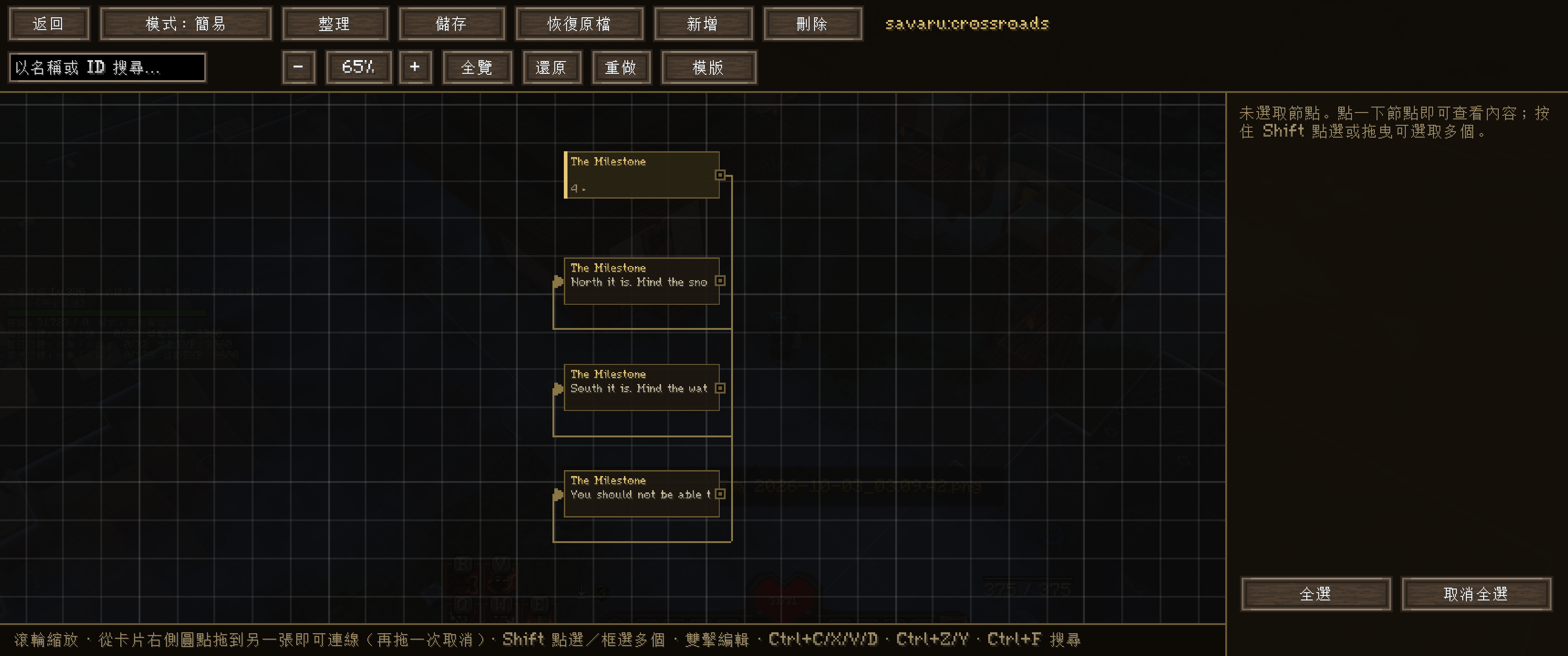
Open the editor from the quest journal to work with quest graphs and conversations. Drag nodes to arrange them, link their connections, and double-click to edit. Search, zoom, automatic layout, multiple selection, copy and paste, undo and redo, and templates help when a graph grows.
The editor also manages NPCs, chapters, speaker rules, appearances, and errands. Simple forms cover common settings; Advanced mode exposes the underlying JSON. Pick supported entities and positions directly from the world, preview NPC appearances, and reset or complete your own quest progress while testing.
Content is stored as JSON and can be distributed with a modpack or datapack. Editor changes can be shared across worlds or kept in one world's datapack, and files can be reloaded without restarting the game. Editing requires operator permissions on servers.
Optional integrations and requirements
With the corresponding mods installed, quests can use Savaru Growthology levels, Savaru Worldology levels and tiers, Savaru Dungeonology completions, and Savaru Affixology gear objectives.
An optional RPG Dialogue importer can bring existing conversations into SVR Quests. It is disabled by default, and imported content may need editing where the formats differ. RPG Dialogue is not required for the quest, NPC, or dialogue system.
Minecraft 1.21.1 · Fabric · Fabric API · Java 21
Install SVR Quests on both the server and clients for multiplayer. English and Traditional Chinese interface translations are included.
SVR Quests Team