Cinemarr
- By
Server-authoritative Plex movie and TV playback on synchronized player-built Minecraft screens.
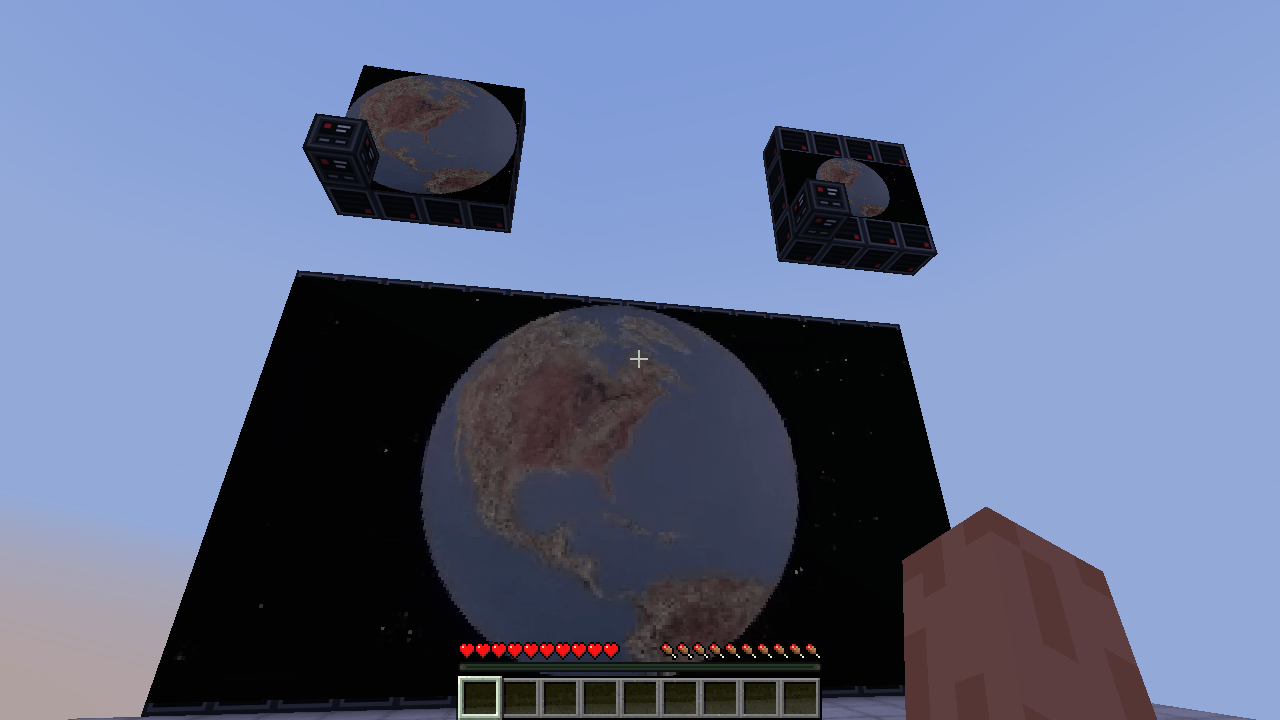
A shared playback timeline across screens of different sizes and shapes.
Description
Cinemarr
Cinemarr brings server-authoritative Plex movie and TV playback to player-built Minecraft screens. The Minecraft server owns the Plex connection, library policy, transcodes, shared playback timeline, and bounded media relay. Clients decode each visible TV stream once and render it across that screen.
Features
- Build screens from ordinary Screen Pixel blocks in arbitrary four-connected planar shapes, including rectangles, holes, notches, and unusual aspect ratios.
- Use progressively crafted Quick TV Kits from 144p through 8K to construct bounded 16:9 prefabs.
- Browse operator-approved Plex movie and TV libraries from a TV Controller.
- Share one synchronized watch-party timeline across tuned televisions; each active TV uses its own stream slot, shared by its viewers.
- Set each TV to Fit, Fill or Stretch; choose Detailed or One pixel per block mapping; and request Auto, preset or custom stream quality. Requested quality is limited by the source, server settings and picture-memory budget.
- Select audio and subtitle tracks, seek, pause, skip, queue media, and control playback with the TV Remote or a redstone receiver.
- Hear synchronized positional audio from the nearest point on the screen.
- Keep Plex credentials and URLs on the server; clients receive only authenticated, bounded media segments.
Requirements and privacy
Cinemarr must be installed on both the Minecraft server and every joining client. A Plex Media Server is required for playback. The Plex URL and token remain server-side, preferably through CINEMARR_PLEX_TOKEN; clients never receive either credential. Server operators explicitly allow each visible Plex library, and no library is exposed by default.
Cinemarr is a standalone sibling of Jammarr and does not require Jammarr at runtime.
Fabric and Quilt installations require Fabric API. Fabric Loader must be 0.19.2 or newer. Mod Menu is optional. Quilt uses the corresponding Fabric JAR.
Use matching Minecraft versions and loaders on the server and clients. Protocol 11 is incompatible with protocol 10; cross-version and cross-loader networking are unsupported.
Quick TV kits support presets through 8K, but this does not guarantee an 8K stream. Bounded construction is the default. Literal construction is limited to 65,536 screen pixels.
Supported releases
Cinemarr 1.0.0 provides 16 artifacts covering 21 tested runtime profiles:
- Forge 1.7.10
- Fabric, Quilt, Forge, and NeoForge for 1.20.1, 1.20.2, 1.21.1, 26.1.2, and 26.2
Java requirements: 8 for 1.7.10; 17 for 1.20.1/1.20.2; 21 for 1.21.1; 25 for 26.1.2/26.2. Packaged native targets are Linux x86-64, Linux ARM64 and Windows x86-64.
The September 25 release uses the verified 16-artifact set from source commit 3ad77156aaa4edbc0e435478246bd188799b3fe7. All required local and hosted validation scopes have passing evidence, including real-Plex controls, display, recovery and lifecycle checks. Windows x64 and Linux ARM64 checks cover native decoding, not full Minecraft playback or physical ARM performance. macOS is unsupported.
Known issues and testing caveats
- Fabric 26.2: one 3.272-second client stall interrupted audio. Focused and subsequent required checks passed, but the original cause remains unknown; no product fix is claimed.
- Forge 1.7.10: one automated display test lost its intended text input. Follow-up verified invalid dimensions are correctly rejected. The input-delivery incident did not reproduce.
- NeoForge 1.20.2 on Linux: an LWJGL native-loader deadlock needed an explicit host OpenGL path,
-Dorg.lwjgl.opengl.libname=/absolute/path/to/libGL.so.1. Use your distribution's actual path. - Software decoding is the default. Auto and VAAPI are experimental. Linux requires libudev, libdrm and libva runtime libraries.
See each version's full changelog for the release-specific caveats, compatibility requirements and verification scope. Source, setup instructions and integrity hashes are available on GitHub.
Cinemarr Team