Jammarr
Jammarr provides one server-authoritative Plex music queue for Minecraft. Players browse and queue music in-game, operators control playback, and every listening client follows the same server timeline.
Jammarr is intentionally a required server-and-client mod. A server-only mod cannot decode arbitrary Plex audio through an unmodified Minecraft client's sound engine.
Requirements
- One supported Minecraft/loader combination from the table below and its required Java version.
- The matching Jammarr Minecraft-version and loader JAR on the dedicated server and every connecting client.
- A Plex Media Server reachable from the Minecraft server. Clients do not need network access to Plex.
| Minecraft | Java | Fabric | Quilt | Forge | NeoForge |
|---|---|---|---|---|---|
| 1.7.10 | 8 | unavailable | unavailable | supported | unavailable |
| 1.20.1 | 17 | supported | supported | supported | supported |
| 1.20.2 | 17 | supported | supported | supported | supported |
| 1.21.1 | 21 | supported | supported | supported | supported |
| 26.1.2 | 25 | supported | supported | supported | supported |
| 26.2 | 25 | supported | supported | supported | supported |
Fabric, Quilt, and NeoForge are unavailable for Minecraft 1.7.10. Quilt is supported on every modern target using the matching -fabric.jar, Quilt Loader 0.30.0, and upstream Fabric API; no QSL, Quilted Fabric API, or separate -quilt.jar is required or published. Fabric-to-Quilt connections and other cross-loader or cross-Minecraft pairings are unsupported. Every artifact uses protocol 5 and is named jammarr-<mod-version>+mc<version>-<loader>.jar; there is no cross-Minecraft or Forge-family universal JAR. Exact pinned dependencies are listed in the family catalogs under gradle/version-catalogs/ and copied into the generated release manifest.
No external FFmpeg installation is required. Plex prepares an MP3 rendition; if a Plex version returns variable-bitrate data, Jammarr normalizes it in-process to the configured constant bitrate using its bundled pure-Java encoder.
Server setup
- Start the server once to generate
world/serverconfig/jammarr-server.toml. - Set
plexUrlto the Plex base URL andmusicLibraryto a music-library title or numeric section key. Leaving the library blank selects the first music library. - Supply the token through
JAMMARR_PLEX_TOKEN(recommended), or put it inplexTokenin the server config. - If using
plexToken, restrict the server-config file to the Minecraft server account and keep backups/logs from exposing it. Restart the server after editing its server config./jammarr reloadreruns connection and library validation against the currently loaded values.
Important server options and defaults:
<markdown-accessiblity-table>| Option | Default | Purpose |
|---|---|---|
restartMode |
RESTART_TRACK |
RESTART_TRACK, CLEAR, or RESUME_POSITION after restart |
pauseWhenNoPlayers |
true |
Automatically pause an active track while the server is empty |
operatorPermissionLevel |
2 |
Permission required for global playback and queue mutations |
queueLimit |
500 |
Maximum global queue length; hard-capped at 500 |
audioBitrateKbps |
160 |
Exact constant-bitrate MP3 transport target |
cacheSizeMiB |
1024 |
LRU audio-cache limit; current and next tracks remain pinned |
stationMetadataFallbackEnabled |
false |
Allow lower-quality metadata/random fallback when Plex sonic analysis is unavailable |
Plex metadata responses are capped at 4 MiB, expanded albums/artists/playlists are capped to the remaining queue capacity, individual transcodes are capped at three hours and 256 MiB, and stalled transcode bodies are aborted after three minutes.
Plain HTTP is allowed for trusted private networks and emits a warning. HTTPS uses normal Java certificate validation.
Bitrate is constrained to 64–320 kbps and cache size to 64–16384 MiB; invalid values are rejected during canonical config loading and reported during startup.
Client listening and volume settings are separate from the server file. Forge and NeoForge expose them from the Mods-list Config entry; Fabric exposes them inside Jammarr and through Mod Menu when installed.
In-game use
- Press
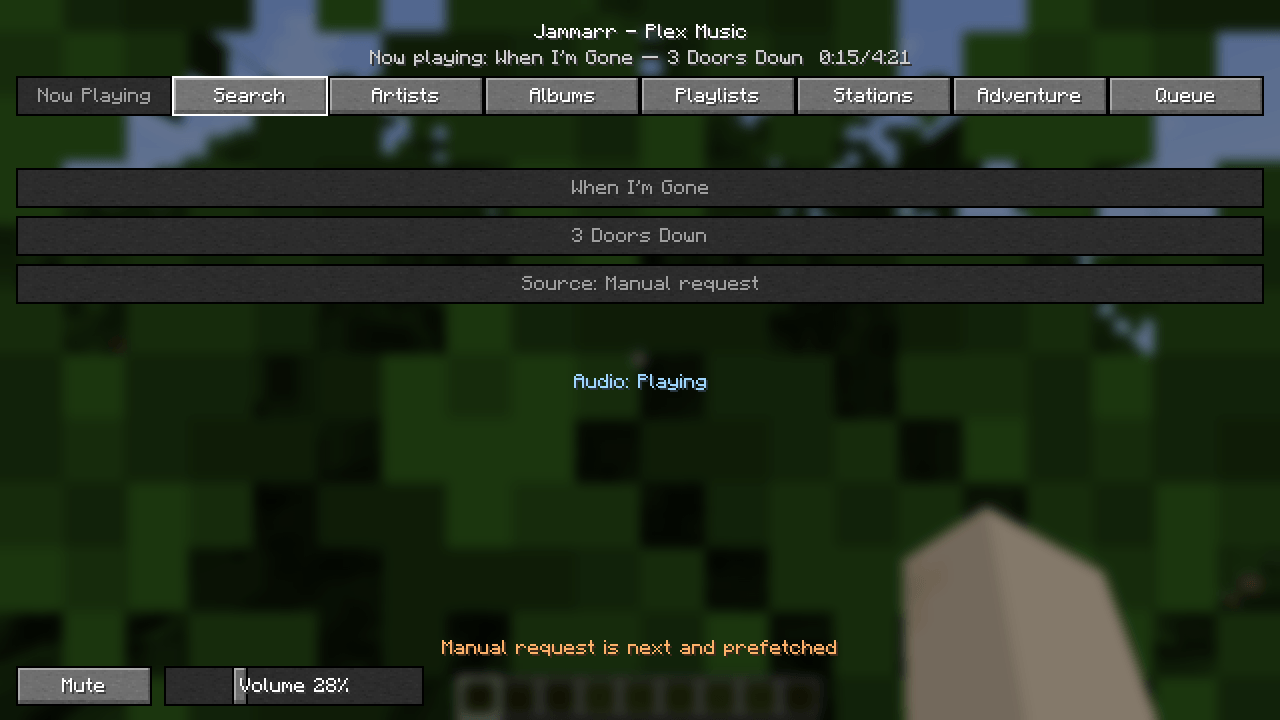
Jby default or run/jammarrto open the music screen. The key appears as Open Jammarr in Controls and can be rebound on every supported version and loader. This avoids the vanilla Social menu'sPbinding on modern Minecraft. - The screen includes Now Playing, Search, Artists, Albums, Playlists, Stations, Adventure, and Queue views with server-side pagination.
- Every player may browse and append tracks, albums, artists, or audio playlists.
- Permission-level 2 operators may pause, resume, skip, clear, remove, and reorder queue entries.
- Each player may independently mute Jammarr and set a persistent local volume. Local opt-out never changes the global queue.
- Operators can run one shared endless source: Sonic Autoplay, Library Shuffle, Track Radio, Artist Radio, Album Radio, or a 2–5 seed Sonic Mix. Track, artist, and album browse rows expose radio/mix actions.
- Adventure is a separate tab. Operators build an ordered route of 2–5 track waypoints, preview Plex's sonic path, and start it normally or immediately. After the final waypoint, Jammarr continues with Track Radio from that track.
- Manual requests always play before generated station tracks after the current song. The Queue view marks generated preview entries as read-only; they do not consume the manual queue limit.
- The Now Playing screen reports both server playback and local audio state. Decoder or transfer recovery is bounded and can be retried from the screen after a final local audio error.
- Search reports short-query, searching, Plex-unavailable, and empty-result states; queue actions report progress and completion, and long titles expose their full text as tooltips.
- Master, Music, and Jammarr volume controls all apply. Vanilla background music is suppressed while the Jammarr stream is active and restored afterward.
Commands:
<markdown-accessiblity-table>| Command | Access | Effect |
|---|---|---|
/jammarr |
Everyone | Open the screen |
/jammarr status |
Everyone | Show global playback status |
/jammarr pause, resume, skip, clear |
Operator | Control global playback |
/jammarr cache |
Operator | Show cache usage |
/jammarr reload |
Operator | Revalidate Plex and the selected library |
/jammarr diagnostics |
Operator | Show sanitized Plex/cache/transfer state, preparation status, and transfer counters |
/jammarr station status |
Operator | Show active station, generated lookahead, and sonic capability |
/jammarr station stop |
Operator | Stop future station generation after the current track |
/jammarr station library-shuffle |
Operator | Start endless library shuffle after pending manual requests |
/jammarr autoplay on, off |
Operator | Enable or disable sonic continuation from the five most recent tracks |
/jammarr adventure status, stop |
Operator | Inspect or stop the shared Adventure source |
Plex sonic setup
Sonic stations require an active Plex Pass for the server owner and completed sonic analysis for the selected music library. Enable Analyze audio tracks for sonic features in the Plex server Library settings and Sonic Analysis in the music library's Advanced settings, then allow the analysis task to finish.
The Stations and Adventure tabs report whether Plex Pass is unavailable, library/seed analysis is incomplete, the server lacks the operation, validation is still running, or Plex is offline. Metadata fallback is deliberately off by default and never substitutes for Sonic Adventure.
Playback and failure behavior
- Every loader delegates server playback to the same Java 8, Minecraft-independent coordinator. Narrow runtime, player/permission, packet-transport, and schema-4 persistence contracts keep loader APIs out of queue, station, Adventure, cache, timing, and transfer policy.
- The server owns the queue, timeline, Plex credentials, cache, and all media requests. The Plex token is never sent to clients.
- Tracks are validated before atomic cache installation. The next track is prefetched while the current one plays.
- MP3 data is split only on frame boundaries into payloads no larger than 16 KiB. Clients pull one server-authorized window at a time, validate SHA-256 hashes, acknowledge complete windows, and retry only the outstanding window. The server rejects out-of-order, unacknowledged, over-buffered, and excessive requests.
- A new track is scheduled five seconds ahead using a filtered client/server clock estimate. Late joiners begin near the authoritative position. More than 500 ms of drift causes a local rebuffer rather than delaying every listener.
- A preparation failure retries three times with backoff. Missing or permanently invalid items are skipped; authentication, configuration, and outage failures wait for the 30-second Plex recovery check instead of retrying from every server tick. Cached playback continues during a temporary Plex outage.
- Client audio recovery retries three times per playback session. A fourth failure stops retrying automatically and exposes a
Retry audioaction instead of leaving a silent stream running indefinitely. - The queue and five-second playback checkpoints live in world saved data. A graceful shutdown records the current position for
RESUME_POSITION. - The active station, autoplay toggle, seed/waypoint definition, current source, and the last 100 tracks used for repeat suppression also live in world saved data. Generated lookahead is rebuilt after restart.
RESTART_TRACKandRESUME_POSITIONretain the source;CLEARremoves it. - Unmodded clients and clients with an incompatible Jammarr network protocol are rejected during payload negotiation. Queue mutations include an expected track key so stale operator screens cannot modify the wrong entry.
- The server diagnostics command reports Plex validation time, cache hit/miss/install/invalid counters, current and next-track cache state, active listener transfer counters, and client-reported recovery/underrun/buffer health.
Security and privacy
- Prefer
JAMMARR_PLEX_TOKENso the token is not written to a configuration file. - Library requests authenticate by header. Plex's progressive transcode endpoint requires query authentication on some server versions; Jammarr never logs that request URI.
- Errors and operator diagnostics redact plain and URL-encoded token values. Player-facing errors contain no server address, request URI, or credential detail.
- Jammarr does not modify Plex ratings, play history, or playlists.
Build and verification
./gradlew releaseMatrixGate --no-daemon --max-workers=1
releaseMatrixGate runs the shared tests, all five three-loader modern family builds, the cleanup-aware GameTest gate, the isolated Forge 1.7.10 Java 8 gate, centralized inspection of every final JAR (including remappable menu-key registration), and fresh dedicated-server checks for all 21 supported loader/version runtimes. Every modern Fabric artifact is exercised under both Fabric and Quilt while remaining one release file. Each runtime must first reject an invalid canonical config without leaking its value, then start successfully and complete authenticated library and sonic-capability calls against a deterministic loopback Plex service. Every runtime launches a real wrong-protocol client and requires the exact rejection on both sides. Modern targets pair a dependency-free missing-client probe with the loader's client-facing rejection; Forge 1.7.10 launches a real matching client with its acceptance-only hello suppressed and requires the explicit missing-hello timeout. A second real client proves public commands are visible before promotion, operator commands appear only after promotion, and /jammarr diagnostics reaches the player without exposing the Plex token or address. Finally, two real clients feed isolated audio sinks so the gate can measure late join, pause/resume, volume, mute, reload, cache-backed outage playback, Library Shuffle, Sonic Adventure, underrun and drift recovery, retry exhaustion/manual retry, reconnect, and clear; state or an allocated OpenAL source alone does not pass. The gate places exactly 16 artifacts in build/releases/ alongside schema-2 manifest.json and SHA256SUMS and fails if a tested server leaves a process or game port behind.
Useful narrower gates are verify1201Family, verify1202Family, verify1211Family, verify2612Family, verify262Family, verifyQuiltRuntimes, verifyLegacy1710, and verifyGameTests. Each target's verifyRelease checks loader metadata, translations, decoder dependencies, license notices, canonical filename, and other target-specific invariants. The legacy verifier additionally checks all Jammarr classes are Java 8 bytecode.
Release checklist:
- <input type="checkbox" id="" disabled="" class="task-list-item-checkbox" aria-label="Incomplete task"> Run
./gradlew releaseMatrixGate --no-daemon --max-workers=1from a clean checkout. - <input type="checkbox" id="" disabled="" class="task-list-item-checkbox" aria-label="Incomplete task"> Validate the credentialed Plex smoke test once per Minecraft family against the intended deployment server.
- <input type="checkbox" id="" disabled="" class="task-list-item-checkbox" aria-label="Incomplete task"> Confirm the automated 21-runtime dedicated-server gate passed and retain
build/dedicated-server-gate/logs with the release evidence. - <input type="checkbox" id="" disabled="" class="task-list-item-checkbox" aria-label="Incomplete task"> Confirm missing-client and deliberately incompatible-protocol clients receive a clear disconnect.
- <input type="checkbox" id="" disabled="" class="task-list-item-checkbox" aria-label="Incomplete task"> Confirm all modern Fabric JARs start under both Fabric Loader 0.19.2 and the pinned 0.19.3 runtime.
- <input type="checkbox" id="" disabled="" class="task-list-item-checkbox" aria-label="Incomplete task"> Confirm all five Quilt client scenarios pass both without Mod Menu and with the pinned Mod Menu version.
- <input type="checkbox" id="" disabled="" class="task-list-item-checkbox" aria-label="Incomplete task"> Complete the audible two-client matrix in
docs/RELEASE_ACCEPTANCE.md; a connected client or allocated OpenAL source is not sufficient. - <input type="checkbox" id="" disabled="" class="task-list-item-checkbox" aria-label="Incomplete task"> On Modrinth, CurseForge, and any other distribution platform, mark each modern
-fabric.jaras compatible with both Fabric and Quilt; never upload a duplicate-quilt.jar. - <input type="checkbox" id="" disabled="" class="task-list-item-checkbox" aria-label="Incomplete task"> Publish the 16 JARs,
manifest.json, andSHA256SUMSfrombuild/releases/together.
The opt-in live Plex test reads credentials only from its process environment:
JAMMARR_LIVE_TEST=true \ JAMMARR_PLEX_URL='https://plex.example.invalid:32400' \ JAMMARR_PLEX_TOKEN='...' \ ./gradlew test --tests stonytark.jammarr.server.PlexLiveSmokeTest
Credentialed live-test results are deliberately non-cacheable. Test credentials are not build inputs and are not packaged into the mod JAR.
Jammarr is released under CC0-1.0. Its license, the complete LGPL-2.1-or-later text for the embedded MP3 libraries, and THIRD_PARTY_NOTICES.md are copied into the built artifact.
See compatibility, migration, and the release acceptance matrix for target-specific details.