Revenge Book Forever (DeathNote): Death Log & World PvP KOS
- By
Death log and world PvP revenge book for WoW Forever. Every death with its cause, a wanted poster and an alarm for every ganker, a chronicle for your guild. 21 languages.
01-title-wanted.png
02-death-log-all.png
03-death-log-causes.png
04-guild-chronicle.png
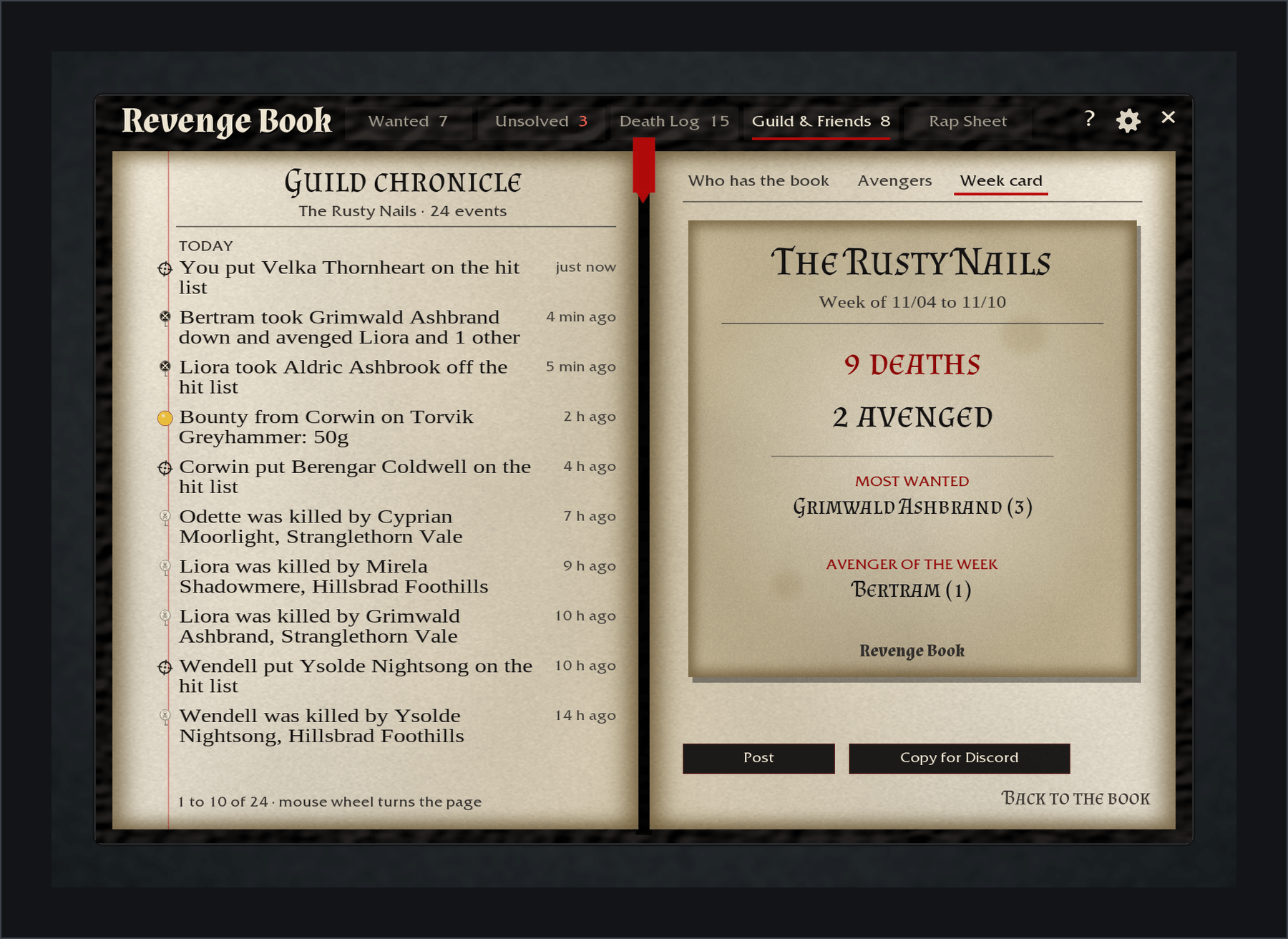
05-week-card.png
Description
Revenge Book keeps every death you die with its cause, and gives every player who killed you a wanted poster and an alarm for when they show up again.
Your guild shares one chronicle of who was killed, by whom, and who took revenge. The book speaks 21 languages and there is nothing to set up. Die, and the book knows how.
It was called DeathNote until 1.5. Your book, your settings and /dn carry over.
Before you start
- Switch on enemy nameplates (V by default). Without them the alarm only sees your target and whatever is under the mouse.
- A new installation asks once for language and cover, then /dn opens the book.
- The ? in the book opens the manual. It has 14 short chapters on everything the book can do, in all 21 languages, and it opens at the chapter for the page you are on.
- The gear holds the House Rules, and the key bindings sit under Revenge Book in the game's key binding menu.
The feud
Every player who killed you gets a page. That is where the book started, and it is still its heart.
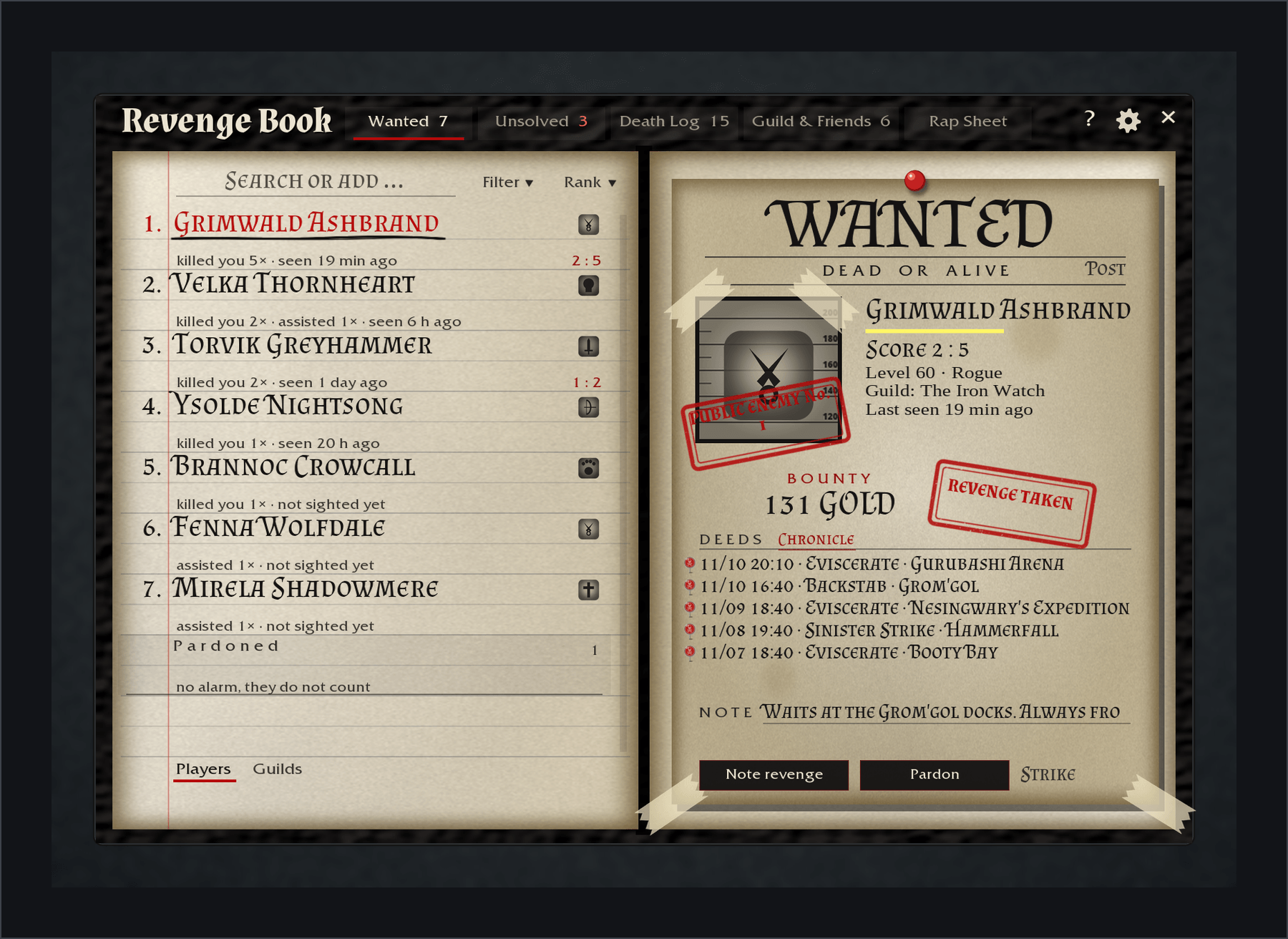
- Wanted poster. Wanted lists everyone who killed you, the biggest open debt first. Click a name for the poster with deeds, place and time, the book's own value for that head and a note of your own. The Chronicle tells a whole feud in order.
- Who killed me. After each death the addon reads the Death Recap. The killing blow makes the killer and everyone else counts as an accomplice. When the recap does not settle it, the death waits under Unsolved and one click decides.
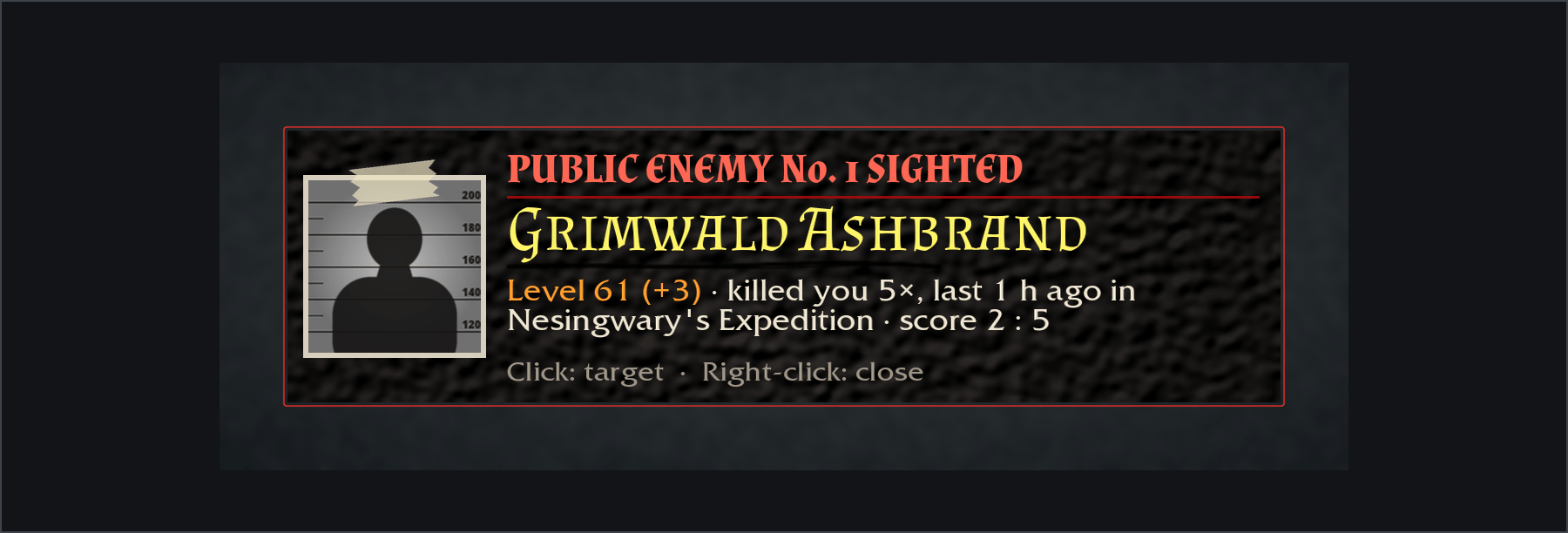
- Alarm. When someone from your book shows up as a nameplate, as your target or under the mouse, a poster drops in at the top of the screen with a sound. Their nameplate carries a small pin with the score.
- Grudge. Attacked but still alive? A small notice lists everyone who went for you. A tick writes them into the book, a cross lets them go.
- Score. Your own killing blows count back, so each feud is open, settled or overpaid. The Rap Sheet keeps your file with ranks and awards.
- Guilds. The switch "Players | Guilds" under Wanted shows which guilds kill you and how you stand against each. "Declare feud" on a guild gives a quiet alarm when one of its members comes into sight.
- Tidy book. Old suspicions with nothing new for 30 play days are filed away on their own. Anyone who killed you stays.
Every death, with its cause
Most deaths are not a ganker, and the book keeps those too.
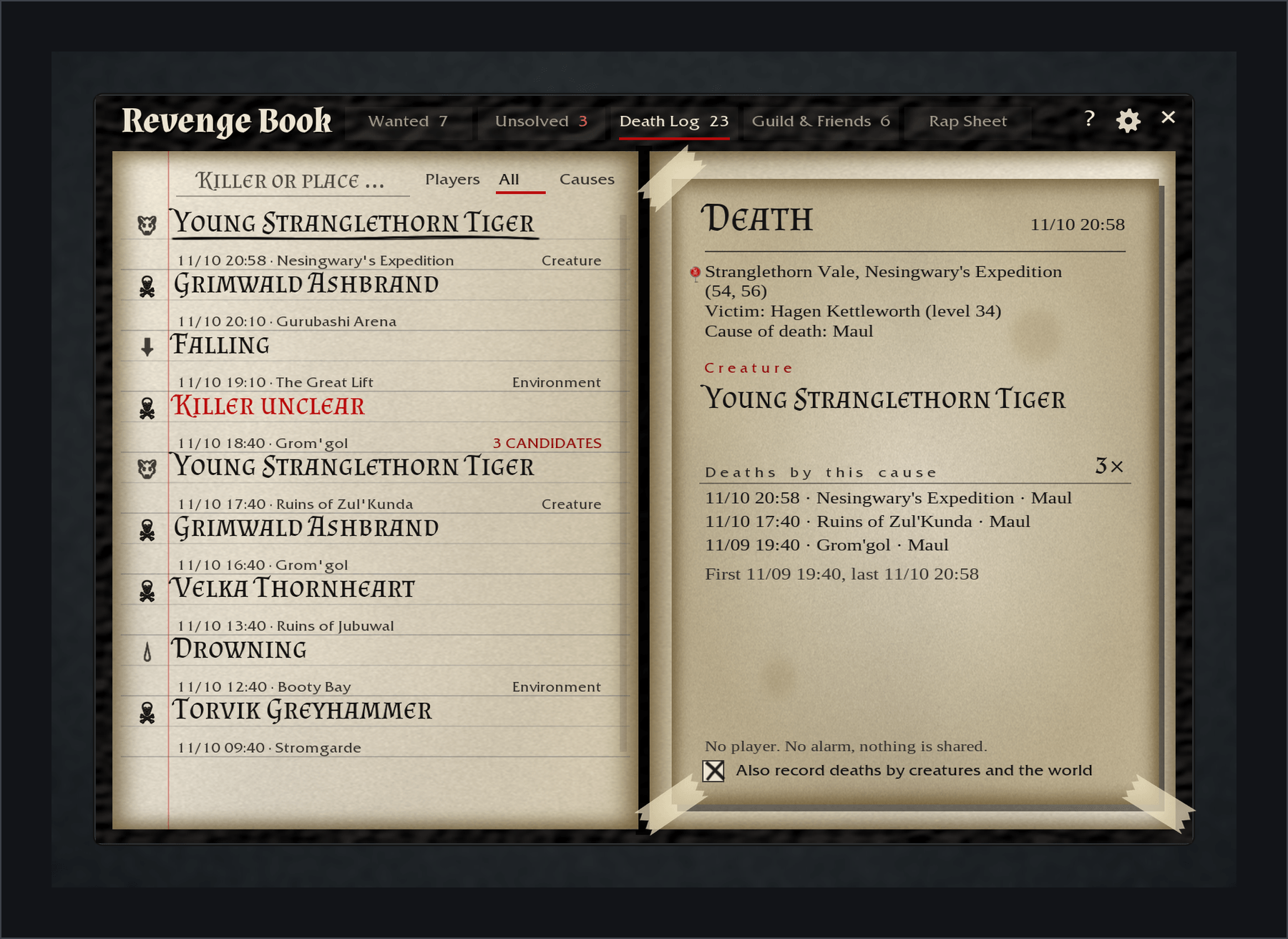
- Death Log. Every death goes in with time and place, whether a player did it, a creature with its name and spell, or the world (falling, drowning, fire, lava, fatigue, slime). Each place is a link to the map.
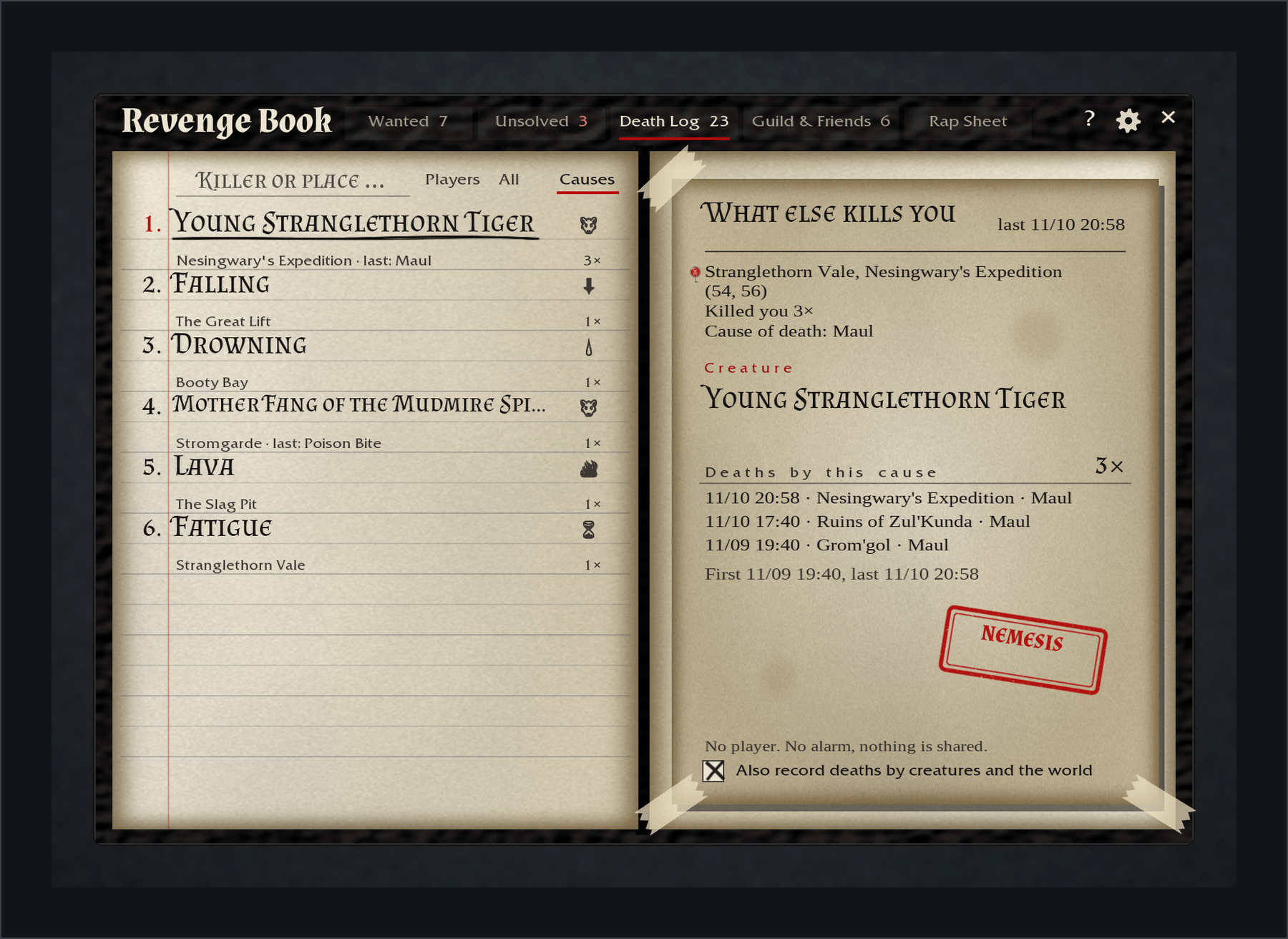
- Three views. All lists every death by time, Players only the deaths by players, and Causes ranks what else kills you. The creature at the top carries a NEMESIS stamp once it got you three times.
- Awards for dying. Eight of them on your Rap Sheet, from your first fall to ten deaths by the same creature. Dry remarks in English and German come with them.
- Quiet by design. A death by a creature or the world never rings the alarm and is never shared. One tick in the death file switches the recording off.
Your guild
Guildmates and friends who run Revenge Book share through hidden addon messages that nobody sees in chat.
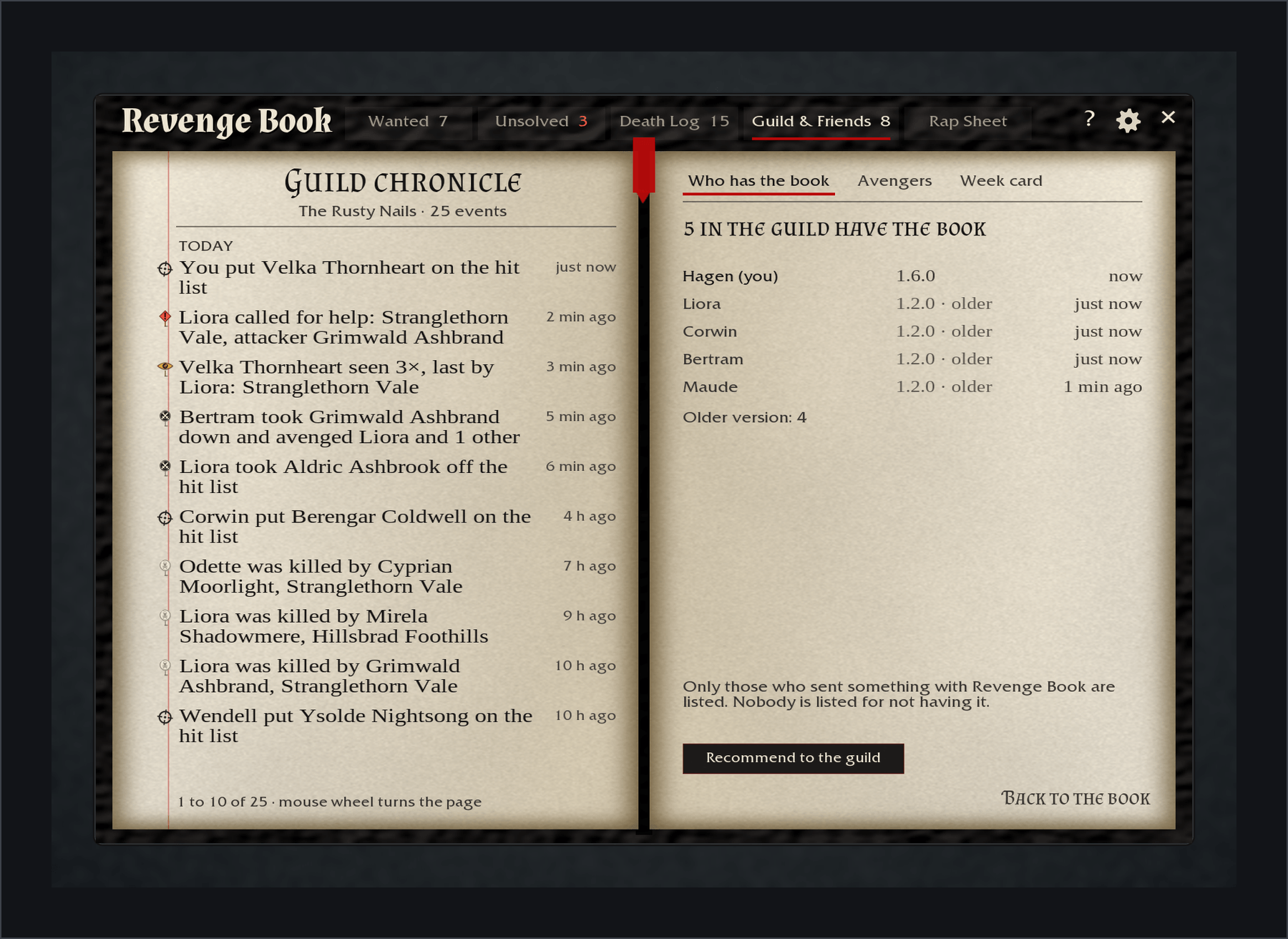
- Guild chronicle. A red ribbon in the guild tab opens what happened to the guild, newest first. It shows who was killed by whom and where, who took revenge, bounties, the Hit List, calls for help and sightings. A click on a line opens the killer's poster, the pin opens the map.
- Who has the book. The chronicle lists guildmates heard with Revenge Book, their version and when they were last heard, and how many of those online have it. Nobody is listed for not having it.
- Week card. It shows the deaths and revenge of the week, the most wanted and the avengers. "Post" puts one line into guild chat, "Copy for Discord" gives you a block to paste.
- Call for help. A key binding, or the small "Call" button on the grudge notice, sends your position and your attacker to your guild, your group and your friends with the book. They get a slip at the top of the screen and a pulsing pin on the map.
- Sightings. When you see an enemy who killed you, a guildmate or a friend in the last 30 days, or a target of the Hit List or a bounty, your guild and friends get a quiet chat line with the place and a pin on the map. If he stands on another layer, the line says so.
- Hit List. The Hit List is shared kill on sight. Put a killer on it for your guild, your friends or both, and everyone with the book gets an alarm when he shows up.
Bounties
Put gold on a head, and your guildmates and friends have a reason to attack him when they see him.
- Post a bounty. Click the value on a poster or type /dn bounty. Guild and friends with the book see it, and their alarm names it when the target comes into sight, for example "50g bounty from Anna".
- Bounty earned. When your own killing blow takes down a target with a bounty from a guildmate or friend, the chat says so at once and a slip "Bounty earned" shows the target, the gold and who posted it.
- Claims both ways. Unsolved has a view Claims with "You owe" for claims on your bounties and "Owed to you" for the bounties you earned, each with its state.
- Nobody has to be online. If the poster was offline at the kill, your book keeps the claim and sends it again by itself once it hears him, for up to 30 days.
- Paid or declined. The poster marks a claim as paid or declines it, and the shooter gets a chat line either way. "Mark as paid" also takes the bounty back.
- Only posted bounties count. The poster shows two words. BOOK VALUE is what the book works out by itself and nobody can claim it. BOUNTY stands only over gold somebody really posted.
- The addon pays nothing. You settle the gold among yourselves by trade or mail.
The map
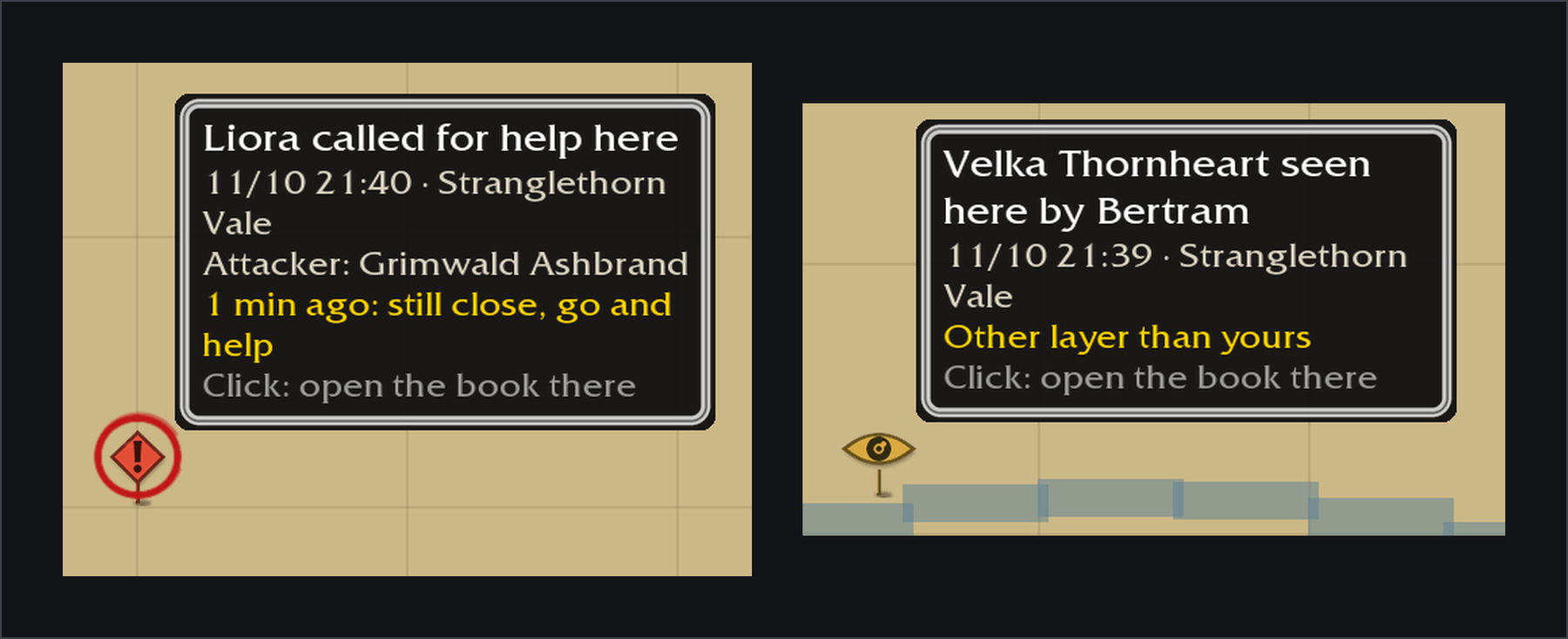
Every death is a pin on the world map that says who killed whom, and when. Your revenge has a pin of its own, deaths of guildmates and friends show too, and a fresh one pulses. A call for help is a red diamond with an exclamation mark and a sighting is an amber eye. Every pin has its own shape, so they read without colour. Click a place in the book and the map opens there.
Commands
- /dn or /rb open or close the book
- /dn add Name Surname, /dn del Name Surname write someone in by hand, strike them
- /dn quiet alarm off and on, /dn test test alarm
- /dn move drag the alarm and the notices to where you want them, /dn move reset puts them back
- /dn grudge grudge notice off and on, /dn grudge test test notice
- /dn hunt Name Surname put on the Hit List, /dn calloff Name Surname call it off
- /dn bounty Name Surname 50 put 50 gold on a head, 0 takes it back
- /dn sync sync with guild and friends now
- /dn lang code language, /dn theme name cover
- /dn help all commands
Good to know
The game does not give addons everything, and Revenge Book does not pretend otherwise.
- This is a book, not a radar. It does not list every enemy nearby and does not detect stealth.
- WoW Forever has no combat log for addons. The killer comes from the Death Recap, and a death without a usable recap ends up under Unsolved.
- For the same reason an attacker is whoever has you targeted while you take damage. Someone who only looks at you while a monster hits you can show up on the grudge notice, marked as unsure, and that is what the cross is for.
- When a creature lands the last hit right after a player's damage, the player stays in the book as the unsure killer and Unsolved decides. A totem or guardian cannot be told from a wild creature there.
- Inside dungeons, battlegrounds and arenas enemy names are hidden, so alarm, nameplate pins and the grudge notice keep quiet there. A call for help does not go out there either.
- Some things could not be measured in the game yet. Among them are whether the Death Recap on Forever names falls and drowning, whether a call for help goes through in combat, in a chat lockdown and over party, raid and Battle.net, whether the layer mark is right on every layer, whether the guild roster says who is online, whether an enemy's guild can be read in the open world and in combat, and how a claim travels when the poster comes online later. /dn probe records all of it, and reports help.
- A feud guild has no mark on the nameplate yet, and a claim shows under Unsolved, not on the poster.
- A bounty is earned only by your own killing blow in the open world. A duel does not count, and neither does a group kill without your blow. The book cannot check a kill it did not see, so the poster always has the last word.
- The spot of a death on the map needs 1.5 or later on the other side, and a sighting with place and layer needs 1.6. Older versions send the zone only.
- "Bounty earned", the claim for a poster who was offline and the answer to the shooter need 1.7 on both sides. With an older version the poster still gets the claim if he is online at the kill, and the shooter's entry stays unconfirmed.
What is shared, and what never is
Nothing goes to strangers. Revenge Book shares only with your guild and with friends from your friend list, and only with those who run it themselves. Messages are hidden addon messages that nobody sees in chat. A line in chat goes out only when you press the button for it.
What goes out is your own confirmed deaths by players with the place (the exact spot can be switched off), names you added by hand, your Hit List entries and bounties, "taken down" and "avenged", a claim on a bounty you earned and the answer to one, a call for help when you send one, and sightings of your killers.
Sightings of your killers are on by default. You can switch them off in the House Rules, sheet Guild, "Sightings of my killers to guild & friends". Then nothing is sent and nothing is taken in.
Deaths by creatures and the world never leave your book, and neither do attacks from the grudge notice, notes, suspects, accomplices, pardons, feud guilds, your Rap Sheet or anything you imported or copied. Every client sends only its own deaths.
Languages
English, German, French, Spanish, Italian, Portuguese (Brazil), Russian, Ukrainian, Polish, Czech, Croatian, Hungarian, Dutch, Danish, Swedish, Norwegian, Finnish, Turkish, Korean, and Chinese in simplified and traditional script. The book follows your client's language, and /dn lang switches it.
The translations were made by machine and checked, but not by native speakers. If a line reads wrong, tell me the language, the wrong line and a better one.
Feedback
Bugs and ideas go to the comments or the issue tracker of this project. For a Lua error the full text from BugSack helps most, together with your addon version and what you were doing when it happened.
Revenge Book Forever (DeathNote): Death Log & World PvP KOS Team