1-shelf-genres-dark.png
2-classics-books-light.png
3-page-parchment-literata.png
4-page-see-through.png
Description
Sonnets, ballads, epics and songs, from Shakespeare and Dante to Dickinson, Dunbar and Owen.
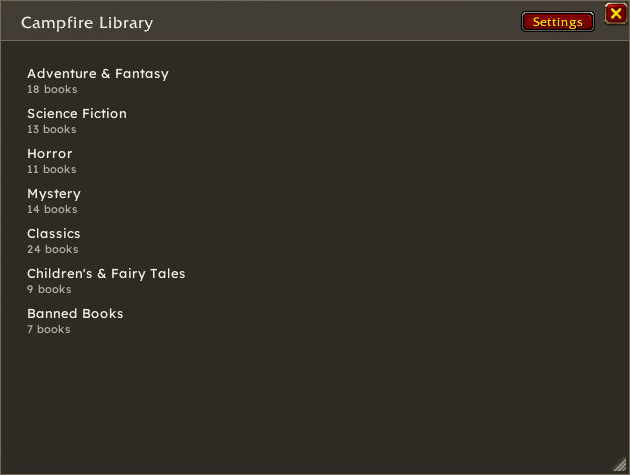
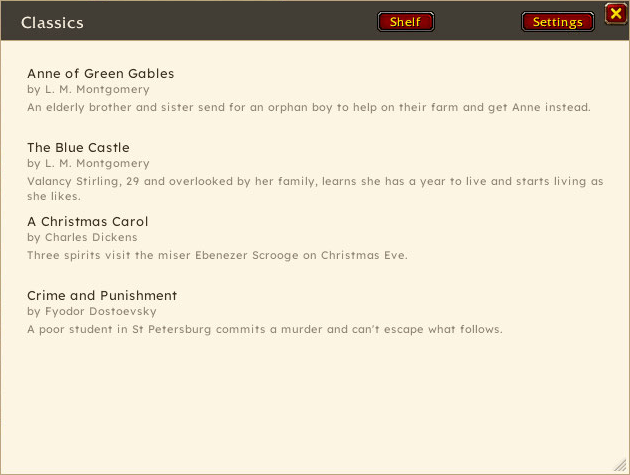
Install it in the CurseForge app and the Campfire Library reader comes along with it; the books appear on your shelf, ready to read. Every book in this pack is in the public domain in the US and Europe. Why separate packs? So you only download the genres you want. Made for every current version of WoW. Tested in WoW Forever so far; the other versions are untested.
The books
- The Ballad of Reading Gaol by Oscar Wilde. Written in France after Wilde left prison: a soldier hanged for murder, and "each man kills the thing he loves."
- Ballads of Romance and Chivalry by Frank Sidgwick, editor. Old English and Scottish ballads of lovers, knights and family tragedies: Barbara Allan, Lord Lovel, the Nutbrown Maid.
- The Book of Nonsense by Edward Lear. Edward Lear's limericks about old men with beards, young ladies of everywhere and other absurd people.
- A Child's Garden of Verses by Robert Louis Stevenson. Stevenson's poems of childhood: my shadow, the land of counterpane, and going to bed by day.
- Childe Harold's Pilgrimage by Lord Byron. A restless young lord wanders Europe's battlefields and ruins, in the poem that made Byron famous overnight.
- Collected Poems by Rupert Brooke. Brooke's poems, among them the war sonnets of 1914: "some corner of a foreign field that is for ever England."
- The Complete Poems by Paul Laurence Dunbar. Dunbar's poems in standard English and in Black Southern dialect, among them We Wear the Mask and Sympathy.
- The Complete Poetical Works by Edgar Allan Poe. Every poem Poe wrote, from The Raven and Annabel Lee to The Bells, with his essays on poetry.
- The Complete Poetical Works of Shelley by Percy Bysshe Shelley. Everything Shelley wrote in verse, from Ozymandias and Ode to the West Wind to Prometheus Unbound.
- The Divine Comedy by Dante Alighieri, translated by Henry Wadsworth Longfellow. Dante's journey down through Hell, up the mountain of Purgatory and into Paradise, in Longfellow's verse.
- Don Juan by Lord Byron. Byron's comic epic of a young Spaniard swept from one adventure, shipwreck and love affair to the next.
- Evangeline by Henry Wadsworth Longfellow. Driven from Acadia with her people, a young woman searches America for the man she was to marry.
- Gitanjali by Rabindranath Tagore. Tagore's song offerings to God, in his own English translation, which won him the Nobel Prize in 1913.
- Goblin Market, The Prince's Progress, and Other Poems by Christina Rossetti. Two sisters, a goblin fruit market and a terrible hunger, with The Prince's Progress and Christina Rossetti's other poems.
- The Hunting of the Snark by Lewis Carroll. A Bellman, a Baker, a Beaver and their crew sail off to hunt a creature no one can describe.
- Idylls of the King by Alfred Tennyson. King Arthur's court from Camelot's rise to its fall, told in twelve linked poems.
- Lamia, Isabella, The Eve of St. Agnes, and Other Poems by John Keats. Keats's last book: the great odes, The Eve of St. Agnes, Lamia and Hyperion.
- Leaves of Grass by Walt Whitman. Whitman's lifelong book of free verse about America, the body and the self: "I am large, I contain multitudes."
- Love Songs by Sara Teasdale. Sara Teasdale's short lyrics of love and longing; the book won the prize that became the Pulitzer for poetry.
- A Lute of Jade by L. Cranmer-Byng. Poems of Li Po, Tu Fu and the other classical poets of China, in English verse.
- Lyrical Ballads by William Wordsworth and Samuel Taylor Coleridge. The book that began English Romantic poetry, opening with Coleridge's Rime of the Ancient Mariner.
- Men and Women by Robert Browning. Robert Browning's dramatic monologues: painters, lovers, bishops and rogues speaking for themselves.
- Paradise Lost by John Milton. Milton's epic of Satan's rebellion, the war in Heaven and the fall of Adam and Eve from the Garden.
- Poems by Wilfred Owen. Poems from the trenches of the First World War, published after Owen was killed a week before the armistice.
- Poems and Songs by Robert Burns. Scotland's poet in his own Scots: Auld Lang Syne, A Red, Red Rose, To a Mouse and hundreds more.
- Poems by Currer, Ellis, and Acton Bell by Charlotte, Emily and Anne Brontë. The Brontë sisters' first book, under pen names, a year before Jane Eyre and Wuthering Heights.
- Poems on Various Subjects, Religious and Moral by Phillis Wheatley. The first book of poems by an African American, written by a young woman brought to Boston enslaved as a child.
- Poems, First Series by Emily Dickinson. The first book of Dickinson's poems, published four years after her death: on life, love, nature, time and eternity.
- Poems, Second Series by Emily Dickinson. More of Dickinson's short poems on life, love, nature and eternity, published the year after the first series.
- Poems, Third Series by Emily Dickinson. The last of the three early series of Dickinson's poems, gathered by her editor Mabel Loomis Todd.
- Renascence and Other Poems by Edna St. Vincent Millay. Millay's first book, opening with the long poem she wrote at nineteen about the sky, the earth and being alive.
- The Rubáiyát of Omar Khayyám by Omar Khayyám, translated by Edward FitzGerald. Quatrains on wine, love and the shortness of life, in Edward FitzGerald's famous English version.
- Sappho: One Hundred Lyrics by Bliss Carman. A hundred love poems Bliss Carman built from the surviving fragments of Sappho, the Greek poet.
- Shakespeare's Sonnets by William Shakespeare. All 154 sonnets, on love, time, beauty and betrayal, addressed to a fair youth and a dark lady.
- A Shropshire Lad by A. E. Housman. Sixty-three short poems of country lads, lost love and early death, carried by soldiers in the First World War.
- Songs of Innocence and of Experience by William Blake. Blake's paired songs of childhood innocence and grown-up experience, from The Lamb to The Tyger.
- Songs of Kabir by Kabir, translated by Rabindranath Tagore. Songs of the divine by Kabir, a fifteenth-century Indian weaver and poet, translated by Rabindranath Tagore.
- Sonnets from the Portuguese by Elizabeth Barrett Browning. Elizabeth Barrett's love sonnets to Robert Browning, among them "How do I love thee? Let me count the ways."
- Spoon River Anthology by Edgar Lee Masters. The dead of a small Illinois town speak their own epitaphs, and tell the truth about their lives.
Old books, as written. These books are printed as their authors wrote them, from times with different ideas. Some use words and views now rightly seen as offensive, and some state as fact things since proven wrong. Myths and legends are stories, not history, and many here are retold by outsiders (a Scottish writer on Native American lore, for one), so they may not be true to how those peoples tell their own stories. They're here for what they are: part of what people have read.
Credits
Texts from Project Gutenberg (gutenberg.org), cleaned up for reading in game.
Every pack and every book: https://campfire.wyrdspinner.com
Campfire Library: Poetry & Verse Team