Surgeon
- By
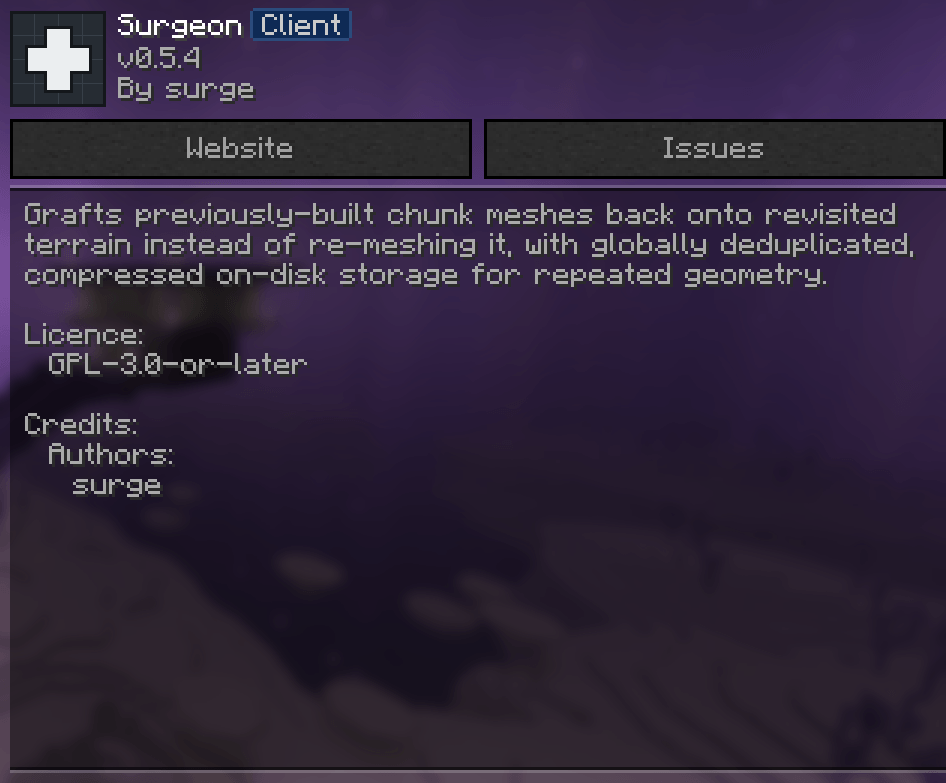
Caches built Sodium chunk meshes to disk — globally deduplicated and compressed — so revisited terrain loads from disk instead of being re-meshed from scratch.
Description
Surgeon
Disk-cached, globally deduplicated chunk meshes for Sodium.
Sodium rebuilds a chunk section's mesh — the per-block model/fluid quad baking that turns 4096 blocks into a GPU vertex buffer — every time that section needs it: on world join, on reload, whenever you fly back into a previously unloaded area. That work is a pure function of the section's block states, light, biome tint, and a few other inputs. If none of those changed since last time, the result is identical.
Surgeon caches that result to disk, keyed by a hash of those inputs, and serves it back directly instead of letting Sodium redo the work.
Does this actually help?
Honestly, it's a narrow, situational optimization, not a universal FPS multiplier. It saves CPU time spent building meshes, not GPU time.
Helps:
- Restarting the client and rejoining the same world/server
- Flying far away and coming back in the same session (sections outside render distance are unloaded and must be rebuilt on return)
- Lower-thread-count CPUs, where chunk meshing competes for cycles
- Repetitive terrain (superflat worlds, stone layers, strip-mine tunnels), where deduplication works especially well
Doesn't help:
- The first time you ever see a given section (always a cache miss)
- Sections with chests, signs, water, lava, fire, or glass (not cached; see What's cached)
- GPU-bound setups, or a CPU fast enough that meshing was never the bottleneck
Deduplicated, compressed storage
Many sections share byte-identical geometry. Instead of storing one full copy per section, each entry is split into:
- a tiny pointer file per section (validity hash + reference to its vertex blob)
- a shared blob store, keyed by the SHA-256 of the vertex bytes and deflate-compressed
The blob store is global, shared across every world and server you've visited, since a stone block's mesh looks the same regardless of which save it's in.
Least-recently-used blobs are evicted automatically once the configurable disk budget (default 2 GiB) is exceeded.
What's cached
A section is only cached when it has:
- no block entities (chests, signs, etc.)
- no animated sprites (water, lava, fire, etc.)
- no translucent geometry (glass, ice)
These are cheap to rebuild live anyway. The expensive part, and the target of this mod, is quad baking for plain solid/cutout terrain.
Correctness
Every read is validated against a fresh hash of the live world: block states, light levels, biome tint, active resource packs, and the Sodium quality settings that actually affect baked geometry (useAmbientOcclusion, hiddenFluidCulling, improvedFluidShaping). Any mismatch simply becomes a cache miss and the section rebuilds normally. It never serves the wrong mesh.
Settings
Settings live as a page inside Sodium's own video settings screen (not a separate screen, and no dependency on Sodium Extra or Reese's Sodium Options):
- Enabled: on/off
- Max Disk Usage (MB): soft budget for the shared blob store
- Clear Cache: wipes everything, with a confirmation dialog
Requirements
- Fabric Loader
- Sodium (matching version)
Two builds are provided, for Minecraft 26.2 and 26.3. Grab the one matching your game version.
Source & issues
Source code, the full technical writeup (architecture, mixin hooks, correctness model) and the issue tracker: github.com/SU4G3/surgeon
Licensed under GPL-3.0-or-later.
Surgeon Team