MinePython
- By
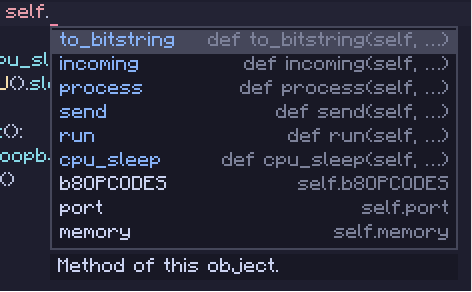
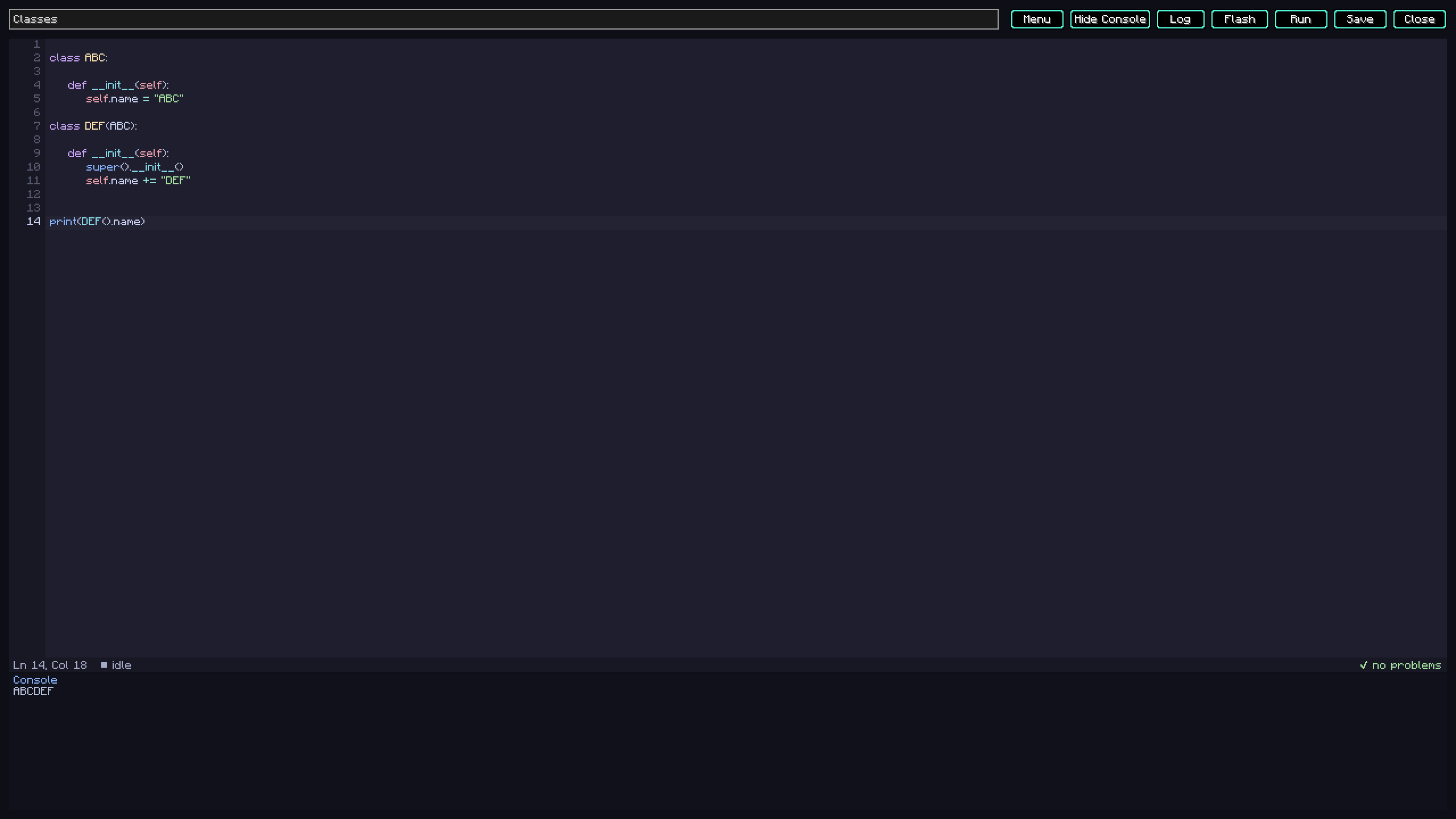
Autocompletes: A well known classic in IDE's
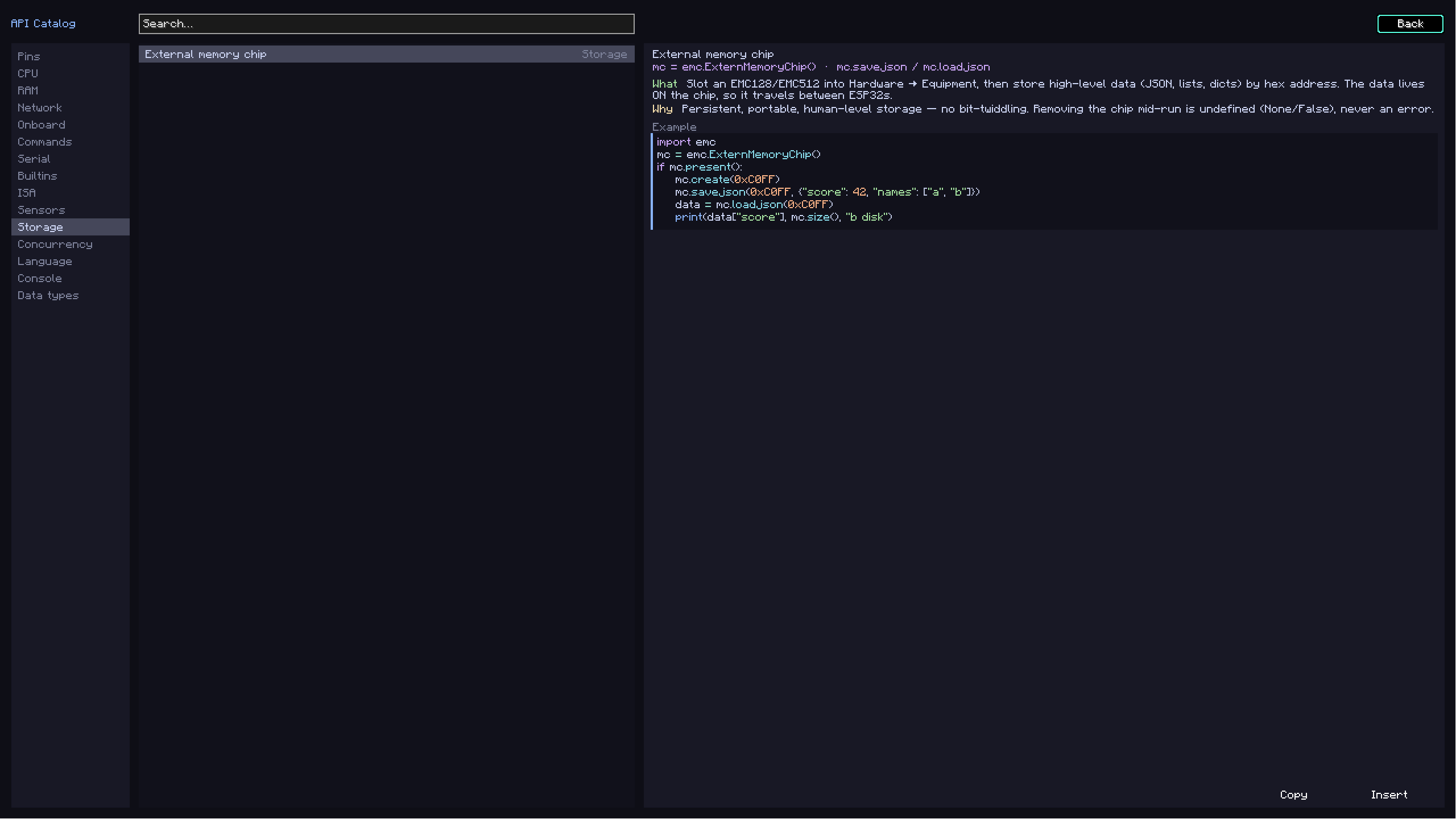
Api Catalog: Lookup any API for MinePython
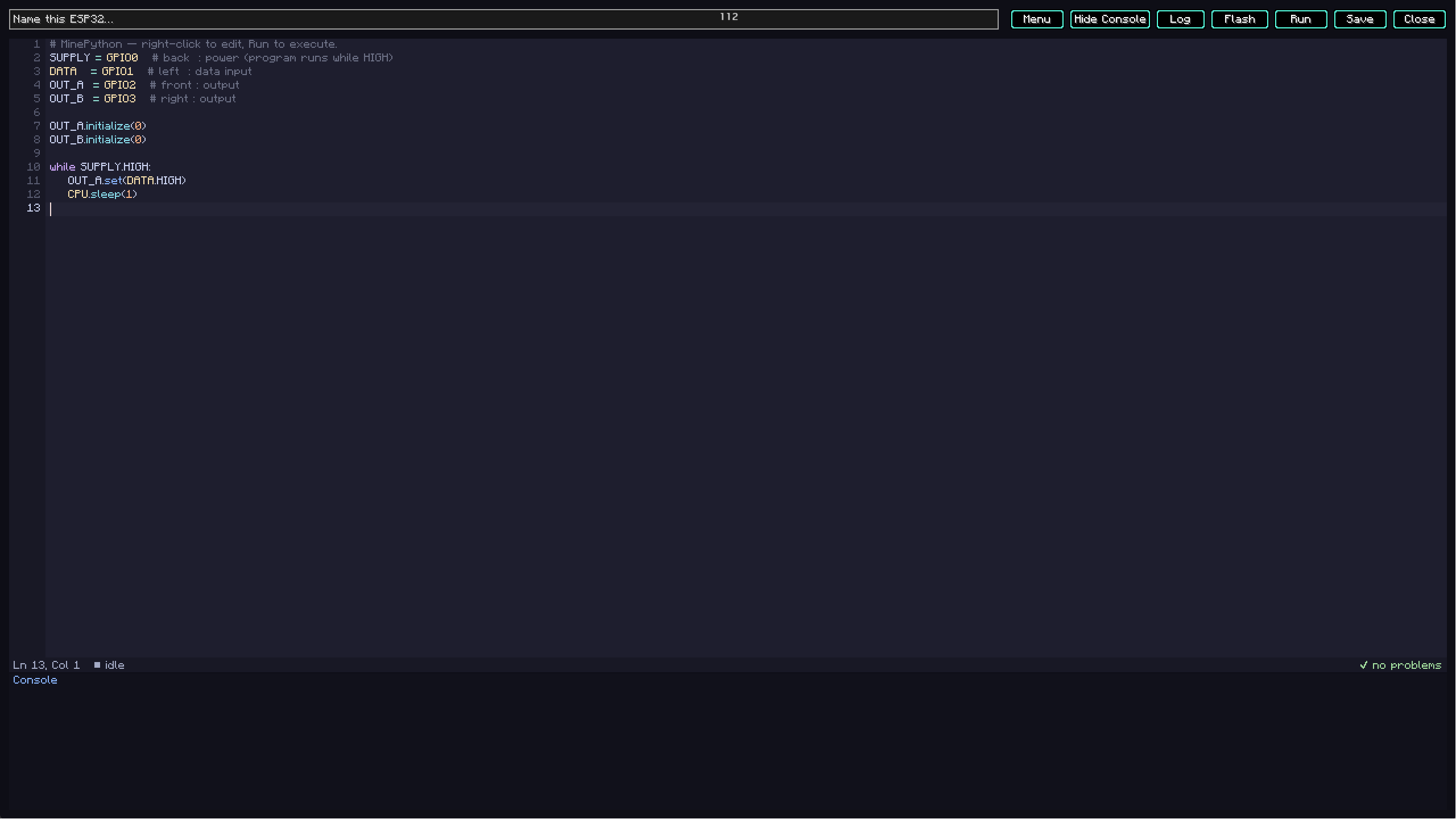
This is the default IDE on the beginner ESP32
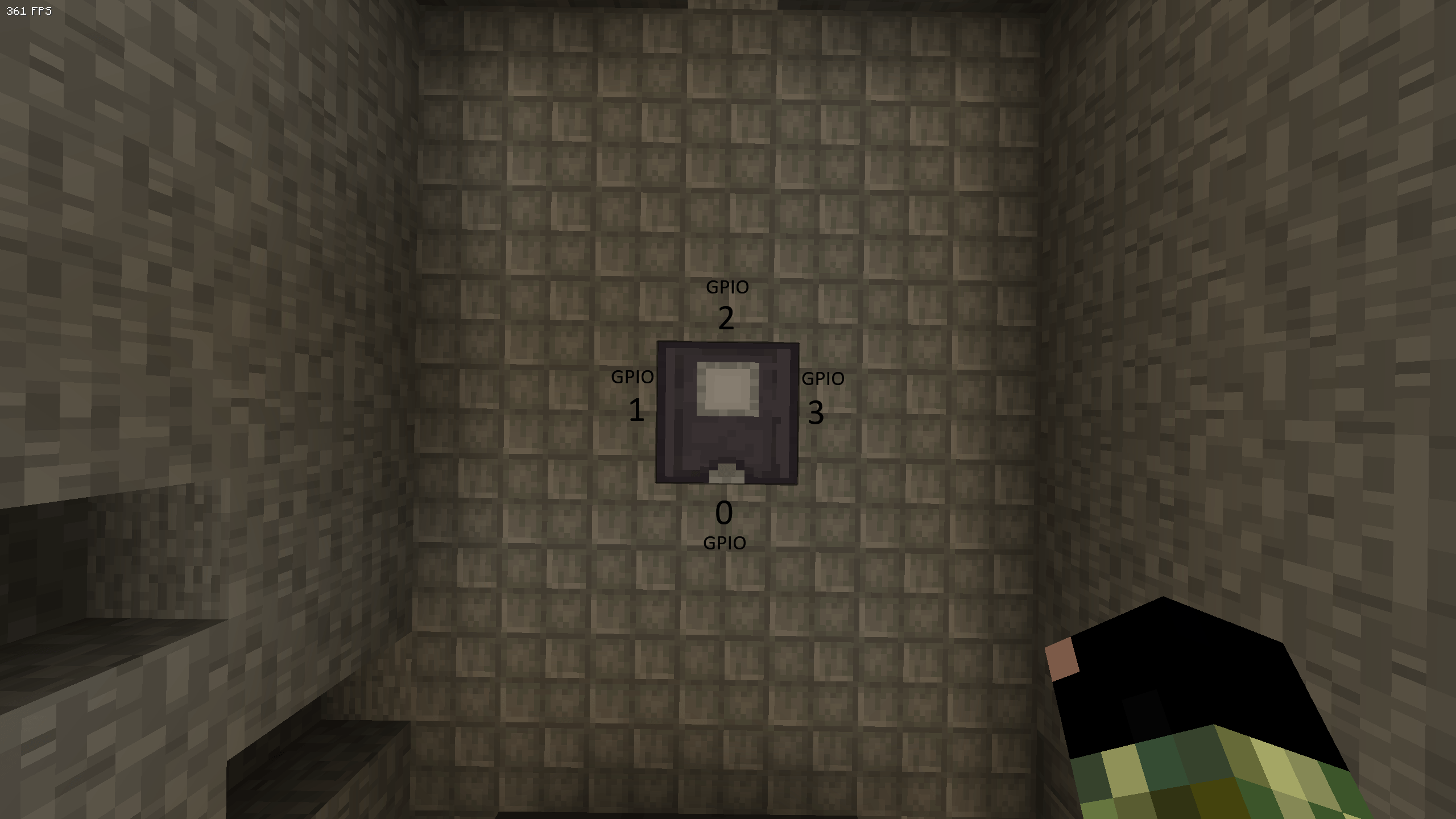
Pinout. The default ESP32 variant uses GPIO 0 as POWER-SUPPLY
Description
MinePython - write real Python inside Minecraft

Place a block. Right-click it. Write Python. Watch it run.
MinePython puts a programmable ESP32 micro-controller into your world and runs a real, from-scratch Python interpreter on it: not command blocks, not a config language, not Lua wearing a costume. You open a full in-game code editor, write an actual program, flash it to the chip, and it runs every tick while powered.
Your very first program can be three lines and blink a redstone lamp. Your hundredth can be a self-coordinating network of controllers spread across the world. Same block, same language, you decide how deep to go.
Your first two minutes
- Place an ESP32 and right-click it. A starter program is already loaded.
- Drop a lever on the back face and a redstone lamp on the front.
- Code your software:
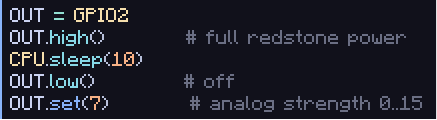
- Hit Run, flip the lever.
Why it's different
Every other "computer" mod hands you an API that hides the hard parts. MinePython hands you the primitives and lets you build the hard parts yourself, which is exactly where the fun (and the learning) lives. There's no built-in sendMessage() that magically networks two chips. There's a radio that moves bits, and you decide what those bits mean. The moment you hit a wall, the solution is something you invent, not something you look up.
It's a genuine on-ramp for learning Python (write a line, watch a lamp react, in a world you already know) and a deep enough sandbox that experienced programmers build routers, protocols, and distributed systems out of raw bits.

What you can build
Redstone, in code. Up to four GPIO sides read and drive redstone: OUT.high(), if DATA.HIGH:, analog strengths, timed pulses, live direction switching. No more repeater spaghetti; one chip drives exactly the line you wired.
Memory that remembers. Ram() storage survives stop/start and chunk reloads: counters, buffers, network inboxes, the save-state for your contraption.
Memory that flees. Ram.JITC() storage only lives until the esp ends. Design cachesystems and more using the Just-In-time-cache
Wireless networks. Ports, sockets, framed packets, and a tunable clock between chips. Build sensor meshes, remote controls, health-checked node networks; the protocol is yours to design.
The world itself. Sounds, particles, chat / title / action-bar output, and a full server-command API when cheats are on.
Sensors & portable storage (S3). Read items, sounds, and the block above as data words; save JSON to EMC chips you can physically pull and carry to another controller. Your data and your code as tradeable items.
Real concurrency (AWC chip). Cooperative worker threads with locks and joins, so one chip can poll, listen, and react at once.
It's a real language
Big-integer math, floats, strings and f-strings, lists / tuples / dicts / sets, comprehensions, generators, classes with inheritance and dunder methods, exceptions, closures, decorators, and a multi-file import system, written exactly as you'd write Python 3. A built-in API catalog (with a What / Why / Example for every feature) and a guided tutorial mean you can learn it without ever leaving the game.
The editor is a real editor, too: syntax highlighting, autocomplete, hover docs, live error-checking with line/column diagnostics, and a multi-file project explorer.
Upgrade as you go
Right-click the chip with a firmware card to upgrade it. The card isn't consumed, so one card flashes any number of chips:
- ESP32 (Standard): externally powered baseline. (GPIO0)
- ESP32 Dev: faster; adds serial I/O and developer tooling.
- ESP32-S3: self-powered (all four pins free), bigger RAM, multi-file projects, sensors, EMC storage.
- ESP32-S3 Dev: everything, fastest, biggest flash budget.
Then slot hardware chips (EMC storage, AWC threads, WR range, DRM memory) and software chips into the equipment bays to extend a controller live, while it's running. Pull a chip mid-program and the code reacts honestly: nothing is hidden, nothing silently breaks.
Showcase
Status
Beta, in active development. The core is stable and runs smoothly, but this is an early public release: expect rough edges, and please report bugs. Built for Fabric, Minecraft 1.21.1 (requires Fabric API). Optional Jade support shows each chip's name, firmware, and run-state on the HUD.
On the roadmap
- Nether storage: a slow, persistent, network-free data layer built on the Nether's coordinate ratio
- More software chips, and continued multiplayer hardening
If real Python in Minecraft sounds like your kind of thing, drop a chip and write your first three lines. Feedback and bug reports are very welcome.
The MinePython Team