LegacyRenderer
- By
Measures what a GPU really supports and fixes the graphics startup failures that keep modpacks from loading on older hardware.
banner-1920x480.png
gallery-1-overview-1920x1080.png
gallery-2-texture-limit-1920x1080.png
gallery-3-requirements-1920x1080.png
MaellDev | LegacyRenderer
Create a server, get 25% off your first month

Description
LegacyRenderer
LegacyRenderer measures what the GPU and driver really support before touching anything, then keeps the game running when a modpack asks for something the hardware does not provide. Diagnostics come first: the vanilla look is never changed, and every patch can be switched off.
Features
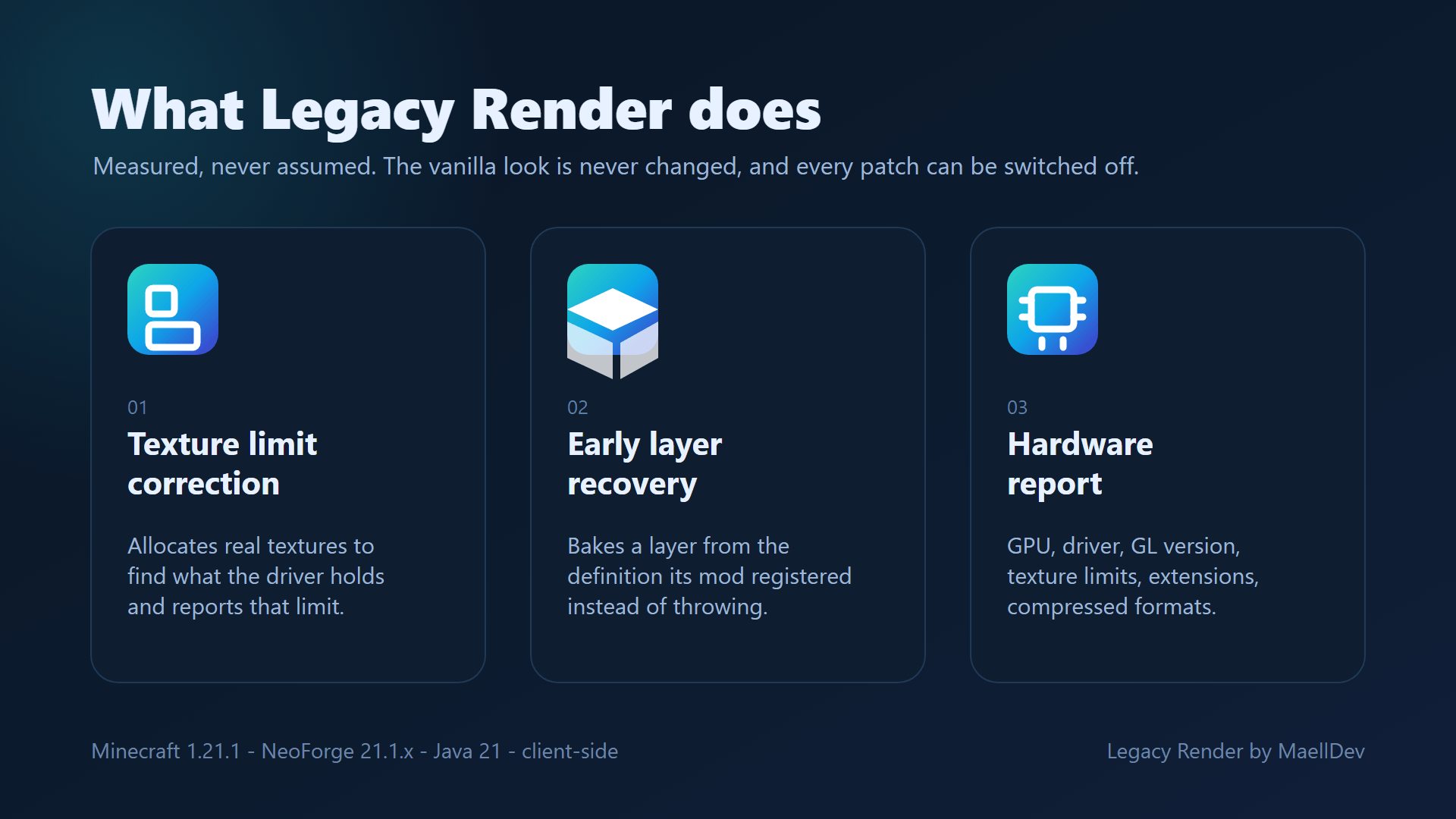
- Hardware report. Vendor, renderer, OpenGL and GLSL versions, declared and really allocatable texture sizes, extensions, compressed texture formats and anisotropic filtering, measured once at startup on the live context.
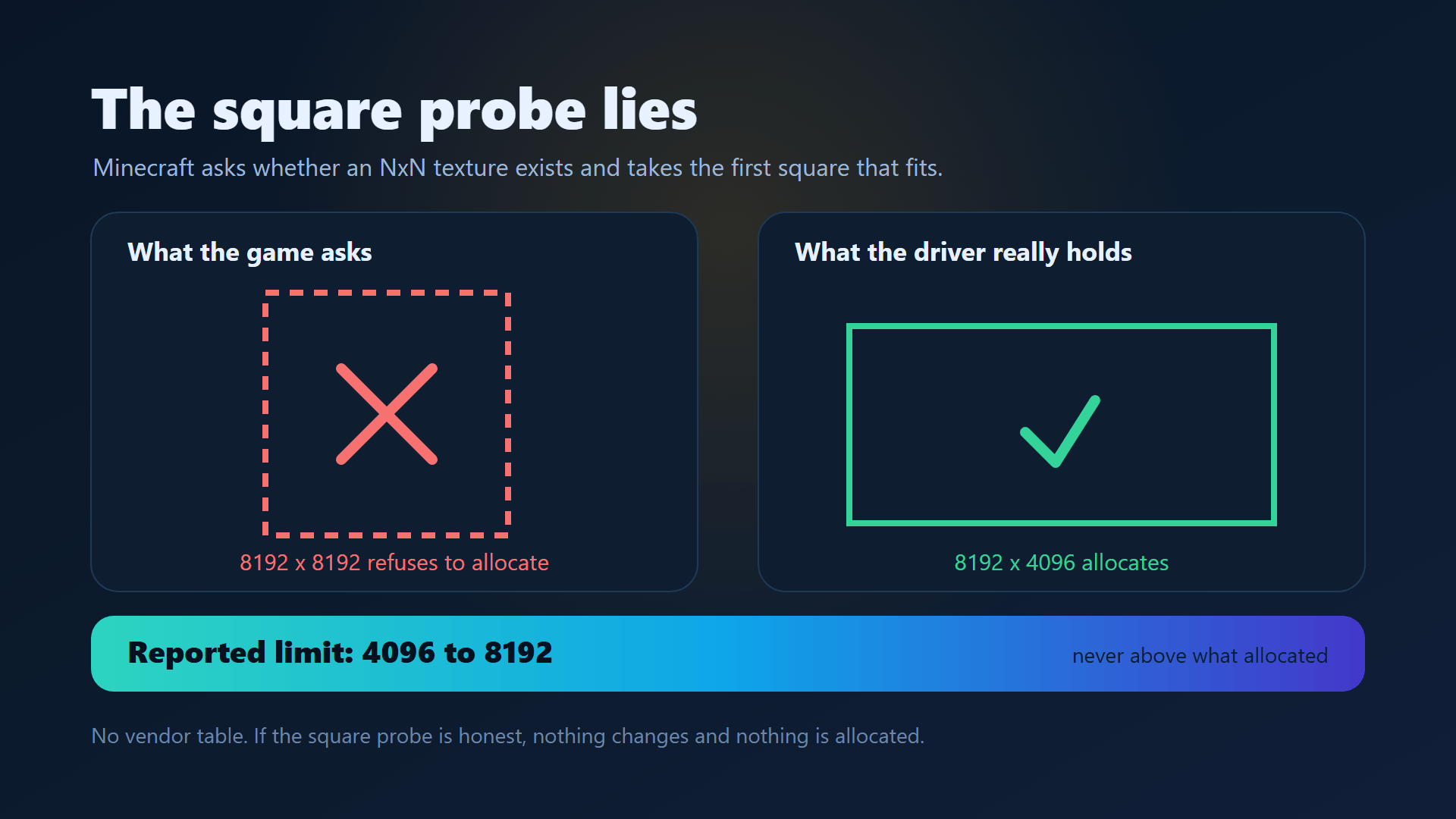
- Texture limit correction. Minecraft asks the driver whether an NxN texture exists and takes the first square that fits, so a driver that rejects the 8192x8192 probe but allocates 8192x4096 makes the game stop at 4096. LegacyRenderer allocates real textures to find what the driver can hold and reports the proven limit, so a pack whose atlas is a rectangle can stitch. The value never exceeds an allocation that succeeded or the declared GL_MAX_TEXTURE_SIZE, and a driver whose probe is honest is left untouched without any allocation at all.
- Early layer recovery. When a mod asks for an entity model layer before the model set exists (Twilight Forest's startup renderers, vanilla skull layers), the layer is baked from the definition that mod registered instead of throwing "No model for layer …". Layers that were never registered keep vanilla's error.
- Resource diagnostics. Every stitched atlas and every baked model is measured per reload, and broken entries are classified as missing resource, hardware limit, incompatibility or unclassified.
- Compatibility decisions. Compressed texture and anisotropic filtering alternatives are resolved from the detected capabilities; native support always wins.
- In-game settings. Every option has a Config button in the mod list and a translated label, and world entry prints one local chat line with the author credit and the channel link.
How it works
Everything is measured, never assumed. One hardware snapshot is taken on the render thread after the OpenGL context exists, and every patch either reads that snapshot or checks the driver directly. When the evidence is missing the patch declines and the vanilla path runs unchanged, including its exception. Failures the mod catches itself are always reported, never suppressed.
Requirements
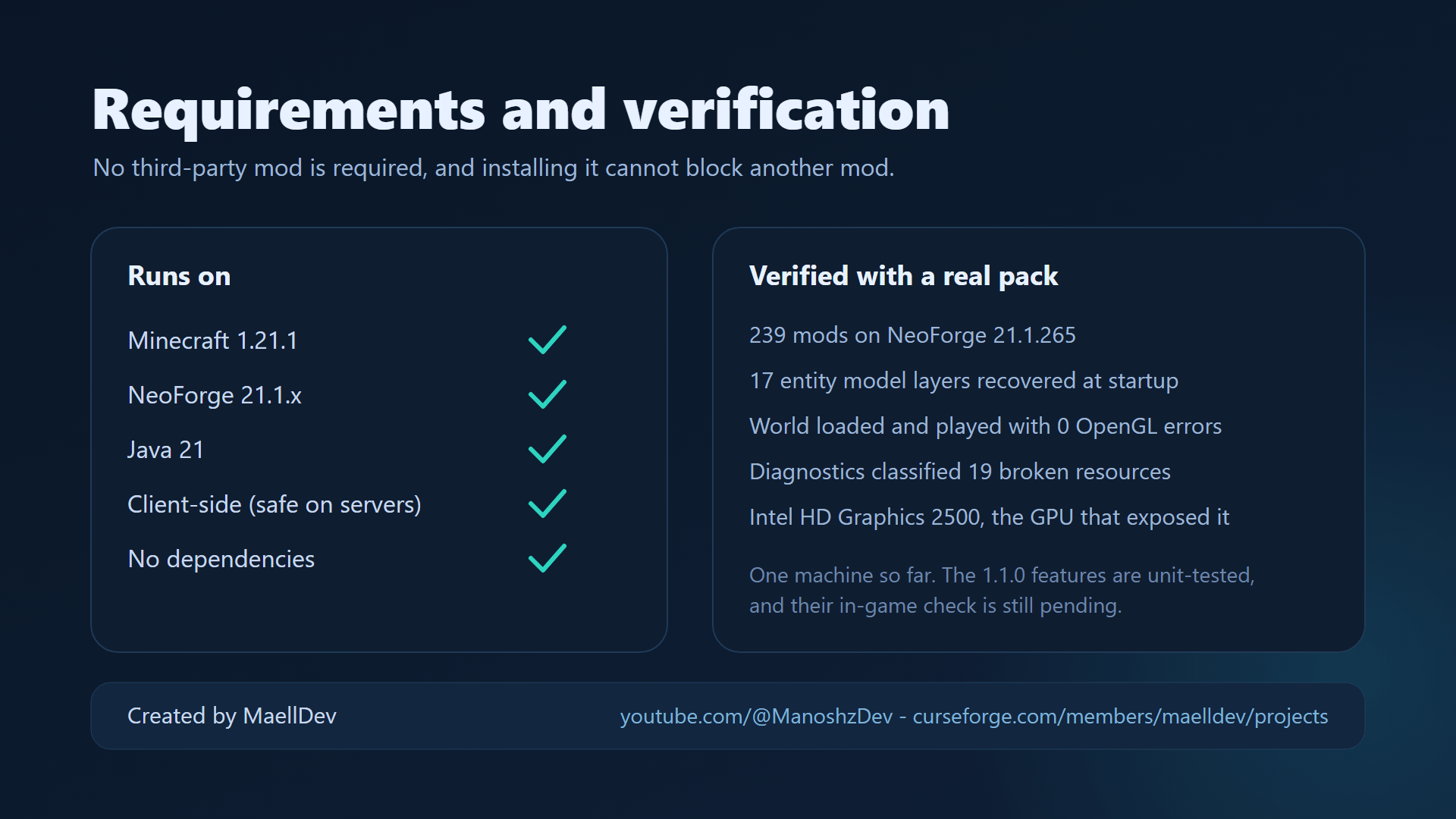
- Minecraft 1.21.1
- NeoForge 21.1.x
- Java 21
No third-party mod is required. The integration with Twilight Forest is detected at runtime and never referenced by class, so installing LegacyRenderer cannot pull in, order around or block another mod.
Configuration
Open Mods > LegacyRenderer > Config in game, or edit config/legacyrenderer-common.toml. The master switch turns off every module and every mixin behaviour.
Verification
Developed and tested on an Intel HD Graphics 2500 with a 239-mod NeoForge pack, where it recovered 17 entity model layers at startup and loaded a world without OpenGL errors.
Credits
Created by MaellDev. YouTube: https://www.youtube.com/@ManoshzDev CurseForge: https://www.curseforge.com/members/maelldev/projects
LegacyRenderer Team