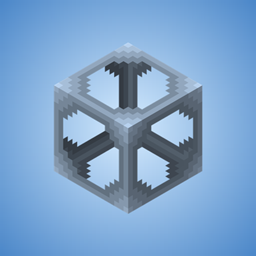
Laterna
- By
Light sources in all sixteen dye colours: lamps, slabs, panels, bulbs, fixtures, rods, a cased lamp, and a recessed spotlight with no thickness at all. Every frame follows its lamp's colour, or stays fixed black or white.
Laterna adds light sources in all sixteen dye colours, in ten shapes, each of which can wear its frame in its own colour or in a fixed black or white. Lit, they give off light level 15. The colours are the game's own dye values, so a Laterna lamp sits correctly beside wool, concrete and terracotta of the same name.
Shapes
Lamp — a full block, and the only shape with a wiring choice: one that redstone switches on, and an inverted one that redstone switches off.
Slab and Panel — half a block, and a thin plate. Horizontal and vertical are separate blocks, so each one places where you point rather than depending on which half of a face you happened to click, and a single item crafts one into the other. Two slabs stack into a full block that still reads as two slabs, on either axis.
Spotlight — recessed into the surface it is put on, with no thickness whatsoever. Floor, wall or ceiling.
Bulb, Fixture and Rod — small fittings. The fixture takes a different shape on a wall than on a ceiling, because the two want different things of it.
Cased lamp — an opaque core inside a clear case, put together the way vanilla puts together a beacon.
Anything mounted on a face drops when the block it is stuck to is broken.
Frames
Every framed shape comes three ways: the frame in the lamp's own colour, fixed black, or fixed white. Which one you get is decided by what the frame is made of — ordinary stone, polished blackstone, or quartz — so no two recipes ever collide and nothing is needed to choose between them.
Crafting
The first lamp is glowstone and redstone in a ring of stone. After that:
- Dye eight lamps of a kind with one dye to get eight of another colour. The kind is kept: dye an inverted lamp and an inverted lamp comes back.
- Turn a horizontal slab or panel into its vertical twin, one at a time, and back.
- Slabs and panels have their own recipes as well, so you need not go through the block.
Under it
368 blocks, and not one of them is written out by hand. The blocks, models, block states, recipes, loot tables, tags and names are all derived from the product of shape, wiring, frame and colour, which is why every colour behaves identically and why nothing is missing from any corner of the set.
The textures are drawn from formulas rather than kept as image files — the repository holds no PNGs at all. A resource pack can still replace any single one of them, because what ships is ordinary textures rather than a tint applied at runtime.
Requirements
NeoForge on Minecraft 1.21.1. No other dependencies. MIT licensed.
The Laterna Team