volume_5_complementary_20s.jpg
2026-11-05_20.22.04.jpg
2026-11-05_20.23.59.jpg
2026-11-05_20.22.24.jpg

Description
Kiloton
A nuclear bomb for Minecraft that behaves like one.
Most nuke mods delete a sphere of blocks. Kiloton runs the physics. Every radius comes from the scaling laws in Glasstone and Dolan's The Effects of Nuclear Weapons, one block is one metre, and the blast plays out over time the way a real one does: first the flash, then the ground shaking, then the blast wave rolling in at the speed of sound, then the long roar as the fireball climbs into a mushroom cloud that you can still see from kilometres away.
And you have to earn it. Mine uranium, mill it, enrich it in a cascade of gas centrifuges, breed plutonium in a reactor, cast the cores, and load them into the pit of an implosion device. How big the bang is depends on how much fissile material you put in.
The blast
- The flash comes first. It whites out the screen, leaves an after-image in your eyes, bleaches the land and sets exposed wood and canopies on fire, out to where the thermal pulse really reaches.
- A blast wave you can watch coming. It leaves ground zero at several kilometres per second and slows down to the speed of sound further out. Blocks break when the wave actually gets to them: glass and leaves first, then wooden houses, then brick and stone. Hills and strong buildings cast a blast shadow behind them.
- A real crater with an ejecta lip, the floor fused into green trinitite glass.
- Ruins, not a clean slate. Forests are blown flat, their trunks lying on the ground pointing away from ground zero. Further out the trees stand stripped bare. Buildings collapse into heaps of their own cracked blocks.
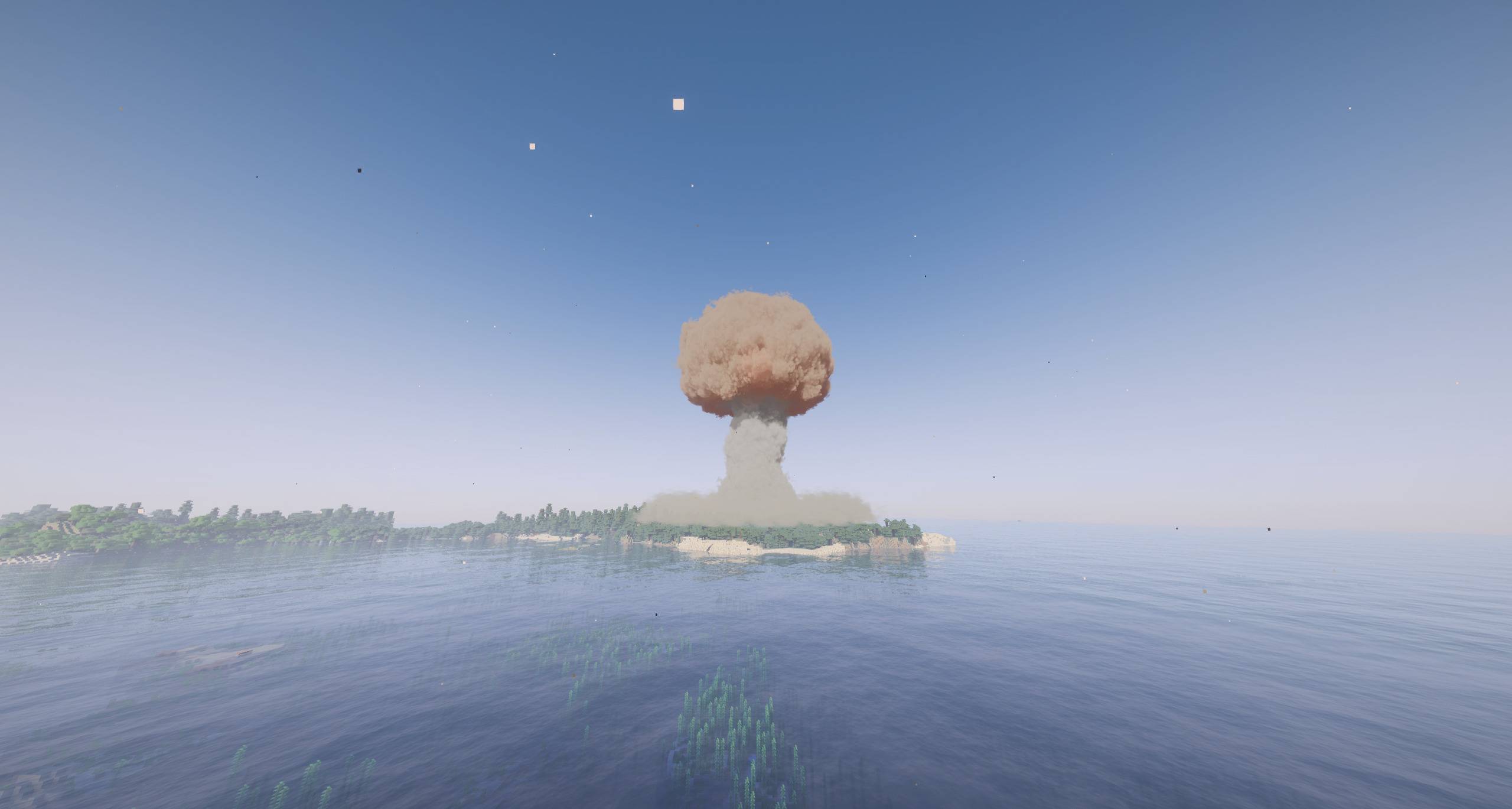
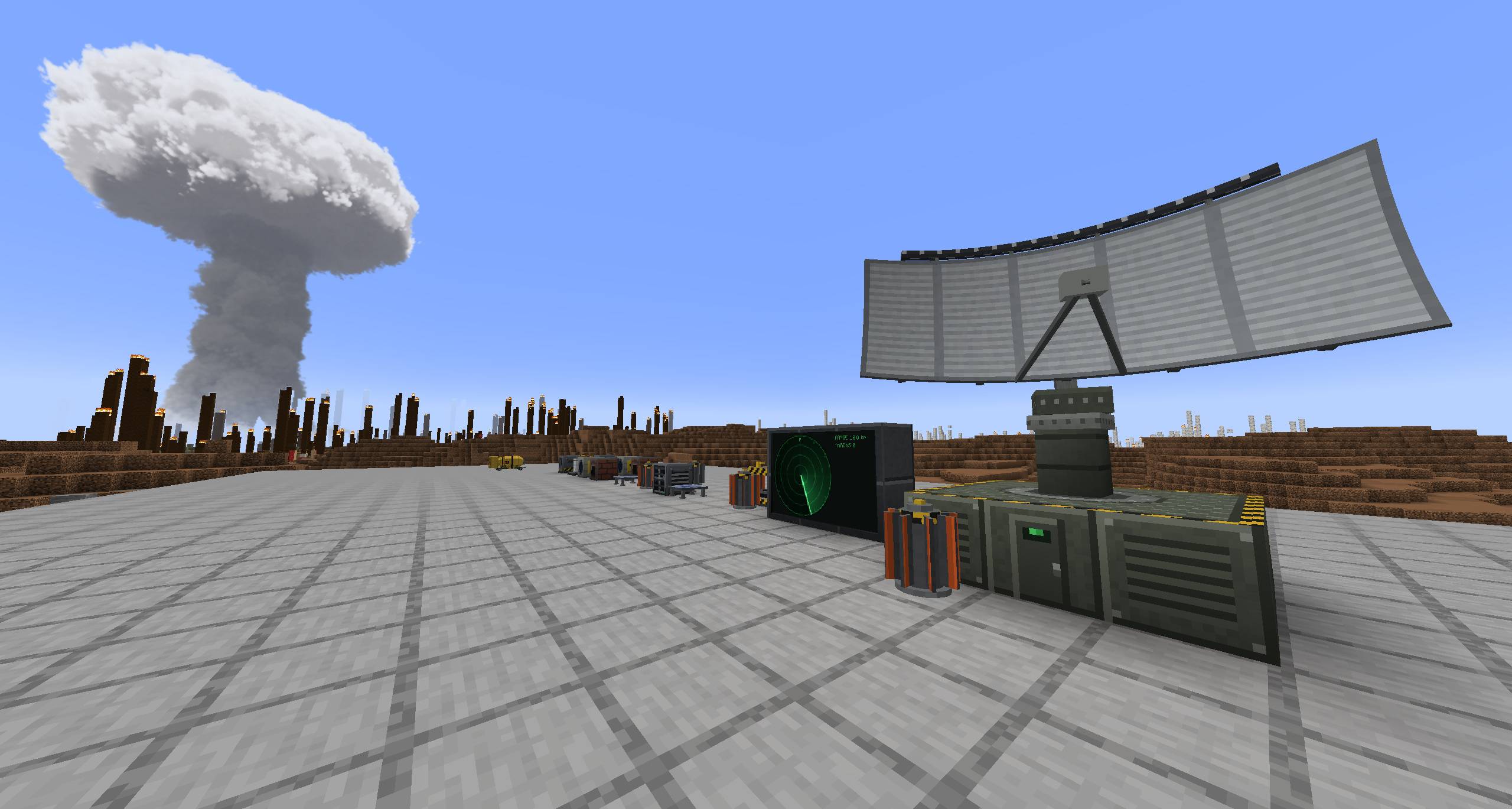
- The mushroom cloud rises for minutes: a rolling toroidal cap, a dust stem, a base surge, a Wilson condensation cloud, condensation collars and an ice cap. It drifts downwind and stays visible far beyond your render distance.
- Sound that arrives late. The boom reaches you only when the wave does, so standing a few kilometres away you get the flash, then several seconds of silence. A near blast cracks; a distant one only rumbles.
- Detonations at sea throw the water aside, and the sea closes back over a crater on the seabed.
The aftermath
- Fallout settles downwind along a plume that follows the wind, and decays with the 7-10 rule: deadly for a few minutes, dangerous for an in-game day, safe after a couple of weeks.
- Black rain, as at Hiroshima: over wet land the soot of the fires and the fallout come down a few minutes later as dark, radioactive rain.
- Radiation sickness in five stages, for players and for animals and monsters too. Shelter cuts the dose to a fifth, being under water cuts it to a tenth.
- A Red Forest: where the dose is lethal to trees, pines and spruces first, the foliage dies and turns red-brown a day later.
- Shadows on the ground. Caught in the open by a lethal flash, you watch from outside your body as the light falls on you, then you are gone, and your shadow stays printed on the ground like the ones left on the steps of Hiroshima. It can be turned off in the config.
- The world keeps changing where nobody is. Chunks that were not loaded during the blast are damaged when they load, and fires, dust and dead forests appear there as if the time had passed.
The bomb
The Nuclear Bomb is an implosion device two blocks long, sitting on its transport cradle. Its panel shows the assembly in cross-section: load up to six uranium or plutonium cores into the pit and, if you want, a depleted uranium tamper around it.
The yield follows the physics of critical mass:
| What is in the pit | Yield |
|---|---|
| Below one critical mass | Only the explosive lenses go off |
| 2 uranium cores + tamper | About 50 tons (a fizzle) |
| 3 plutonium cores + tamper | About 20 kilotons (Fat Man was 21) |
| 3 uranium + 3 plutonium cores + tamper | About 100 kilotons |
| 6 uranium cores + tamper | About 115 kilotons |
The readout tells you what you are about to do: the yield, how far past critical the pit is, the fireball, how far houses are flattened, how far fires start and how far away to evacuate. Set the countdown (5 seconds to 10 minutes), lift the safety cover and press the red button. A redstone signal arms it too.
While it counts down, every player within reach of the blast gets a warning in chat and a red bar with the time left, and the beeps speed up in the last ten seconds. An armed device cannot be broken. Disarm it first.
The remote detonator
Every bomb has a six-digit arming code on its panel, a Permissive Action Link. Sneak-click a bomb with a Remote Detonator to link it, then open the detonator anywhere, type the code and press ARM or SAFE.
- The radio works up to 10 km away (configurable) in the same dimension.
- Three wrong codes lock the radio out for a minute.
- An armed bomb keeps its chunk loaded, so the countdown runs on after you have left.
- A linked detonator is useless without the code, so in multiplayer you can hand one over and keep the code to yourself.
Ballistic missiles
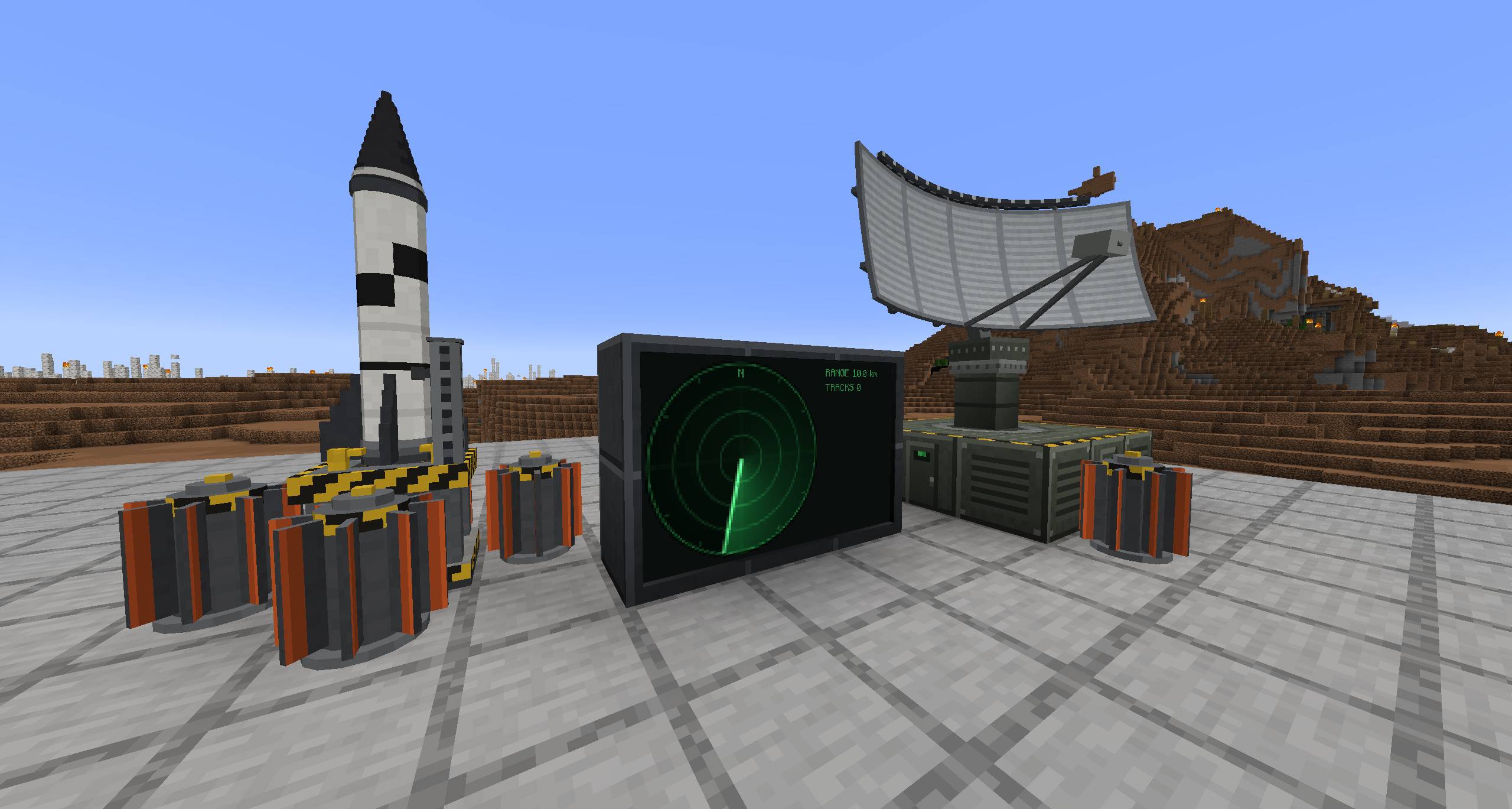
Put a Ballistic Missile on a Launch Pad and it stands there, three blocks tall. Load its warhead like a bomb's pit, type the target's coordinates, charge the pad with energy, lift the cover and press the switch.
- After a ten-second countdown, which you can abort, the missile lifts off slowly.
- It pitches over, coasts over the top of its arc and dives onto the target, up to 20 km away.
- Its flame and smoke trail can be seen from kilometres away.
The flight costs your server nothing: a missile in flight is a path computed from the clock, not an entity dragging chunks along. It survives a restart.
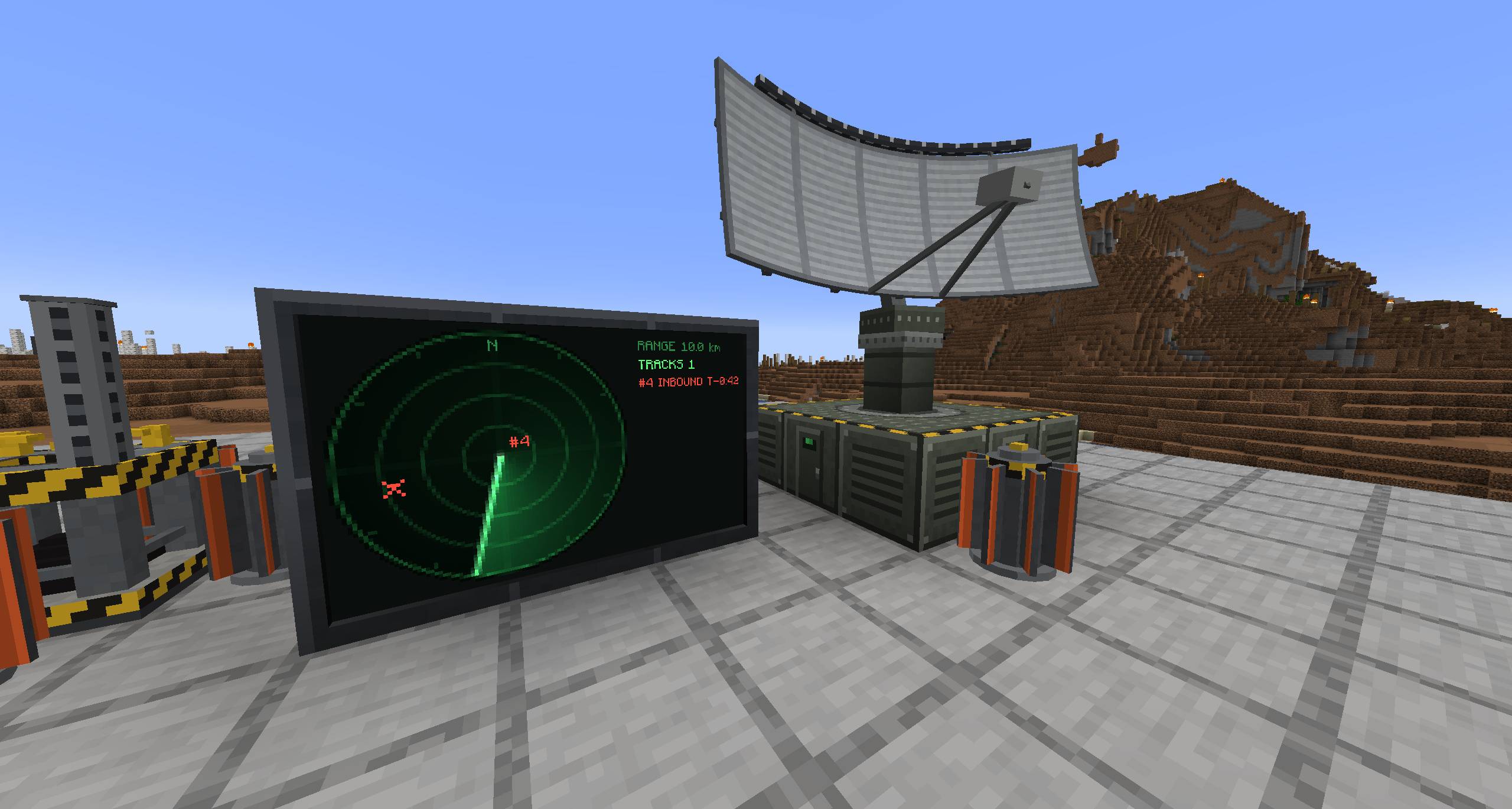
Radar
The Radar tracks every missile in flight within 10 km on a sweeping green scope:
- missiles coming down inside its range turn red, with their impact point marked and the time left;
- while one is coming in, it gives a redstone signal, so you can wire it to blast doors, lamps or anything else.
Fallout shelters
A shelter is a pocket of air closed on every side. Kiloton finds it and works out what it can take:
- Blast: the walls hold until the wave is stronger than their weakest point. A one-block stone-brick bunker holds 17 psi; a bunker dug into rock only fails inside the crater. Inside, the wave cannot hurt you and the flash cannot reach you.
- Radiation: the walls cut the prompt radiation and the fallout's gamma by their real protection factor. A metre of stone stops nearly all of it; a wooden hut very little.
- Air: without a filter, fallout dust seeps in over a few minutes. An Air Filter keeps it clean.
The Shelter Survey Meter tells you all of it:
- whether the room is closed, and if not where the air gets in;
- the overpressure its walls hold, and where the weakest wall is;
- how far away it survives a Fat Man and a full-size warhead;
- its protection factor;
- whether its air is filtered.
Power
Everything runs on Forge Energy, so you can use any power mod. Kiloton also brings its own sources:
- Solar Panels for the early game: up to 15 FE/t at noon, less in the morning, evening and rain;
- Nuclear Cells, plutonium power cells that give 40 FE/t for two hours of play in a Radioisotope Generator or any machine's fuel slot;
- the Breeder Reactor.
The uranium industry
Uranium ore (pitchblende) lies deep in stone and deepslate, about as common as gold.
| Machine | Takes | Makes |
|---|---|---|
| Uranium Mill | raw uranium or the ore | yellowcake |
| Gas Centrifuge | yellowcake, then low-enriched, then highly enriched uranium | 4%, then 20%, then 90% (weapons-grade) uranium, plus depleted uranium at every pass |
| Breeder Reactor | depleted uranium, burning low-enriched fuel | plutonium-239, and power for the machines around it |
| Core Foundry | weapons-grade uranium, plutonium or depleted uranium | uranium cores, plutonium cores and tampers |
Centrifuges placed next to each other form a cascade and run faster. Every machine runs on Forge Energy: burn coal in its fuel slot, connect another mod's cables, or put it next to a running reactor. Hoppers and pipes work. Other mods' uranium (the c:raw_materials/uranium and c:ores/uranium tags) goes into the mill.
All the recipes show up in JEI, including the machines.
The Geiger counter
Hold it to hear it click and to see its dial, from the natural background (about 12 µR/h) up to 1000 R/h. It counts like a real tube: a click every few seconds in clean air, a crackle near exposed uranium ore or a pocket full of plutonium, and a roar in fallout. Use it to read the dose you have absorbed.
Advancements
A whole tab, from your first uranium ore to Now I Am Become Death, the Destroyer of Worlds, with challenges for disarming a bomb in its last five seconds, setting one off from more than a kilometre away and living through a blast where it flattens houses.
Server friendly
The destruction runs a few milliseconds per tick, a budget you can configure, and follows the wave instead of happening all at once. Blocks are written straight into chunk sections, with one light update per column and no item drops. Unloaded chunks inside the radius are remembered at one bit per chunk and damaged when they load. /nuke status shows what running blasts cost the server, and /nuke stop ends the block damage.
Commands
/nuke <kilotons> [x y z]: detonates at once (a surface burst)./nuke info <kilotons>: prints the radii of a yield./nuke status,/nuke stop
Configuration
Server:
- block damage on or off;
- maximum radius (4 km by default) and maximum yield (150 kt);
- tick budget;
- fires;
- creature damage;
- fallout;
- the death scene;
- the countdown a new bomb starts with;
- machine speed;
- detonator range, missile range and radar range.
Client:
- the size of the mushroom cloud;
- flash strength (or off);
- camera shake;
- sky effects.
Compatibility
- Minecraft 1.21.1 (NeoForge) and 26.3 (NeoForge).
- Works with Sodium, Iris and shader packs on 1.21.1.
- JEI for every recipe and machine.
- JourneyMap: your own missiles in flight on the map and minimap, with the time to impact and the target.
- Forge Energy and item pipes from any mod. Uranium from other mods is accepted through the common tags.
Made from scratch
Every texture and every sound in Kiloton is generated by code: no samples and no third-party assets. The explosion sounds come from a small physical model: a shock N-wave, the boom, the afterwind roar and things breaking. They reach the listener through terrain echoes and the air's frequency-dependent absorption.
By Gabriele_333, SaturnX Studios.
Kiloton Team

Owner