


HoodCraft
- By
Description
Tameable pets modelled on the mascots of Robinhood Chain tokens.
A small, self-contained progression that hangs off Minecraft's own archaeology loop. It starts with a bird and a feather, and ends with you brushing dust off something that hatches.
Two pets so far. More arrive as more mascots do.
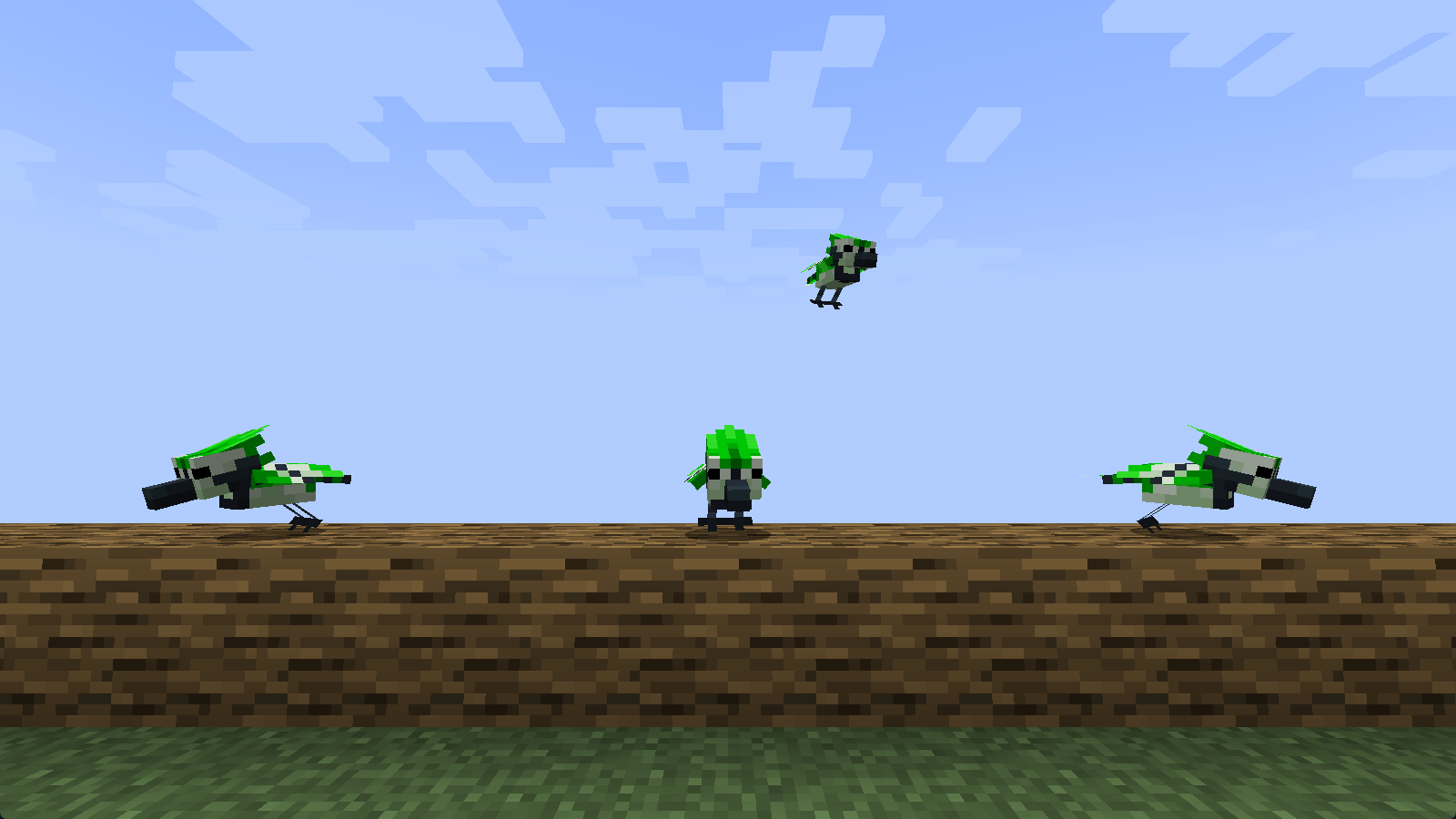
The Ray
A green bird that behaves the way a parrot does — it flies, it perches on your shoulder, it sits when told, and it never takes fall damage. Two things set it apart: you tame it with wheat seeds rather than cookies, and unlike a parrot, a tamed pair can be bred. Forest biomes.
The Cash Cat
The crying cat. It sits where it spawns and weeps, which is its whole character. Cooked salmon tames and breeds it, but salmon will not cheer it up — only a gold ingot does that, and only for one Minecraft day, during which it drops the slouch, stops crying and behaves like an ordinary cat. Feeding it any ingot is also a lottery: one time in ten thousand it turns up a buried treasure map. Creepers and phantoms fear it exactly as they fear a vanilla cat.
The Black Feather
What a Ray drops, and the only feather the Hood Brush can be built from.
The Hood Brush
A Black Feather, a gold ingot and a stick. It handles exactly like the vanilla brush — 64 uses, 4.8 seconds a block — but uncovers a different set of things: a nautilus shell, an emerald, leather boots, a stone hoe, or at 6.7% a pet egg.
Pet eggs
Brushing is the only way to get one. Place it and wait: 30 minutes to hatch, 15 on wool, 5 on slime or honey, through three visible cracking stages. The block underneath is re-read at every stage, so moving an egg part-way through changes the time left.
Only pets you cannot otherwise find get an egg. The Ray spawns in forests and is where the Black Feather comes from, so an egg for it would be a circular reward. The Cash Cat has one.
Suspicious gravel in ancient cities
Thirty percent of the loose cobbled deepslate on an ancient city's floors becomes suspicious gravel, so a brush has somewhere new to be used. Vanilla's suspicious sand behaves as it always did.
Unlike a vanilla brush, the Hood Brush also works on suspicious blocks you placed yourself — handy for testing and no exploit, since neither block can be obtained in survival at all. A block that has already been brushed keeps whatever it rolled, so results cannot be re-rolled.
Reference
| Ray | 6 hearts · wheat seeds to tame (1 in 3) and breed · forest biomes |
| Cash Cat | 10 hearts · cooked salmon to tame (1 in 3) and breed · plains, savanna, taiga |
| Cheering a Cash Cat | one gold ingot, one Minecraft day (24,000 ticks) |
| Treasure map | any ingot, 1 in 10,000 |
| Hood Brush | 64 uses · 96 ticks (4.8 s) a block |
| Pet egg from brushing | 6.7% |
| Egg hatch | 30 min · 15 on wool · 5 on slime or honey |
Requirements
Minecraft 1.21.1 and NeoForge 21.1.x. Nothing else. The Ray's model was rebuilt against vanilla, so there is no dependency on Citadel despite the geometry originating in a mod that needs it. The Cash Cat is built on vanilla's own cat mesh, reposed.
Credits and licence
Released under GPL-3.0-only. The licence is inherited rather than chosen: the Ray's model geometry and its bird calls derive from the Blue Jay in Alex's Mobs by Alexthe666, which is GPL-3.0 and copyleft. The Cash Cat's geometry is vanilla's cat, reposed, and it uses vanilla cat sounds.
HoodCraft Team
