Heedless Horticulture
A little botany, a little redstone, and several plants that would rather you kept your distance.
Heedless Horticulture adds thorny bushes, iron-coated dripstone, concealed spike traps, an earthy new pigment, and a coastal wetland with salt gathering and blue-hearted Salt Mahoe trees. Its survival recipes connect exploration, harvesting, building, and a few deliberately unhelpful discoveries.
Watch where you walk
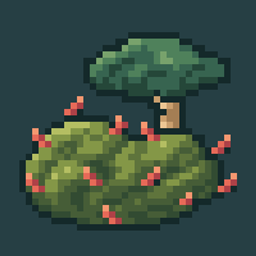
Prickly Stuff grows two blocks tall in birch forests and meadows. Touching it applies Pricked: movement slows to 60%, ordinary jumps reach roughly 85% of their usual height, and the bush deals 2–3 health points on each damage pulse. A red border flashes with the damage, and thorns remain visible on affected players.
Shear a bush to obtain Trimmed Prickly Stuff, a harmless low patch with upright thorn stems. Use a glass bottle on five fresh trimmed patches to collect a full Bottle of Prickly Liquid. Each harvest leaves a desiccated patch that can fuel a furnace for as long as a stick. Prickly liquid is a crafting ingredient; it cannot be drunk.
Iron-coated spikes and redstone traps
Craft Reinforced Pointed Dripstone by surrounding pointed dripstone with eight iron ingots. Place a single spike or build a cluster of up to four in one block, then extend connected upright or hanging columns. Reinforced stalactites fall faster, hit harder, and cause extra armor wear. Exposed standing tips also hurt when landed on.
Combine trimmed prickly stuff, reinforced pointed dripstone, and a heavy weighted pressure plate vertically to craft a Prickly Trap. Power its supporting block to raise four spikes through recessed sockets in the iron plate. Remove the power to retract them.
Make Prickly Dye
Craft a full prickly-liquid bottle with a brush. The recipe returns the empty bottle. Paint an iron block with the coated brush, then scrape the coating away with an axe to collect Prickly Dye and restore the iron block.
The pigment has an earthy, raw-terracotta color. Use it in supported building materials, leather equipment, beds, banners and shield patterns, fireworks, sign lettering, sheep fleece, and pet collars. Extra vanilla dyeable items are supported where those items exist in the selected game version.
Explore the Salty Marsh
Salty Marsh generates in new Overworld coastal wetland terrain. Shallow pools, muddy beds, and muddy banks form a swamp-like landscape. Pink-and-white Salty Mud is visible along the waterline and beneath the surface. Glasswort, smooth cordgrass, sea aster, and saltgrass grow underwater with Wet Salt deposits.
Use a hoe on salty mud to collect 2–3 Wet Salt, leaving ordinary mud behind. Natural wet salt clumps grow on suitable submerged sediment rather than salty mud. Collected clumps can be placed against supporting faces, with multiple faces sharing one block space.
Craft nine wet salt into a Wet Salt Block. Place it over a solid block with pointed dripstone hanging below: it dries into a Salt Block using the same random-tick mechanism as mud drying into clay. It does not fill a cauldron. A salt block crafts into nine salt.
Salt cooked meat, fish, rabbit stew, carrots, or potatoes to gain one extra food point. Salted sweets retain their familiar names but restore one less food point.
Two unusual trees
Salt Mahoe has pale brown bark, muted deep-blue cut wood and planks, and broad dark-green leaves with falling leaf particles. Ordinary trees stand 4–6 blocks tall and have 2–5 curling branches. Rare old growth has 3–7 branches, larger crowns, and occasionally thicker bases. Salt Mahoe Roots grow around the base and can be waterlogged. Muddy Salt Mahoe Roots sit in the soil and can be crafted from roots and mud. The wood family includes logs, stripped wood, planks, stairs, slabs, fences, gates, doors, trapdoors, buttons, and pressure plates.
Utopibark is a rare golden-green tree with purple foliage found in pale gardens on versions that include them. Its wood is stubbornly hard to break, and axes do not speed it up. The Laminated Utopibark Knot is an especially questionable building material: leave it unsupported and it falls, with an unpleasant chainmail surprise waiting below.
Installation and compatibility
Choose the file that explicitly matches your Minecraft version and loader. Install the listed dependencies and put the mod JAR in the mods folder. Install the same mod version on the client and server for multiplayer. World-generation additions appear in newly generated chunks.
Release 0.0.3 includes the reworked Salty Marsh. Choose the exact game version in each file title and its compatibility notes, especially for snapshots that share a CurseForge tag.
| Edition |
Minecraft |
Requirements |
| Fabric |
Exact versions listed on each file |
Fabric Loader, matching Fabric API, and the game's Java version |
Install the edition for your loader. Games with fewer vanilla blocks and items may use documented substitutes. Each file lists its dependencies and verification scope.
For Paper, Spigot, and CraftBukkit, see Heedless Horticulture: Server Edition. That separate Bukkit-compatible plugin uses vanilla world visuals and has its own supported-version list and feature differences.
Feedback and support
Comments are open. Please report bugs through this project's Issues tab and include the Minecraft version, loader, mod version, steps to reproduce, and relevant crash report or log excerpt.
You can support development through GitHub Sponsors: tjtjklra529.
The project icon is original pixel artwork drawn on a fixed grid and rendered with Python. This is an independent project and is not affiliated with Mojang or Microsoft.