Evolution: You Become What You Do
- By
Evolution_0.png
Evolution_1.png
Description
Evolution
You become what you do.
2.0 — Two dimensions.
The Blight is where the corruption comes from. Nine creatures, a boss, a weather of its own, and a way to shut the source for good. Going in is for the prepared.
The Reflection is yours alone. It begins as a flat plain of bare stone, and it grows into a country as you do — hills, rivers, lakes, forests, snow. One per player, and nothing you build there is ever touched.
Evolution never asks you to pick a class. It watches how you play.
Every sprint, every blow landed, every dive, every night spent underground is measured. Your character adapts to what you actually do — not to a box you ticked on day one.
Two players who start the same world will not end up with the same character.
How it works
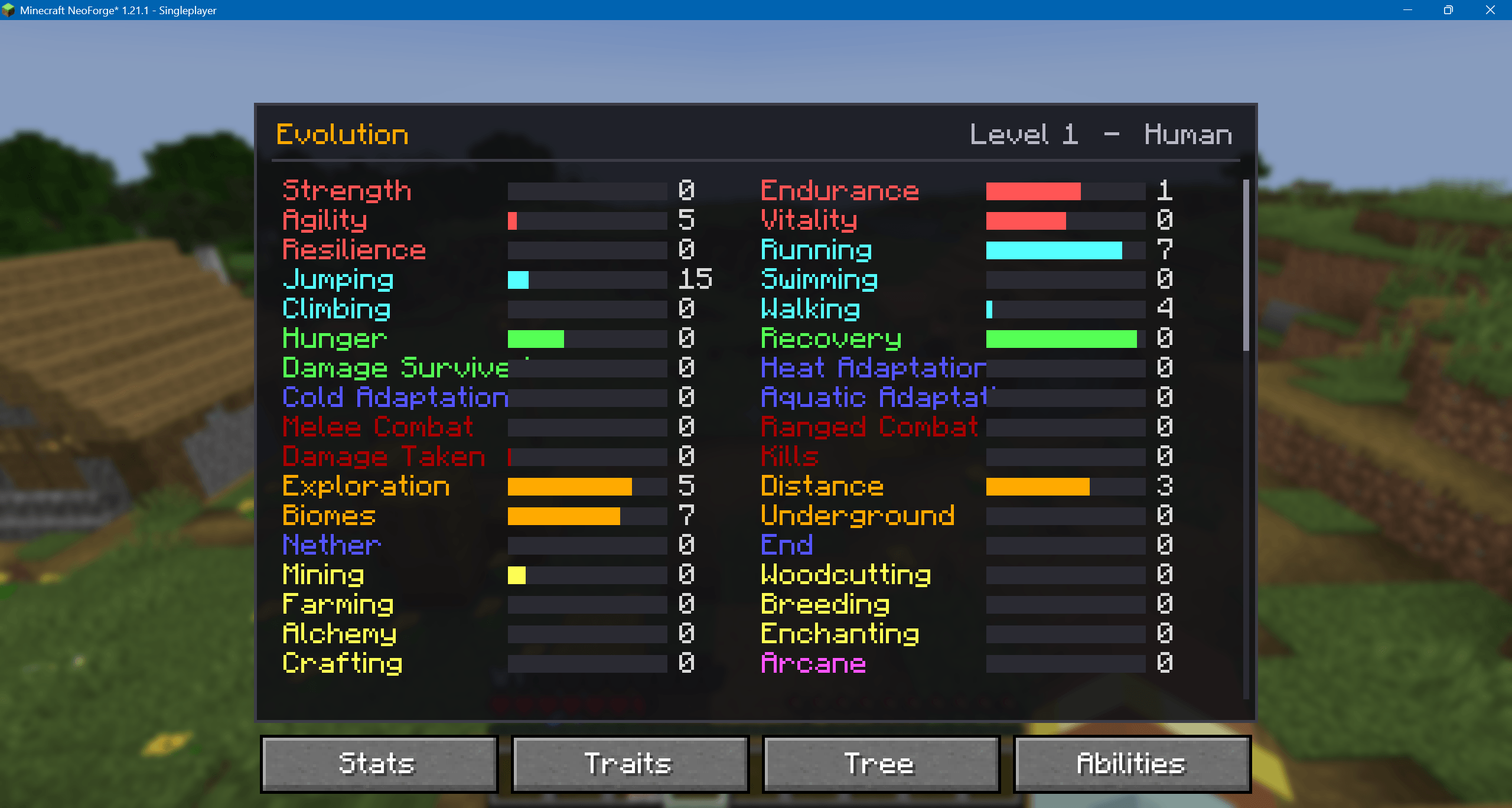
39 behavioural stats rise on their own as you play. Running feeds Running and Endurance. Diving deep feeds Aquatic Adaptation. Taking hits forges Resilience. Cleaning corrupted ground feeds Purification.
Those stats unlock 59 passive traits, then 110 evolutions across six tiers — including 10 that never announce themselves.
HUMAN
  ├── ATHLETE ───── ACROBAT ───── GALE WALKER ───── STORMBORN
  ├── WARRIOR ───── BERSERKER ─── WARLORD
  ├── EXPLORER ──── NOMAD ─────── WORLD WALKER
  ├── SWIMMER ───── DIVER ─────── ABYSS WALKER ──── ABYSSAL SOVEREIGN
  └── CLEANSER ──── GREENWARDEN ─ LIFEBRINGER
Some evolutions merge two branches. A berserker who also studied the arcane can become a Blood Mage — but only if both paths were genuinely walked.
Others are mutually exclusive. Committing to the berserkers closes the monk's road for good. Your choices carry weight.
Pacing you can feel
Progress is quick at the start and stays honest: on whatever you are actively doing, expect around level 5 after five minutes, level 30 after an hour, level 50 after two.
More importantly, every stat runs at the same pace. That sounds obvious and it wasn't: because walking is sampled twenty times a second while brewing happens once a minute, some stats used to reach level 50 in six minutes and others in nearly two hours. Each of the 39 was measured against an hour of focused play and calibrated to the same target.
One setting, xpScale, moves the whole mod faster or slower without breaking that balance.
Vanilla experience is multiplied by four, at the single point every source passes through — mobs, ore, furnaces, fishing, breeding, trading. Levels you spend are untouched: enchanting still costs what it costs. Gain faster, don't pay less.
The traits
Fifty-nine of them, spread over seven categories. Some are plain bonuses; the interesting ones sit at the edges.
Three are negative, and all three are reversible. Sedentary if you stop moving, Soft Hands if you stop breaking blocks, Frail if your body is never tested. They only appear after thirty minutes of play — a fresh character has every stat at zero and would otherwise start diminished, which is the opposite of the point. Each fades the moment you take it up again.
Mana has its own three. Wellspring deepens your reserve by 15%, Quick Channel returns it 25% faster, and Archmage — which asks for both plus the arcane — takes 10% off every mana cost in the mod.
Cooldowns shrink as you grow. Two levers multiply: the level of the ability itself, and your overall character level. They multiply rather than add, because added reductions eventually reach 100% and abilities become free.
Mana and magic
A mana bar sits above the food bar, out of the way of your armour. It powers 27 abilities — some fired from a key, some always on, some you toggle.
| Ability | Effect |
|---|---|
| Dash | Leap in the direction you face |
| Flight | Sustained flight, continuous mana drain |
| Meditation | Stand still and draw mana back in |
| Devourer | Swallows the blocks in front of you, range grows with level |
| Fireball | Explosive projectile at high level |
| Time Warp | Slows everything around you |
| Blight Sense | Reveals putrid soil through the world around you |
| Predator Vision | Outlines every hostile within range |
Abilities level up through use. An ability you rely on becomes stronger and cheaper.
Magirite
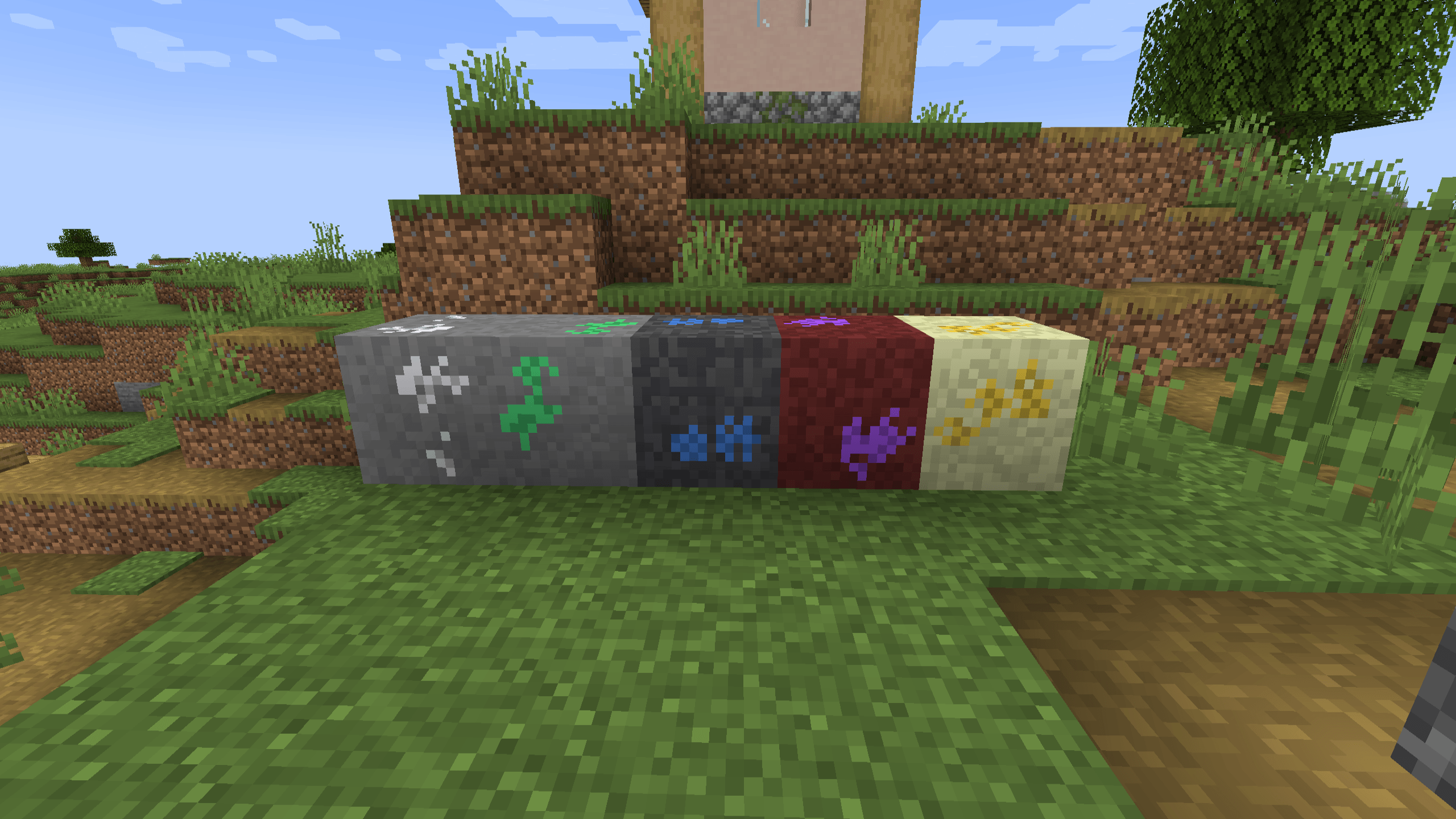
Five magical ores, each in its own dimension:
| Where | Height | Rarity | |
|---|---|---|---|
| White Magirite | Overworld | Y −16 to 112 | common |
| Green Magirite | Overworld | Y −32 to 64 | uncommon |
| Blue Magirite | Overworld, deepslate | Y −64 to 0 | rare |
| Purple Magirite | Nether | Y 10 to 110 | very rare |
| Yellow Magirite | The End | Y 0 to 70 | legendary |
Each yields a full equipment set — armour, sword, bow, four tools — plus two weapons found nowhere else.
The wand fires an arcane bolt in the exact colour of its material. The grimoire strikes up to six enemies at once. No ammunition: only mana, and the rarer the Magirite, the less it costs.
The focus is an amulet that lightens all your magic. It has its own inventory slot — carrying it in a pocket was invisible, and nothing stopped you putting it in a chest while believing you kept the bonus.
Magirite gear is unbreakable and enchantable. Both, which took some doing: unbreakable items are still enchantable in 1.21, but only if the item tags say so. All fifteen are shipped.
The five torches
Magirite torches light at 15 — the game's maximum — and never go out in the rain. Four of the five do something beyond that.
| Torch | What it does |
|---|---|
| Green | Grass spreads onto bare dirt, plants grow twice as fast, and putrid corruption cannot cross |
| Blue | Pushes corruption back, returning it to bare earth — fast |
| White | Nothing hostile spawns within 50 blocks |
| Yellow | Shoves hostile mobs out of a 12-block radius and makes them forget their target |
| Purple | Coloured light, and that is all |
The yellow torch pushes rather than kills: a monster that died on approach would be a silent, free experience farm. The white torch's radius is far larger than the yellow's because their costs work differently — one answers a question, the other goes looking.
The white torch spares anything loaded from disk, and anything marked permanent. Without that, a mob farm built inside the radius would quietly stop working.
The putrid corruption
A world event, not a biome. Dirt turns, and it spreads if nothing stops it.
Walking on it drains your hunger — not your health. A floor that hurts is a floor you walk around; a floor that starves you is a floor you want to clean, which is the behaviour worth encouraging, because cleaning it is possible.
A green torch holds the front. A blue torch takes ground back. The two keep distinct roles on purpose: blue returns bare earth, green makes it green again. Clearing it by hand pays full price into the Purification stat; a blue torch working while you stand guard pays a fifth — and pays nothing at all if no player is within 32 blocks.
Purification unlocks three traits and a three-step evolution branch that starts from human: repairing the world is neither strength nor speed.
The whole event switches off from the settings screen. It is a world rule, not a display setting — only an operator can change it, and it applies to everyone.
Markers and teleport cubes
Magirite markers pin a place. Five per world, shared between every player — that is a design choice, not a limit: it forces you to agree on what deserves pinning. Past five, the oldest stops being followed and the message says which marker and whose, and warns its owner too. A compass strip at the top of the screen gives direction and distance for every marker in your dimension.
Teleport cubes cost nothing to use. No mana, no delay, no range. The whole price is in the recipe — four gems including purple and yellow, so nothing before the Nether and the End. Right-click any cube to see every other cube in the world and go there.
Two consequences you should know about, both open by default and both closable in one line of config:
- cubes cross dimensions, which short-circuits the 8:1 portal ratio — the main reason to build in the Nether;
- cubes work in combat, so any fight can be left instantly, Nemesis included.
Every teleport request is recalculated from scratch by the server: seven separate refusals, from cheapest to most expensive. The list your client receives is for display, nothing more.
The Blight — a whole dimension
The putrid corruption is not spontaneous. It leaks from somewhere, and 2.0 lets you go there and close it.
The terrain has the shape of an Overworld. Hills, valleys, caves, stagnant pools — but everything has rotted. You recognise a familiar landscape that something has happened to, which unsettles far more than an exotic one.
The danger is hunger, not a horde. Nothing spawns from the light, and the dimension drains you continuously: about nine minutes from a proper meal, four and a half from a plain full bar, two from a half-empty one. You do not go in to fight. You go in with food, a plan and a way back.
That drain is exhaustion, not food removed — so saturation absorbs it first and the mod's own metabolism traits reduce it. A player who pushed HUNGER lasts far longer down there. The dimension rewards a kind of progress that has nothing to do with combat.
Cleared ground takes itself back. Cleaning a patch wakes the saturated ground around it, which creeps in again. A green torch blocks that, and holding a clearing is the whole point of going. Purification pays ten times more here than anywhere else.
Getting in
Build a frame of Blight Frame — the same 4×5 shape as a Nether portal, corners optional — and light it with a Putrid Catalyst. The catalyst is consumed, and its recipe calls for putrid soil: you cannot open the door before you have met what comes out of it.
Nine creatures, and each one speaks to hunger
| What it does | |
|---|---|
| Blight Carrion | Circles overhead. Dives only when your food bar drops — it senses weakness, and gives up the moment you eat. |
| Rootdragger | Slower than a walking player. It never catches anyone; it holds you, which is what makes three of them deadly. |
| Spore Swarm | Fast, fragile — and it corrupts the ground where it dies. The one creature you are better off not killing. |
| Heartbearer | Guards the Hearts, and grows stronger near one: you cannot lure it away to fight it in peace. |
| Pale Leech | One point of damage, six of exhaustion per bite. It does not kill you, it empties your reserves. |
| Mire Swimmer | Ambush. It punishes entering the water, not standing near it. |
| Ashen Goat | The only meat in the Blight, and it does not breed — a herd on site would have deleted hunger outright. |
| Lanternback | Harmless, slow, luminous. Follow it and it leads you to a Heart. |
| The Blight Mother | The boss. The fight has a clock, and it is not your health bar. |
The Heart is bait, not treasure
Hearts are rare, buried and slow to break — about a minute with a diamond pickaxe, while your food bar falls. Breaking one wakes the Mother, and it is her death that seals the source: no new outbreak will ever begin in your Overworld.
Outbreaks already installed stay yours to clean by hand. A reward that erased them would have erased the torches, the traits and the evolution branch that exist for them.
Putrid Cores drop from Hearts and from the Mother. Place one and nothing spawns within 45 blocks — and not merely the hostile things, unlike the white torch. Breeding pens keep working inside the radius: babies, anything loaded from disk and anything marked permanent are always spared.
The ground is the enemy too
Waiting used to be free. A hearth left alone was a stain on the floor and nothing more. Now the ground itself argues with you.
Explosive mushrooms, three maturities, three radii — one, two, three blocks. The size reads from a distance, and that is deliberate: you cross a field of young shoots accepting the scratches, and you walk around a big one. They ripen over time, so a neglected hearth becomes a minefield.
Measured: the small one lets anyone live, the medium one kills an unarmoured player, and the large one kills through a full set of iron. Diamond is what it takes to absorb.
Two seconds before it goes, it blinks and hums — eight pulses. You are told,
once, and then it is your problem. Breaking one by hand never sets it off: a trap
you cannot remove is not a danger, it is a wall. And the blast obeys
mobGriefing, exactly like a creeper, so a server that turned that rule off keeps
its buildings.
Putrid tendrils never kill on their own. They slow you down, and that is where their danger lies: a player held in the middle of a mushroom field cannot back out. Fifty blocks of tendrils costs eight hearts — going round costs time, going through costs blood.
Putrid water poisons on contact, and it burns. A stretch of water in a Blight valley is no longer shelter and no longer a road: it is one more obstacle. It also catches fire from flame or lava, which is your weapon against the terrain — burning a pool opens a path, at the price of a fire to cross.
Its own weather
The Blight has three skies, drawn in turns of three to eight minutes.
| Weather | Share | What it does |
|---|---|---|
| Green storm | 20 % | Green lightning falls near anyone in the open: eight hearts, half of what full diamond absorbs |
| Acid rain | 30 % | Poisons whoever stays outside. Any roof at all is enough |
| Clear | 50 % | The only time the sky leaves you alone |
The difference that matters: the storm is suffered, the rain is avoided. All three shares are server-side settings.
Blight fauna spills over. Swarms and carrion now appear on Overworld outbreaks. No new creature for it — they are the same ones, and seeing them at home says better than any text where the corruption comes from.
The Reflection — a world that grows as you do
The mod has measured 39 stats since its first version, and only ever showed them as numbers on a screen. The Reflection turns them into a landscape.
It begins as nothing. A flat plain of bare stone to the horizon, at fixed noon, without a single tree. That is what a starting character gets, and it is the whole point: a world that is already beautiful cannot become beautiful.
Then it grows. Every visit, the land is reshaped to match where you are now.
| Global level | What is there |
|---|---|
| 1 | a flat plain of bare stone |
| 5 | the first swells, grass around you |
| 15 | real hills, and a first thread of water |
| 25 | rolling country, rivers widening, the first lakes |
| 40 | proper wooded hills |
| 60 | snow-capped mountains, lakes, forests |
| 100 | peaks 56 blocks above the plain, water everywhere |
Your global level shapes the land — how high the hills rise, when rivers appear, when lakes fill. Your stat families choose the materials, each pushing its own frontier outward from where you arrive:
| Family | What it brings |
|---|---|
| Survival | soil, then grass — the ground comes alive |
| Mind | trees |
| Craft | flowers and tall grass |
| Physical | snow on the peaks |
| Movement | sand along the shores |
| Combat | mossy stone |
| Exploration | reach — how far all the others can go |
A family left at zero leaves its material absent. A pure-combat character lives in a desert of mossy rock; a pure-mind character, a forest on bare stone. The imbalance shows, and that is the idea.
Getting there
  Mirror
  G G G      G = glass
  G R G      R = redstone
  I I I      I = iron ingot
Nothing that needs the Nether. Craftable on day one, and that is deliberate: the Reflection is not a reward, it is an instrument for looking at where you stand, and an instrument that arrives late measures nothing.
Hang it on a wall like a painting and right-click. A return mirror is always waiting for you on the other side.
One per player
Eight real dimensions exist in the mod's data, and you are assigned one the first time you go through. Activating someone else's mirror sends you to your own Reflection, not theirs — a mirror built in the village square does not expose its owner's world. Past eight distinct players the assignment wraps around, and the mod tells you so rather than letting two people discover it by building on top of each other.
Eight rather than "one per player" for an honest reason: creating a dimension while the game is running goes through an interface NeoForge marks with an unambiguous warning. A fixed pool lives in files, saves like anything else, and depends on no internal API. Raising the number is a matter of adding a file.
What you build there stays
The mod keeps a ledger of every position you have touched. Placing a block claims it. Breaking one claims it too — otherwise a tunnel dug by hand would be filled back in by the next pass, and nothing would have warned you. A claim is permanent: breaking your own wall does not hand the ground back to nature.
A claim stops the sculpting rather than being skipped over. The hill halts at the foot of your house; it never runs through it.
One exception, and it is on purpose: the return mirror is re-placed on every visit, claim or no claim. A promise about scenery is not worth a way out.
What to expect when you arrive
The whole reach is brought up to date in a single visit, and you watch it happen — between two and thirteen seconds of land rising around you, depending on your level. Nothing needs walking to; every chunk within reach is reworked whether you have ever been there or not.
The centre stays flat on purpose: a twenty-block stone forecourt where eight monoliths stand, one per stat family, their height reading your progress. Beyond it, the living world.
Two things the Reflection does not do. No stat rises while you are inside — it is a place to look, not to farm. And there is nothing hostile: only Echoes, neutral silhouettes of what you used to be, whose number follows your global level. Strike one and it disperses in particles without a fight. It is the one place in the mod where you risk nothing.
If your machine struggles as the land forms, blocksPerTick and chunksPerTick
in the reflection config section are the first two dials to turn down. The world
then forms more slowly and nothing else is lost.
The Reinforcement Altar
Got a level 40 wooden pickaxe and a brand new diamond one? The altar transfers the levels across.
The transfer destroys the source tool and loses 80% of the levels. That loss shrinks with your Arcane stat and the rarity of the Magirite you spend — down to 15% at best, never less.
The screen spells the operation out: each slot is labelled — Destroyed, Enhanced, Magirite — with an arrow showing which way the levels travel, and the exact gain and loss shown before you press anything. Nothing here should be discovered afterwards.
Crafting
Every recipe below works with any of the five Magirite. M is the gem of the tier you want; the tier decides the stats, never the shape. Learn the grid once and it holds from white to yellow.
Tools and weapons
Vanilla layouts, so nothing new to memorise.
  Sword          Pickaxe         Axe           Shovel        Hoe
  . M .          M M M          M M .          . M .        M M .
  . M .          . S .          M S .          . S .        . S .
  . S .          . S .          . S .          . S .        . S .
Armour
  Helmet         Chestplate      Leggings       Boots
  M M M          M . M           M M M          . . .
  M . M          M M M           M . M          M . M
  . . .          M M M           M . M          M . M
The magical weapons
Neither takes ammunition. Both spend mana, and the rarer the Magirite the less each shot costs.
  Wand           Bow             Grimoire
  . . M          . M S           M M M
  . S .          M . S           M B M
  S . .          . M S           M M M

  S = stick      S = string      B = book
Magical items
  Focus          Lamp            Torch          Mana Potion (shapeless)
  . C .          . g .           . M .          glass bottle + 2 lapis
  . M .          g M g           . S .          + glowstone dust
  G G G          . g .           . . .
                                                or, cheaper: 1 Magirite
  C = chain      g = glowstone   S = stick       + bottle + glowstone dust
  G = gold ingot
Markers, cubes, storage and the altar
  Magirite Marker     Teleport Cube        Magirite Block
  W . .               B P B                9 gems → 1 block, and back for 9
  S . .               Y E Y
  S . .               B P B

  W = white gem       B/P/Y = blue, purple, yellow gem
  S = smooth stone    E = ender pearl

  Reinforcement Altar          Mirror
  W G B      W/G/B = white,    G G G      G = glass
  G O G      green, blue gem   G R G      R = redstone
  S S S      O = obsidian      I I I      I = iron ingot
             S = smooth stone
The altar asks only for the three Overworld tiers — you can build it before ever seeing the Nether. The mirror asks for less still: it is meant to be reachable on day one.
Every recipe is in your recipe book. All 97 of them unlock as you pick up the ingredient that defines them — the yellow Magirite sword appears the day you first hold yellow Magirite, the Blight catalyst the day you first pick up putrid soil. You never have to look a pattern up on a wiki.
When a stat hits its ceiling
Level 100 used to be the end of that stat. Actions kept being counted and thrown away, and nothing said so.
Prestige gives that moment a use: reset the stat to zero and its ceiling rises by 10. Five ranks in, the ceiling is 150 — the stat ends up stronger than it ever was, which is what makes the reset worth accepting. Every rank also speeds up experience on all your stats, because a prestige that slowed you down overall is a prestige nobody would ever take.
Ascension is the same idea at the scale of a character. Five prestige ranks and a legendary evolution let you wipe the current life — every stat, every trait, every evolution — and keep only what outlives it: your mutations, your prestige ranks, the biomes you know, and a permanent two hearts per ascension.
Both are deliberate, both are irreversible, and neither ever triggers on its own. Ascension asks for confirmation twice and tells you exactly what you are about to lose.
/evolution prestige          what is ready, what you have
/evolution prestige mining   spend it
/evolution ascend            what you would lose
/evolution ascend confirm    go through with it
Mutations
Twelve alterations that arrive rather than being earned. Every time you reach a new evolution there is a small chance something shifts — and it is not always in your favour.
Five are pure gains. Six trade one quality for another: Dense Bones give armour and take speed, Hollow Frame gives speed and takes two hearts, Overclocked Heart hits harder and guards worse. One is simply an affliction.
Mutations are permanent. There is no way to remove one, and that is the point: an alteration you can undo becomes a piece of equipment you optimise. This one you live with.
The double-edged ones are deliberately the most common. A random roll that only ever helps you is not randomness, it is a reward with extra steps.
The world learns from you
Two systems, and they read different things.
Eight omens, one per stat category, answer what you have become. Spend your time underground and the stone starts remembering you — every vein within reach lights up at once. Fight for a living and something eventually follows your trail to where you sleep. None of them changes the world permanently: a rare event that wrecks your build is an event you regret, and nothing undoes it.
And the world watches how you fight.
Spend your time with a sword, and some monsters — 1 to 5%, never all of them — start appearing hardened against melee. Switch to the bow, and the world adapts again, gradually.
Elites appear, carrying stacking affixes: vampiric, berserker, frozen, reflective. Harder, better rewarded.
And if you kill enough, something eventually takes notice.
A strange presence has noticed you.
Your Nemesis is born, takes the body of what you hunt, and finds you. It learns your fighting style over successive encounters — not instantly — and develops counters. It evolves: Hunter, Stalker, Nemesis, Apex Hunter.
Killing it pays well. It comes back anyway.
Hunger still bites
The Hunger stat and the metabolism traits slow how fast the food bar drains. They never stop it.
That distinction is deliberate. Slowing is a reward; stopping would quietly delete a whole layer of the game — no more farming, no more cooking, no more reason to carry food. At level 100 with every metabolism trait, the bar still empties in about six and a half minutes of sprinting, against two and a half for a fresh character. A hard floor in the config makes it structurally impossible to go further, whatever you set.
A weaker start
You begin with six hearts, not ten.
Every health bonus in the mod — from stats, traits and evolutions — then becomes something you feel. Crossing back over ten hearts is a real milestone rather than a rounding error.
Not to your taste? One line in the config restores the vanilla ten.
Everything else
- Two dimensions — the Blight, with its own creatures, boss, weather and a way to end the corruption for good; and the Reflection, one per player, which grows from a bare plain into a country as you do
- Putrid Core — place it and nothing spawns within 45 blocks
- 97 recipes, all of them in your recipe book, unlocked by the ingredient that defines them
- Magic Bag — storage that opens row by row as you progress, up to 45 slots
- A dedicated focus slot, saved with your character and synchronised like any chest
- Sorting buttons in your inventory and every chest: sort, deposit matching, deposit all
- Unbreakable gear that gains levels through use, and takes enchantments
- Tree felling — break the base, the whole tree comes down
- Sugar cane grows to seven blocks instead of three
- 29 advancements — a full tree, from your first ten levels to the legendary evolutions and the Nemesis. Install the mod mid-save and you get the ones you already earned
- Full Moon Gift — a hidden discovery, yours to find
- Complete interface — stats, traits, the full evolution tree with hybrid links drawn on hover, abilities, and a searchable codex of everything the mod contains
- Experience overlay on the left edge: what rose, by how much, and how far the next level is — at whatever opacity you choose
- Its own sound and its own particle — fourteen synthesised sounds and a slow rising mote, instead of borrowing the vanilla totem and firework. The stat chime rises in pitch with the level, so progress is audible without a single line of text
- 146 hand-built textures, one template per item so all five Magirite tiers stay identical but for their colour
Controls
| Key | What it does |
|---|---|
| K | Evolution screen — stats, traits, evolution tree, abilities |
| N | Magic bag |
| O | Settings — HUD, overlay, marker compass, world rules |
| R | Ability slot 1 |
| G | Ability slot 2 |
| V | Ability slot 3 |
| B | Ability slot 4 |
| Z | Ability slot 5 |
| X | Ability slot 6 |
All nine are rebindable in Options → Controls → Evolution, and none of them collides with a vanilla binding by default.
Press O and you get a small settings screen with a live preview: the experience overlay is drawn at the opacity you are choosing, right there, so you can dial it in without closing anything. Changes save as you make them. Display settings are per-player — on a server, yours are yours. World rules on that screen are a different matter: they belong to the server, and only an operator can move them.
The six ability keys are slots, not abilities. Minecraft cannot register new keys while the game is running, so instead of one key per ability, the mod gives you six fixed slots and lets you decide from the Evolution screen which ability sits in each. Unlock a twenty-sixth ability and you still have exactly six keys to press — you just choose what they do.
The bar in the bottom-left of the HUD shows the current six, with their key and their cooldown.
Two keys you already have. Your inventory and every chest gain three buttons in the top-right corner: sort, deposit matching, deposit all. They work on the container you are looking at, and on the magic bag too.
The magic bag starts empty. Its first row opens at global level 5, then one more row every 12 levels — 17, 29, 41, 53 — up to five rows and 45 slots. Global level is the average of all your stats, so the bag rewards broad progress rather than grinding one skill. Both thresholds are configurable.
Configuration
Start here:
/evolution preset gentle | balanced | demandingA hundred-odd options is a lot to face. Three presets set the fifteen that actually decide how the mod feels — pace, starting health, decay, elites, the Nemesis, loot. Roughly one hour to level 50 on gentle, two on balanced, three and a half on demanding.
The command writes into the config file rather than layering invisible values over it, so you can still adjust anything afterwards. A preset is a starting point, not a mode.
Sections worth knowing about, if you go past the presets:
| Section | What it holds |
|---|---|
attributes |
a multiplier and a ceiling for each of the 19 attributes the mod grants |
automatic |
every self-triggering effect — night vision, life steal, regeneration, auto-smelting — switchable one by one, without disabling the trait that carries it |
putrid |
the corruption: spread rate, torch radii, explosive mushrooms, putrid water |
blight_sky |
the shares of green storm, acid rain and clear sky, and what the lightning costs |
reflection |
reach, materials, and the two dials to turn down if the land forming stutters |
satchel |
at which levels each row of the magic bag opens |
Every gameplay value lives in the config. Nothing that matters is hard-coded.
155 settings in config/evolution-common.toml for the world, and 5 in evolution-client.toml for what you see.
The split matters in multiplayer: the common file belongs to the server, so display settings live apart. On a server, your HUD is yours — press O and change it, nobody else is affected.
Four of them deserve a mention, because they let you shape the mod to your taste rather than merely switch it off:
Overall pace. xpScale is the single lever for how fast everything levels. Doubling it halves every timing at once, and because all 39 stats are calibrated against it, nothing drifts out of balance.
[progression]
    xpScale = 35.0
Attribute tuning. Each of the 19 attributes the mod touches has a scale and a max. Jumping too high for your liking?
[attributes.jump_strength]
    scale = 1.0
    max = 0.05
You keep progressing in Jumping — only the effect is bounded.
Automatic effects. The 16 effects that fire on their own — night vision, life steal, auto-smelting, regeneration — each switch off independently, without disabling the trait or ability that carries them.
The two teleport locks. Cross-dimension travel and use in combat are both open by default. Close either one and the block stays exactly as it is; only the refusal changes.
[anchors]
    crossDimension = true
    allowInCombat = true
Every system can be turned off on its own.
Compatibility
- Minecraft 1.21.1
- NeoForge 21.1.244 or later
- Java 21
- Singleplayer and multiplayer — each player has their own progression, and their own display settings
- Full English and French translations, 954 keys each
- No other mod required, and no dependency beyond NeoForge
- Evolutions load from data files: a datapack can add or rebalance them without touching the code
Licence
MIT. Do what you like with it, modpacks included.
You become what you do — and what you become changes the world.
The Evolution: You Become What You Do Team