Cloudscape
WARNING - THIS IS AN EARLY BETA TESTING RELEASE! Fly far above the overworld to find the Sky dimension, filled with clouds, wind, and new threats and treasures. Discover small additions to the Overworld, including copper armor and zircons.
WARNING - THIS MOD IS HIGHLY EXPERIMENTAL AND INCOMPLETE!
It will be improved upon as time passes. For now, it is posted purely for pre-alpha testing. Expect bugs, glitches, imbalances, missing content, and other serious issues. If you are interested in this mod but have been deterred by this warning, bookmark it and come back later. I am improving it on a weekly basis and am actively listening to feedback.
USE AT YOUR OWN RISK
YOU HAVE BEEN WARNED
Note that sounds produced by entities in this mod are currently placeholders, and will be replaced before the project is completed.
A wiki for this mod may be created sometime in the future; for now, please see the description below. The GitHub repository containing the code has been made public, linked above.
Note that this project was originally titled ZirconMod for the last year; I may accidentally refer to it as such.

"Fly high above the overworld to find the Sky Dimension, filled with clouds, wind, and new threats and treasures. Smelt Amethyst into Citrine to trade with Wisps and solidify the clouds to build your home in the sky. Additionally, explore the Overworld with copper gear, and discover several useful improvements such as Wood Golems, a Petrified Forest biome, additional hazards in the Deep Dark, Zircons, and several small structures."
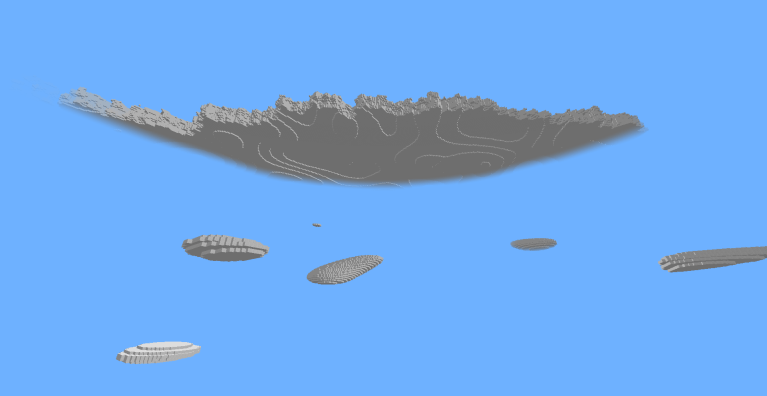
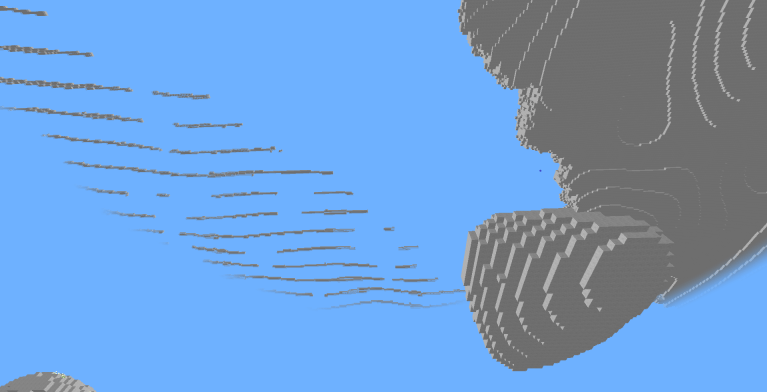
Cloudscape's primary feature is the Sky Dimension, accessed by flying several hundred blocks above the Overworld. Within the Sky Dimension, you will find a thriving world based above, below, and (in some cases) within large floating clouds. Forget about finding floating islands in the sky - this isn't the Aether, and the unwary player will quickly realize that clouds are not naturally solid. You can, however, place blocks on them to provide a solid landing site. While there are only three biomes in the sky at the moment, more are anticipated as their content is developed.
The Sky
More Sky
Amethyst takes on new value as it can be smelted into Citrine, a type of yellowish-brown gem that has the unique property of being able to solidify adjacent clouds within a radius. While any citrine substance will solidify clouds within some small distance, carefully harvested crystals will prove the most effective. The fortunate player may uncommonly find natural deposits of citrine beneath jungle biomes. Citrine is extremely fragile in its natural state - the player does not have the necessary skill to work it into tools or armor, but others in the world might.
The entities capable of working with citrine - Wisps - are presently found only in Creative Mode; in future versions, they will generate in unique village-like structures in the Sky. While the Wisps themselves are nearly complete, developing the structures for their villages has proven to be more time-consuming.
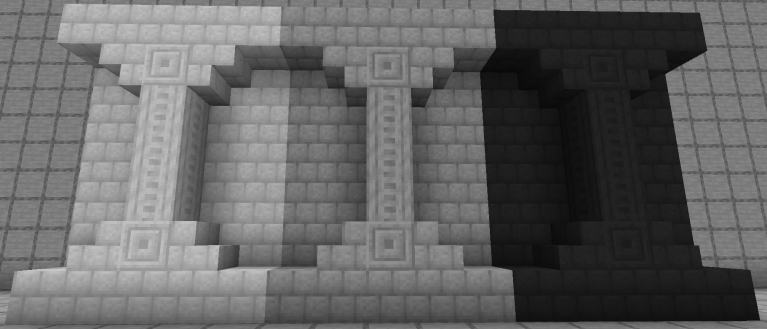
A number of useful materials can be found in the Sky; Cloud Blocks form the majority of the (semi) solid ground in most biomes of the sky. These can be harvested with the Silk Touch enchantment or with any citrine tool. Cloud Blocks can be crafted (along with a Citrine Shard) into Cloud Bricks, which are always solid and are the primary building material native to the sky. However, creating a large amount of Cloud Bricks may require significant quantities of Amethyst to be collected and refined to Citrine. Cloud formations may occasionally be composed of Rain Cloud, which continually drips water. Rarely, clouds can be formed of Thunder Cloud, a dark variant of Cloud Blocks which can also be crafted into bricks. However, Thunder Clouds are electrically charged and may not be pleasant to walk on or stand in. Cloud Bricks are also difficult to work with, and more elaborate patterns may be beyond the player's crafting skill.
An assortment of cloud brick variations
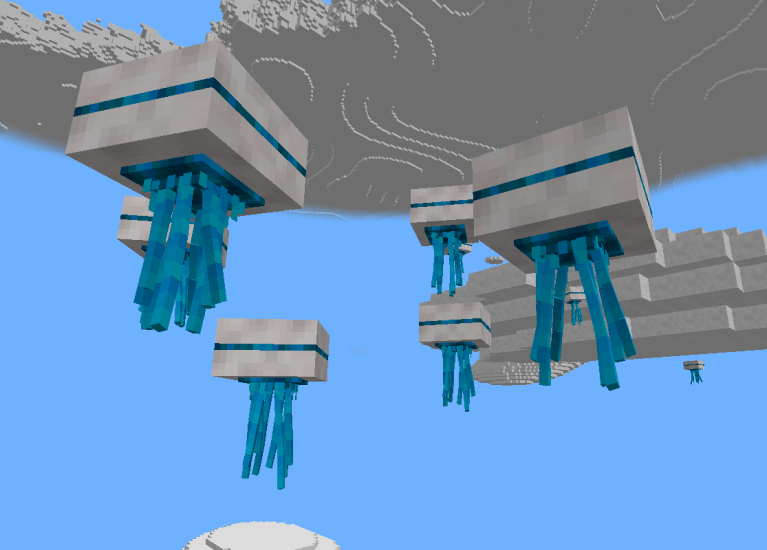
Additionally, the clouds play host to a thriving lighter-than-air ecosystem. Nimbulas, friendly jellyfish-like animals that are apparently formed of clouds, may be commonly seen floating through the skies. They seem to be attracted to water. Instead of directly producing young, nimbulas create polyps, which will eventually hatch into nimbulas. Nimbula Gel can be used as a food source, and nimbulas also drop both String and Cloud Blocks when they die. They can be bred with items containing water, such as potions, water buckets, and wet sponges. Don't worry - they won't eat the container, just its contents!
Nimbulas currently do not generate in the world correctly; this is a known issue which is currently under investigation.
A school of nimbulas. Each one is about one meter across, and three meters tall.
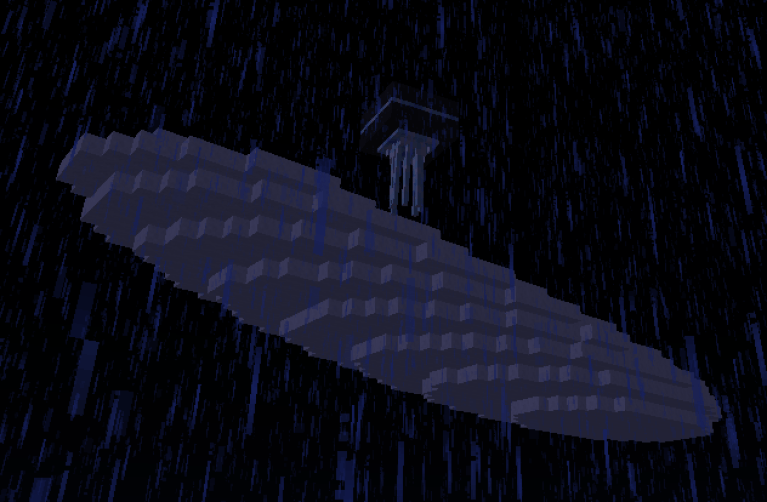
Less friendly are the fragile Gusts that can be found in rainy weather everywhere that there are cloud blocks. These creatures are formed of a swirl of air, and pack a surprising punch - in the split second before they dissipate on impact with anything solid. While they may not deal any damage themselves, Gusts do considerable knockback in a fairly sizeable radius. It is possible, though difficult, to catch a Gust in a bottle to harness their considerable power. A Gust in a Bottle can be released to provide a massive speed boost in the direction the player is facing. However, each bottle only has eight uses. Gusts are difficult to see if they are not moving, especially in the rain. There is therefore no image for this section.
The most dangerous creature found in the Sky as of yet is the Tempest - while this creature may look similar to a very large Nimbula, its behavior is completely different. While the Nimbula is harmless and playful, the Tempest will aggressively hunt nearby players, barraging them with freezing hailstones and occasionally summoning a powerful electric charge in the air around their target. Touching said electric charge is not recommended. However, the rewards for defeating a Tempest are well worth the challenge - slaying a Tempest is the only way to obtain a Heart of the Sky, which can be used to craft Elytra and a variety of other useful materials. In the future, Hearts of the Sky will be used to upgrade Elytra in a variety of ways into various other Wings. Suggestions are welcome, but are not a guarantee that the wings will be added.
Objects in image may be larger than they appear.
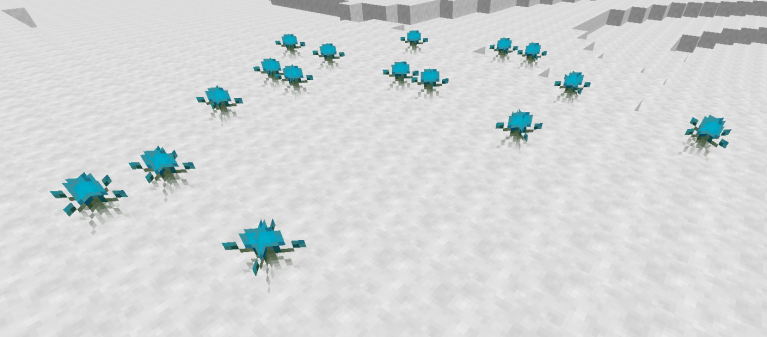
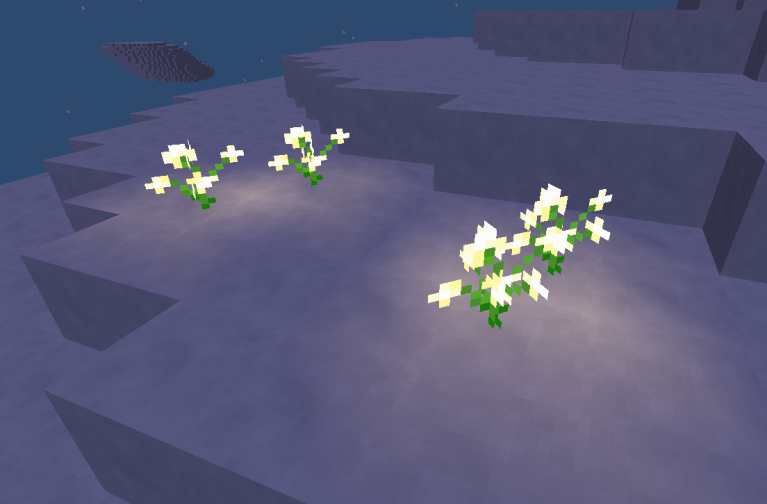
The flora of the Sky Dimension is currently rather limited, consisting only of two varieties - the Bubble Berry and the White Orchid. Bubble Berries are a food source that can be found growing in areas of denser cloud, suspended in the sky by their lighter-than-air fruit and gathering moisture from the clouds beneath them. White Orchids can be found rarely in lower elevations, and can be used to create Suspicious Stew granting a brief burst of Levitation. Other plants will be added in the future, and suggestions are welcome.
Bubble berries in their native habitat.
White Orchids illuminating a small area around themselves.
Descending from the Sky Dimension is easy - simply fall or fly a short distance below the lowest clouds to return to the Overworld. You will reappear high in the sky, so a means of preventing fall damage is recommended.
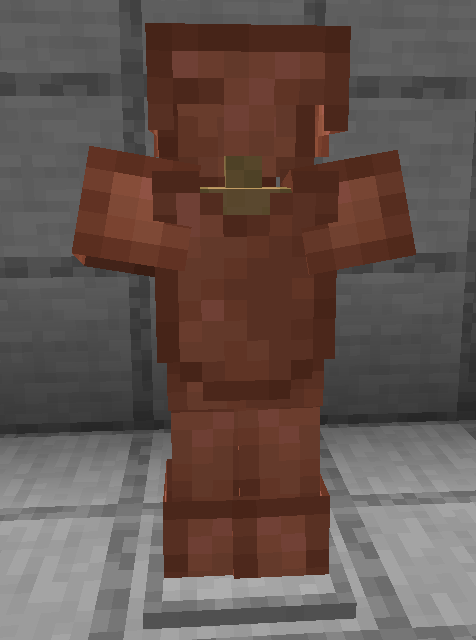
The Sky Dimension is not the only feature of this mod: miscellaneous features have been added to the Overworld as well. Copper can now be crafted into weak but effective armor, weapons, and tools. Be warned that they will quickly oxidize and wear down when held or used. Copper can also be crafted into buttons, which change how long they stay pressed down based on how much they have oxidized. Most ores can now be reversibly crafted into stairs and slabs.
Copper armor.
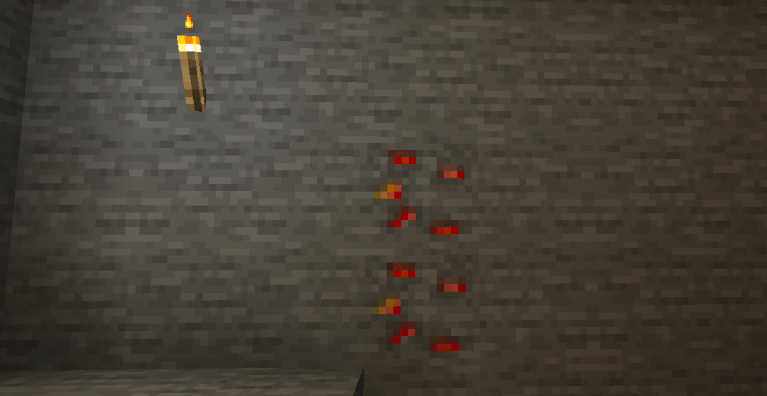
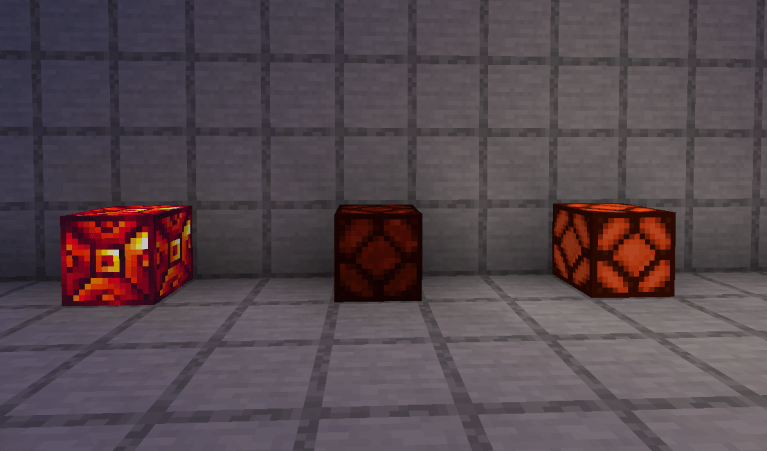
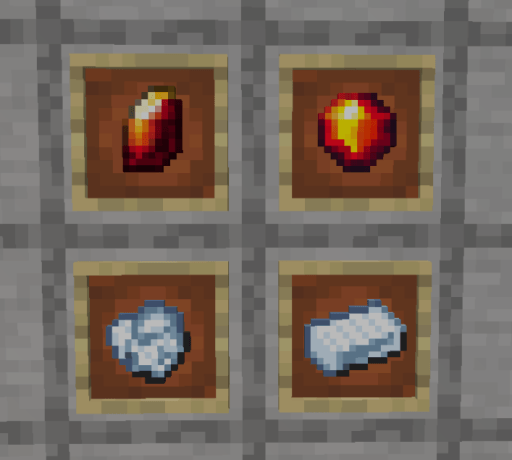
Zircons will now generate commonly in the world. These gems, which must be refined from their raw form, can be used to craft a decorative block which doubles as a dim light source. Additionally, they can be crafted into a variant of the Redstone Lamp which can be toggled by right clicking it, but can no longer be controlled by redstone. This makes them ideal for both decoration and reconfigurable signboards. After collecting enough zircons, the player can smelt them into Raw Zirconium, a curious heat-resistant material which can be further refined into Zirconium Ingots. Functioning as an earlier-game version of Netherite, Zirconium Ingots can be used to upgrade iron tools, armor, and weapons into more durable and fire-resistant variants. This may require a large amount of zircons, however.
Zircons in a cave.
A decorative zircon block and two zircon lamps. The one in the center is off, and the one to the right is on.
From left to right and top to bottom: a zircon shard, a cut zircon, raw zirconium, and a zirconium ingot.
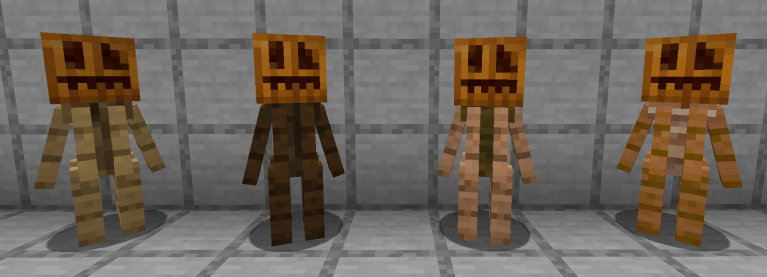
A new type of golem, the Wood Golem, can be summoned with wood logs (topped with a Pumpkin) placed in the same configuration used to summon an Iron Golem. If the logs are of the same type, then the corresponding wood golem will be created. There are several types that can be created, though they only differ in appearance. Wood Golems are weak, though they can be repaired with any type of wooden fence. Wood types from other mods are not supported at the moment. If there is enough demand, then compatibility might be added for larger and more popular mods. This will be a low priority task, however.
A variety of wood golems. From left to right, they are oak, dark oak, jungle, and palm (see below).
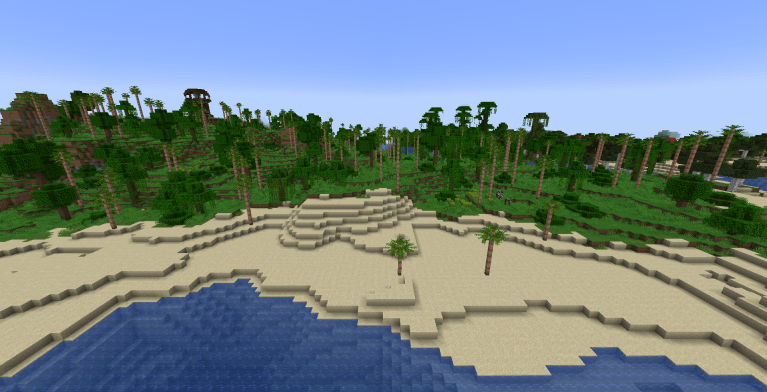
Wood Golems can even be created for a new wood type added in this mod: palm. Palm trees will generate commonly in Sparse Jungles, and less commonly on beaches. Rarely, they can be found the Desert biome, clustered around an oasis. Palm Trunks can be crafted into Palm Logs, which can then be converted into their respective plank variants. Palm Fronds can be collected for decoration or quick-burning fuel. Palm wood products are excellent for tropical or beach-themed construction.
Palm trees, in a Sparse Jungle and on a Beach.
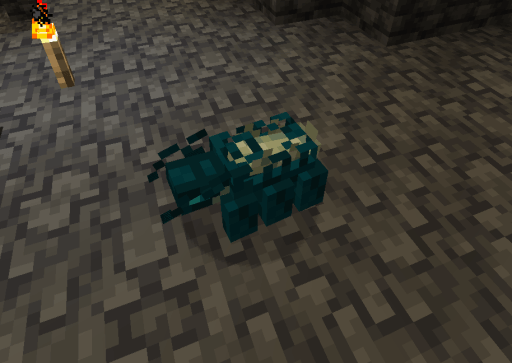
Delve deep beneath the surface to discover that the Deep Dark has received some minor changes; two new blocks provide increased hazards, and Moles - a new type of small monster - will hunt unwary players. Sculk Roots will cover the ground in some areas, emerging from beneath unsuspecting passers-by to slow their motion. If they are allowed to grow fully, Sculk Roots will damage anything in their limited reach. Sculk Jaws - a feature which was considered although not added to Vanilla Minecraft - will act as cactus-like hazards. Prolonged contact with them is not recommended. Moles will seek out the player; while they do not do nearly as much damage as the Warden, the commotion of the battle may still draw unwanted attention.
A mole, waiting for a player to walk by.
Echo Shards can now be used to craft a few new items, including the Resonator. Echo Powder is crafted from Echo Shards. The Resonator - a block used to replicate the Warden's sonic attack - is crafted from an Echo Block, the block form of Echo Powder. It is triggered by redstone signals, although it does have a cooldown. Suggestions for additional functionality for the Resonator and Echo Powder are welcome.
A resonator. Notice that, based on the bar on the side, it is halfway charged.

A new type of melee weapon rewards both agility and defensiveness - the Spear. Spears are crafted from two sticks and one material of their corresponding type. While spears do not do as much raw damage as, for instance, a sword, they make up for it by doing increased damage based on the relative velocity of the wielder and the target. In other words, the faster you charge the enemy, the more damage you will deal. If your enemy is also charging you, they will be impaled with even greater force. Alternatively, spears can be used defensively - crouching and standing still will noticeably increase the damage dealt, in addition to the bonus from the target's speed. Spears can be enchanted with Impaling, which will increase the speed-based damage bonus.
Note that zirconium and netherite spears must be upgraded from iron and diamond spears, respectively. The Citrine Spear must be purchased from a Wisp. Spears are currently highly imbalanced; gaining extremely high velocity allows them to deal extreme amounts of damage. This is a bug, not a feature, and is in the process of being rebalanced.
Items forms of the spear variants; spears have three-dimensional models when held.

This mod adds other, more miscellaneous changes as well.
Elytra can now be combined with chestplates to produce the respective variety of wings. while this does allow for using flight alongside armor, it also significantly decreases the lift provided by the elytra. While the effect is hardly noticeable for Leather Wings, it significantly limits the usability of Netherite Wings. Netherite Wings require almost constant use of rockets. Note that the combined chestplate and elytra cannot be separated, and that their durability is shared. Thus, wearing out the chestplate will also break the elytra capabilities, and vice versa. Mending and Unbreaking are highly recommended to protect the significant investment.
The varieties of armor/elytra combinations.

Blueberry seeds can now be purchased from villagers. Similarly to Sweet Berries, Blueberries can be harvested by right-clicking the fully grown bush, though they must be planted on farmland. All types of berries, including Blueberries, Bubble Berries, Sweet Berries, and Glow Berries, can be crafted into Berry Pie, which has the same statistics as Pumpkin Pie and a similar recipe.
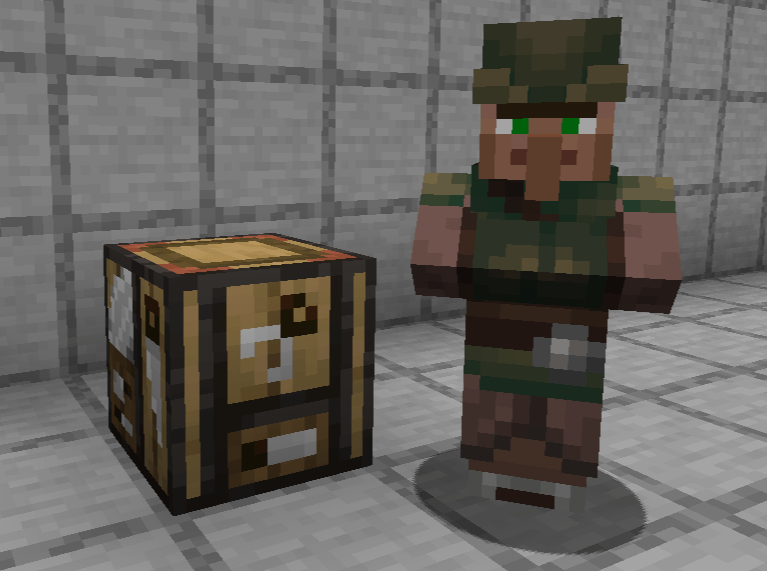
A new villager trade has also been added - the Forester. Foresters trade logs and planks at lower skill levels. When unlocked further, they will purchase various woods-related items, and begin to sell rarer plants and saplings. Foresters can be used to slightly decrease the amount of tedious plant harvesting needed for some decorative constructions. The worksite corresponding to the Forester is the Carpentry Table, an otherwise useless block similar to the Fletching Table. The Carpentry Table is crafted with a crafting table, an iron ingot, and a copper ingot. Another use for the Carpentry table may be added in the future. On the topic of villagers, farmers will now buy blueberries and sell blueberry seeds; butchers will also purchase raw meat.
A Forester.
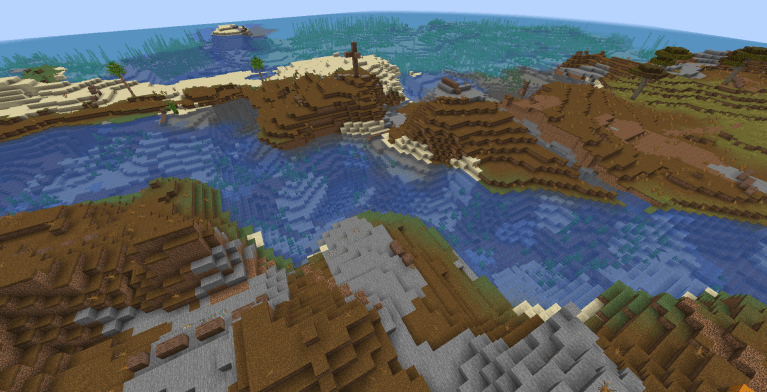
A new biome, the Petrified Forest, will rarely replace sections of savannas. This depressing-looking biome sports patches of stone and petrified logs, as well as plentiful gold and calcite.
A petrified forest bordering a beach and a savanna.
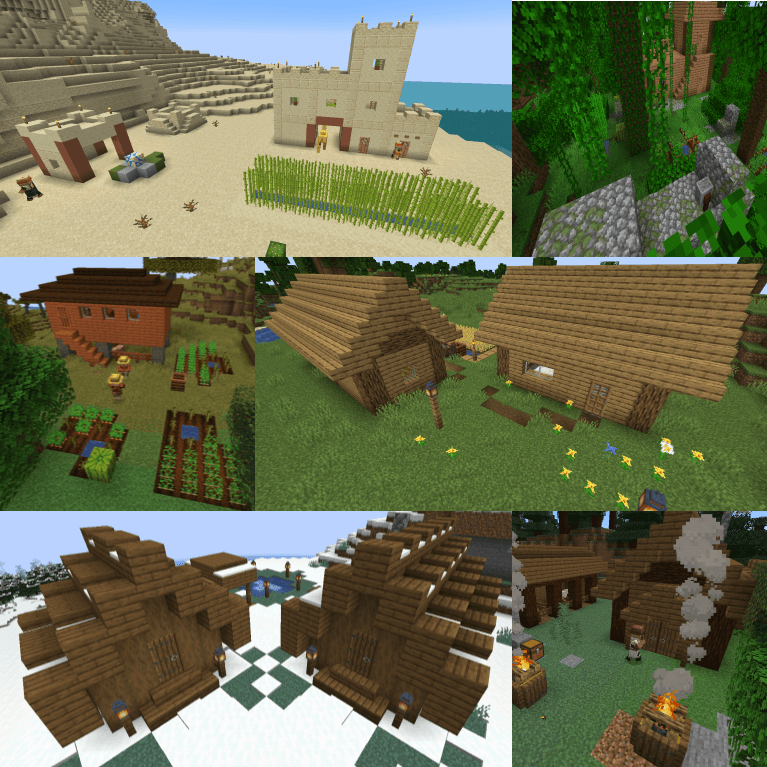
Several new structures decorate the Overworld and Nether; farmsteads will generate with a few villagers in some Overworld biomes, and variants of dungeons can now be found in the Nether. There is a farmstead for each villager type, generating in the corresponding biome, except for the swamp.
A montage of farmsteads.
Soul Sand and Soul Soil can now be crafted into Soul Sandstone, a new mostly decorative material. It burns blue, and still provides a speed boost with the Soul Speed enchantment.
As noted above, this mod is currently in the pre-beta stage! It is significantly lacking in content, and will contain flaws, bugs, and imbalances. However, I will actively respond to questions, comments, suggestions and even criticisms.
Cloudscape Team