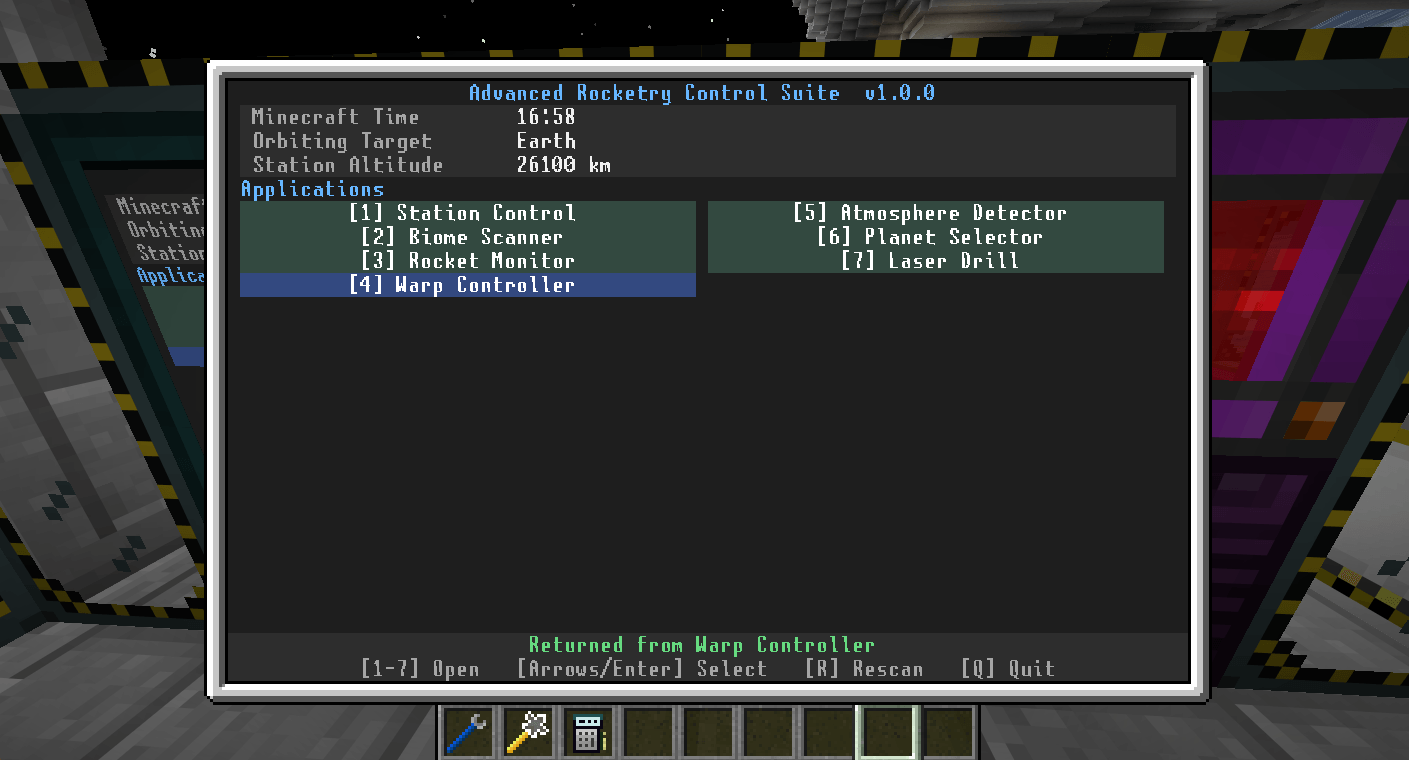
Spacestation_Control.png
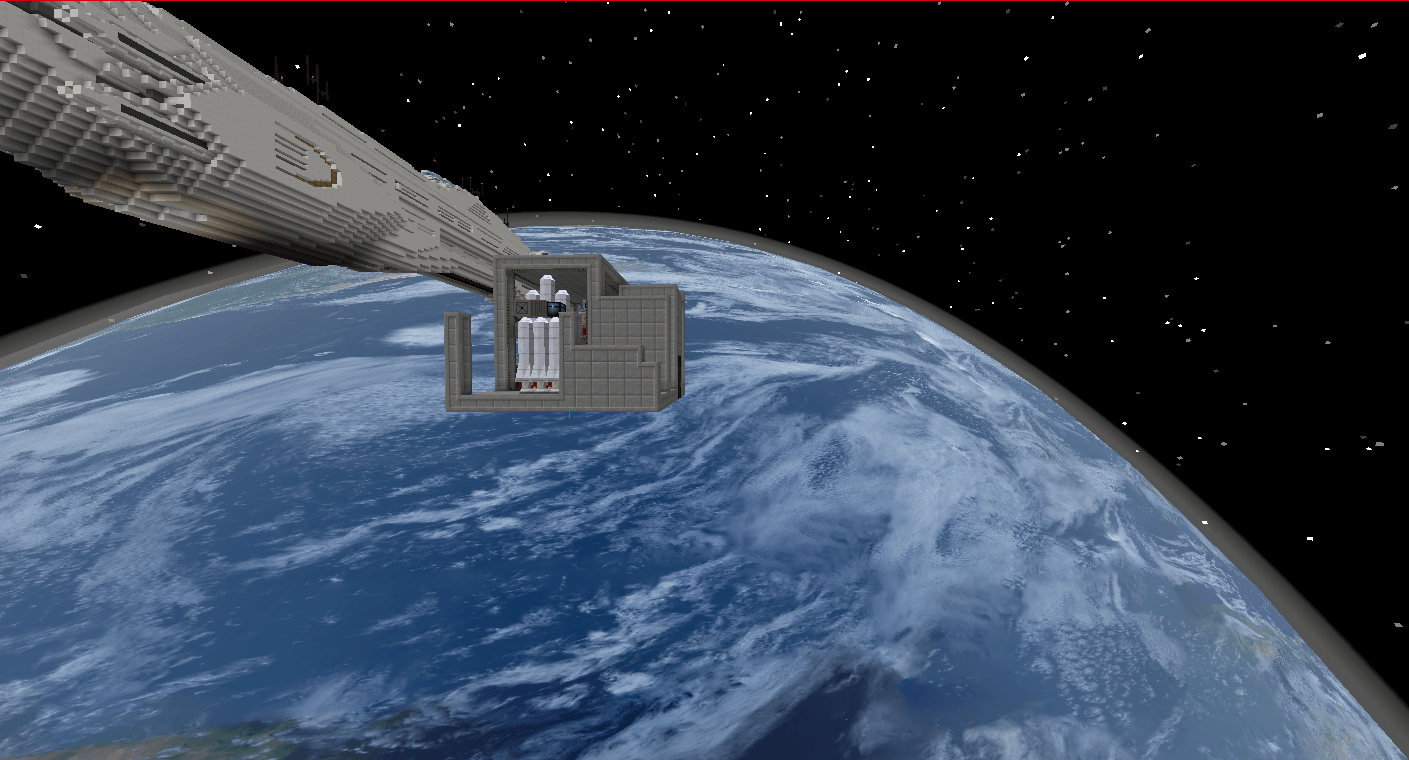
NewPlanet-and-Atmosphere.png
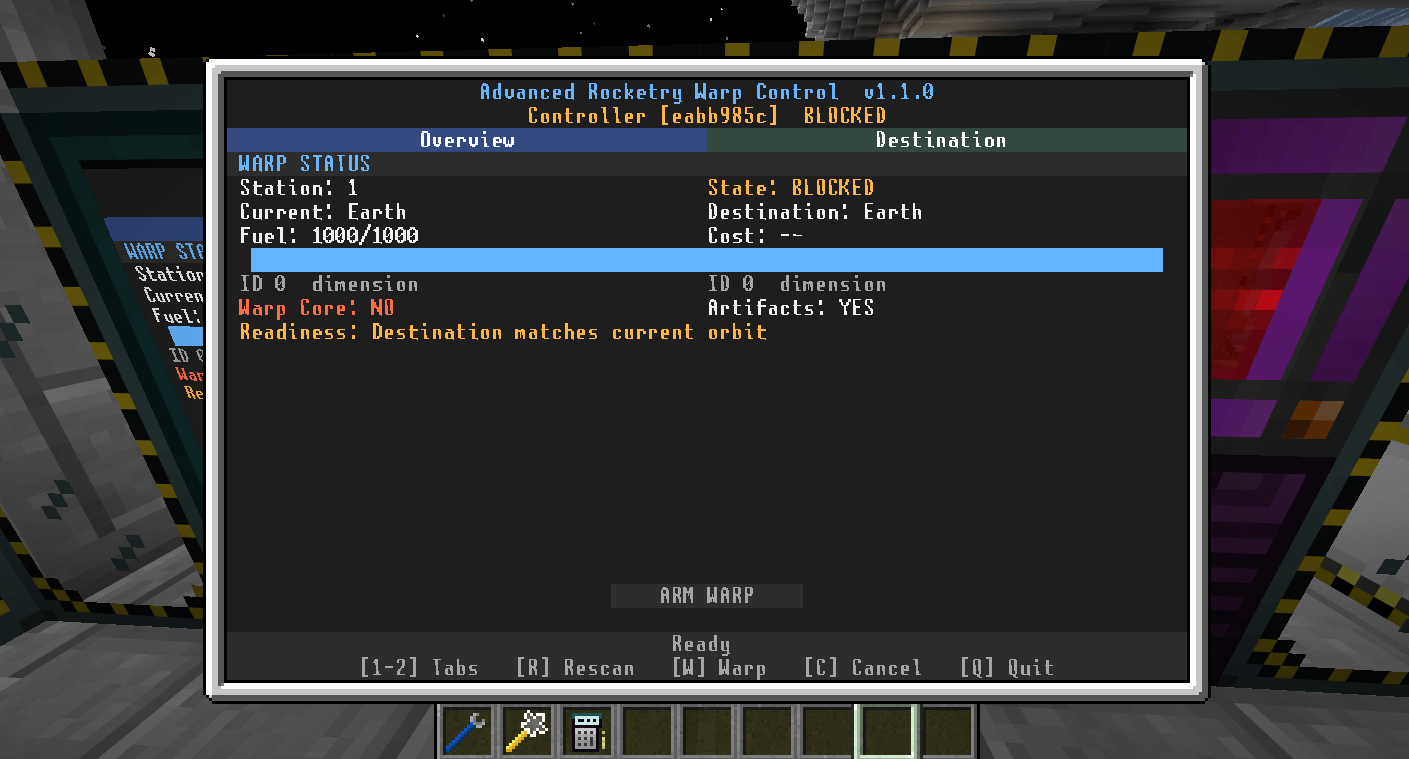
Warp_Control.png
Description
AdvancedRocketry Continuation
This is a community-maintained continuation fork of AdvancedRocketry for Minecraft 1.7.10. The current release is 1.4.3-continuation and requires libVulpes-Continuation 0.2.11 or later.
For the complete changes and upgrade notes for versions 1.4.2 and 1.4.3, see latest version changelog.
This branch selectively ports 56 commits by which kuzuanpa/AdvancedRocketry-TFRU is ahead of the shared baseline d79d71d, covering the range from d0c66bc0 through 161cd3b6, inclusive. The porting policy is to retain generally useful bug fixes and new features while removing content written specifically for the TFRU modpack, TerraFirmaCraft, GT6/GregAPI, and the Dyson sphere system. A commit-by-commit audit of the decisions and adaptations is available in TFRU_COMMIT_PORT_AUDIT.md.
Additions and Fixes in This Continuation
Added native OpenComputers components for space-station and rocket automation, seven independent OpenOS GUIs, and the unified
advrocketlauncher. When OpenComputers is installed, the native AdvRocket program disk can be crafted, installed withinstall AdvRocket, and safely refreshed from a newer JAR with the offlineupdatecommand. Without OpenComputers, neither the disk nor its recipe is registered, and AdvancedRocketry still starts independently.Added an unpowered Oxygen Detector for dual-door airlock interlocks. It ignores faces blocked by airtight blocks and can output redstone when either any exposed face or every exposed face is breathable. With OpenComputers installed, the individual state of all six faces—north, south, east, west, up, and down—can also be queried.
Added zero-buffer airtight RF and fluid passthrough interfaces. Until the last current source is removed, the fluid interface accepts only one fluid type. When the relevant mods are installed, the mod also conditionally registers a six-sided airtight OpenComputers cable, an 8-channel ME smart interface, and a 32-channel ME dense smart interface. These integration blocks and recipes are not registered when OC or AE2 is absent.
Backported Kerr-style black-hole stars and the Black Hole Generator from the 1.12.2 code line. Black holes persist through XML/NBT/network synchronization, appear correctly in the star map, holographic selector, planetary sky, space-station sky, and free space, and can be selected as synthetic space-station targets without being registered as Forge dimensions.
Added a server-authoritative Black Hole Generator multiblock. A completed station directly orbiting a top-level black hole can consume configurable matter fuels and produce a base 500 RF/t, multiplied by
blackHoleGeneratorMultiplier, while revalidating structure, orbit, fuel, output capacity, chunk reloads, and warp transitions.Added
AUTO,FAST,HIGH, andLEGACYblack-hole render modes with Kerr-style apparent shadows, photon-ring approximation, animated accretion disks, gravitational-lensing images, Doppler asymmetry, and a fixed-function fallback that does not require an external shader pack. Optional free-space interaction modes range from the safe defaultVISUAL_ONLYthrough warnings and gravity to opt-in destructiveCAPTURE.Replaced the old layered atmosphere shells with a real-time spherical scattering approximation using Rayleigh/Mie scattering, optical-depth LUTs, altitude-dependent haze, terminators, twilight, and safe legacy/off fallbacks. Existing planet XML remains compatible and may optionally override the visual atmosphere profile.
Reworked the space-station planet from a flat LEO plane into a rotating, subdivided sphere with a matching atmosphere shell, high-resolution Earth and Moon textures, and configurable scale, rotation speed, and texture tiling. The Altitude Controller now also provides a persisted 1x-10x maximum altitude change-rate slider.
Fixed unmanaged third-party dimensions inheriting an oxygenless AdvancedRocketry atmosphere, so unmapped RFTools, Compact Machines, and similar dimensions default to breathable air while explicit dimension mappings keep their configured atmospheres.
Fixed dynamic oxygen-blob isolation for airtight non-full blocks such as whitelisted Galacticraft airlock seals, and fixed Oxygen Detector redstone updates through an adjacent powered solid block.
Restored the Crystallizer in the Holographic Projector and fixed the placed Quartz Crucible's identity, localization, and multiblock recognition.
The FTL Warp Core now consumes
gemDilithiumorcrystalDilithiumthrough the Ore Dictionary and correctly calculates fuel points using thepointsPerDilithiumconfiguration value.Planet XML now supports
<spawnable>entries with NBT. Entity registry names, class names, weights, and NBT are validated safely, while creature categories without custom configuration continue to use the vanilla spawn tables.Recipe XML now supports item NBT. Rewritten XML escapes text correctly and consistently uses semicolons as delimiters.
Fixed duplication exploits, null pointers, invalid output, and non-atomic fluid consumption in the Oxygen Charger.
Added experimental multistage-rocket structural analysis. Stage engine blocks, asynchronous structure scans, NBT persistence, and API queries are available. The main thread first creates a detached snapshot containing TileEntity NBT, so the background thread never reads the live rocket blocks or TileEntities. Stages are not yet separated or ignited automatically.
Added a projector API through which other mods can register character-mapped structures. No direct GregAPI or GT6 integration layer was introduced.
The jetpack renderer is now initialized only once, alongside multiple fixes for GUIs, star-map zooming, the Linker, phantom blocks, rocket rendering, and null pointers.
Separated the space-station dimension from the free-flight space dimension. Their default IDs are now
-2and-3, respectively, and startup checks for dimension conflicts. Legacy addon class namesWorldProviderSpaceandRenderSpaceSkyretain their space-station semantics.Added Java 7-compatible stellar and planetary orbital simulation together with level-of-detail (LoD) starfield rendering.
The simulated universe now uses a safe positive-Y origin and lower bounds for celestial bodies. On both client and server, free-space rockets are clamped to a safe altitude before movement to prevent Minecraft 1.7.10's void-removal logic from deleting them incorrectly.
Planet Identification Chips use
DIRECTtravel by default. SettingplanetChipTravelModetoMANUALmakes only player-piloted rockets enter free space, travel according to the player's view direction, and land after approaching a target body. Empty-seat remote launches, satellites, unmanned rockets, and asteroid missions retain their previous workflows.Added an explicit seat-presence flag so a newly built rocket whose seat is at structure coordinate
x=-1is no longer mistaken for a seatless rocket.getSeatX()still returns the legacy value-1when no seat exists, and old saves with the seatless marker are migrated correctly.Expanded the Simplified Chinese translation and added multiple startup, network-synchronization, and dimension-property compatibility fixes.
Related configuration options:
spaceStationId: space-station dimension ID; default-2.freeSpaceId: free-flight space dimension ID; default-3.planetChipTravelMode: Planet Identification Chip travel mode; defaultDIRECT. Set it toMANUALto enable manual free-space flight.maxSpaceRocketSpeed: maximum rocket speed in each direction while in free space.pointsPerDilithium: FTL fuel points supplied by each piece of Dilithium. The corresponding code field isfuelPointsPerDilithium.blackHoleRenderMode: black-hole visual quality/fallback mode; defaultAUTO.blackHoleFreeSpaceInteraction: free-space black-hole gameplay behavior; defaultVISUAL_ONLY.blackHoleGeneratorMultiplier: multiplier applied to the generator's 500 RF/t base output; default1.0.atmosphereRenderMode: atmosphere visual quality/fallback mode; defaultAUTO.stationPlanetSphereScaleMultiplier: apparent size of the planet below a space station; default1.5.overworldSkyOverride: whether AdvancedRocketry replaces the Overworld sky renderer; defaultfalsefor new configurations.
Explicitly Not Ported
- TerraFirmaCraft/TFRU dimension migration, environment detection, version suffixes, and modpack-specific configuration.
- Dyson spheres, Dyson swarms, stellar dimensions, landing on stars, and the related models, textures, and renderers.
- GregAPI-based GT6 projector integration and third-party JARs bundled directly into the repository.
- Maven/build-script changes added for modpack distribution and temporary changes that disabled GUIs.
The project's pre-existing general GregTech compatibility code and optional integration remain in place. The excluded content is specifically the tightly coupled GT6/GregAPI implementation later added by the TFRU branch.
Original Core Features
- Build rockets from most blocks and operate them with fuel, guidance chips, and multiple mission payloads.
- Construct space stations orbiting planets or moons, perform warp travel, dock vehicles, and control local gravity.
- Define planetary systems through XML, with dynamic orbits, gases and oxygen, satellites, astronomical observation, and data research.
- Automate asteroid mining, gas-giant resource collection, orbital lasers, and cross-dimensional logistics.
- Integrate with IC2, RF, and mappings for many external dimensions.
License and Sources
This continuation contains ported code from an AGPL-3.0 branch and is therefore released as a whole under the GNU Affero General Public License v3.0 in LICENSE. The MIT license text for the original AdvancedRocketry code is retained in LICENSE-MIT, and its original copyright notices continue to apply to the corresponding code.
The Advanced Rocketry - Continuation Team