River Fishing
- By
riverfishing_banner_notext.png
2026-07-07_15.27.27.webp
2026-07-07_15.30.05.webp
2026-07-07_15.25.20.webp
2026-07-07_15.27.40.webp
2026-07-07_15.33.40.webp
Description
River Fishing 🎣
A realistic river, ice and sea fishing simulator, built to be the thing a modpack is about rather than a minigame beside it. Fishing here is a process, not a click on the water: you assemble a rod from a blank, a reel, a line and a rig; you mix your own groundbait and match bait, hook size and leader to the fish you actually want; you read the water, the season, the hour and the barometer; and then you fight what takes.
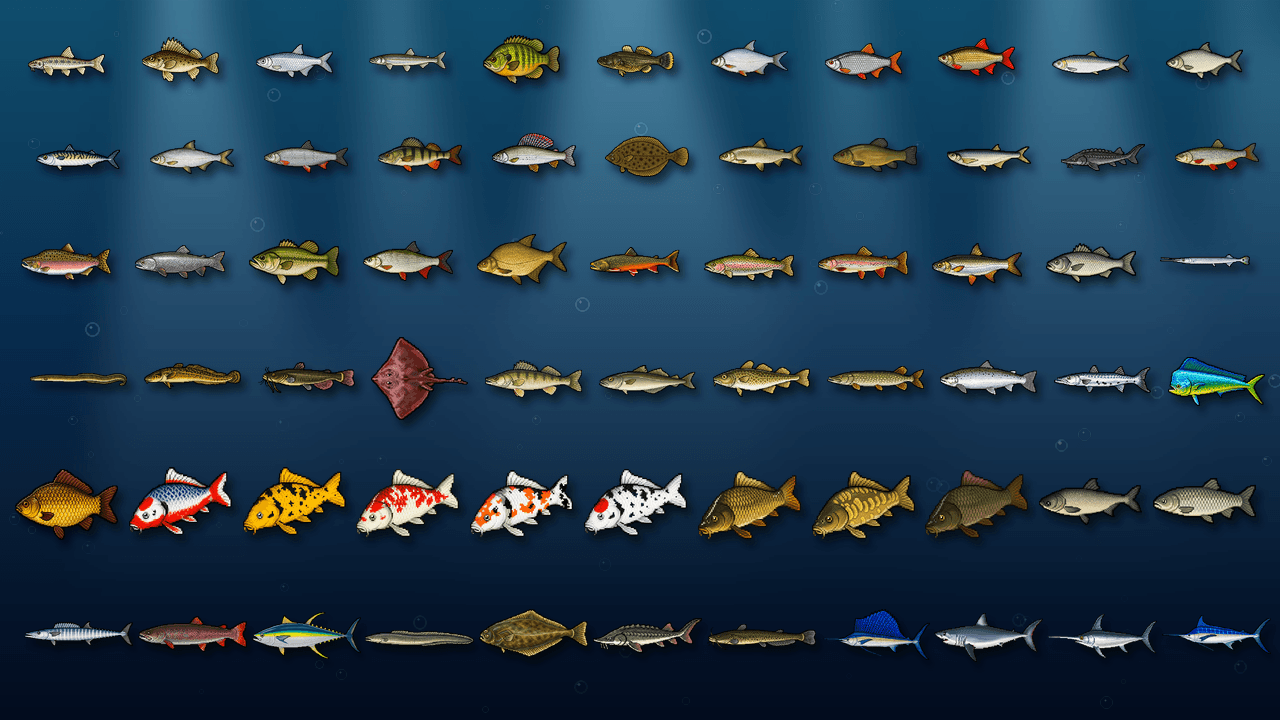
Nothing bites by luck. A data-driven bite engine weighs your whole setup against every one of 93 species under the current conditions and decides both what takes and how long you wait.
Versions
- 1.20.1 — Fabric & Forge
- 1.21.1 — Fabric & NeoForge
- 26.1.2 — Fabric & NeoForge
- 26.2 — Fabric & NeoForge
Requires Architectury API; on Fabric also Fabric API.
The mod runs fine alone, but the balance is written around two optional add-ons:
- Serene Seasons — unlocks the full seasonal bite (spring spawning runs, the winter slow-down).
- Biomes O' Plenty — a richer world for the habitat and biome factors to work in.
Neither is version-locked: Serene Seasons is reached by reflection and simply falls back to a neutral season if it is absent, and Biomes O' Plenty is read through biome tags rather than referenced in code at all. The compatibility page lists the exact versions every build is tested against.
JEI and Jade are supported on 1.20.1 and 1.21.1.
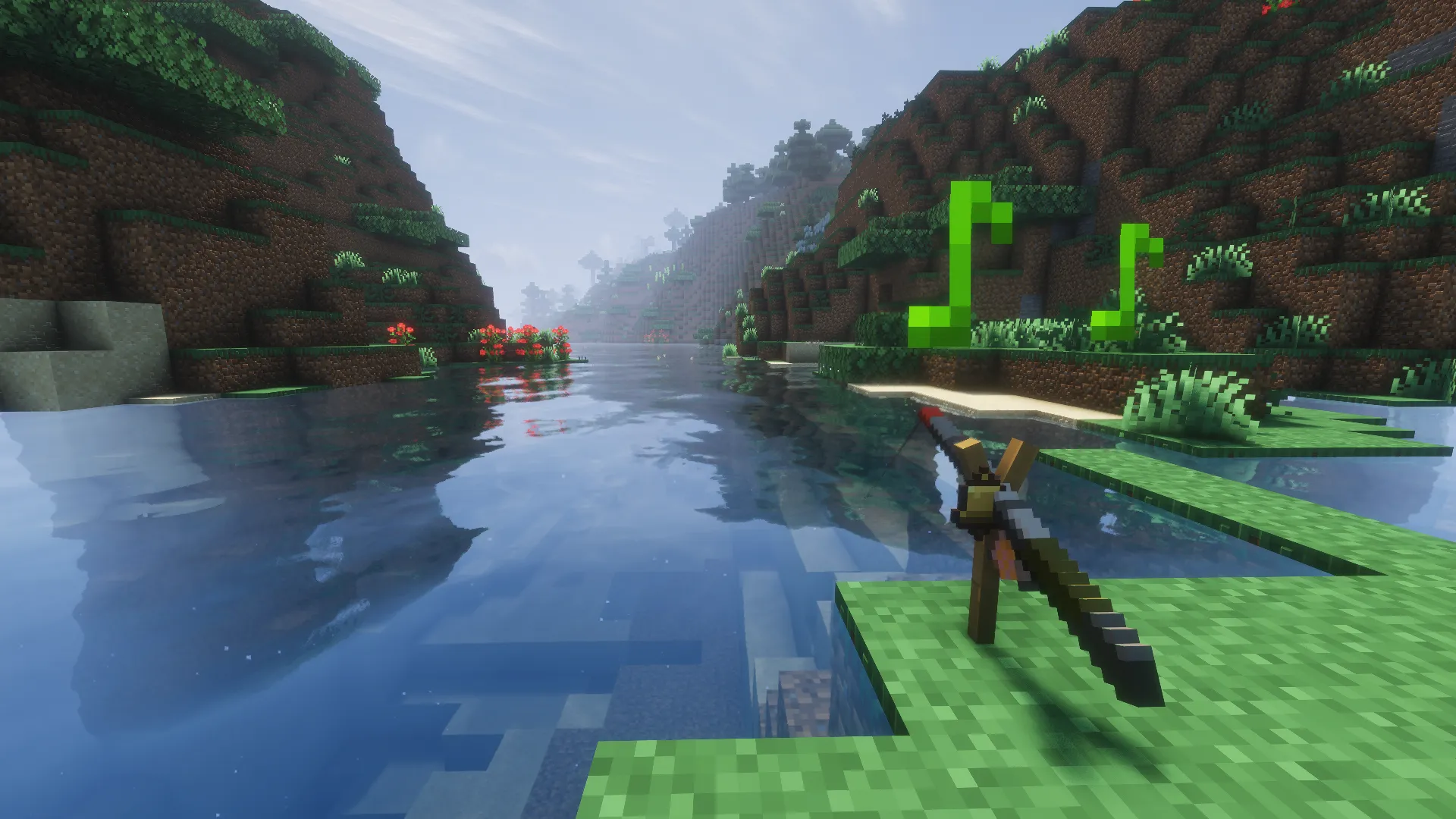
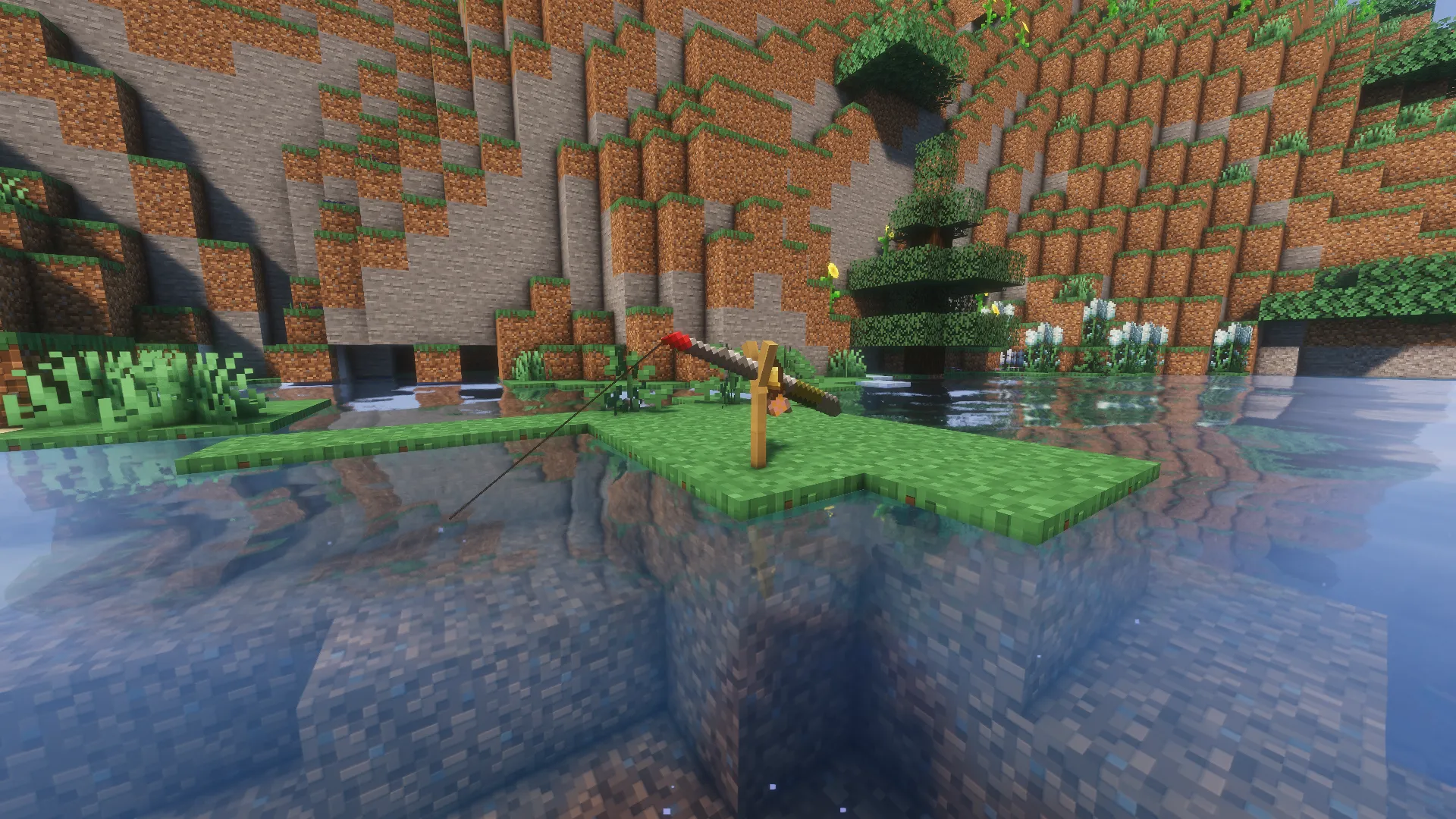
The rod is a real object
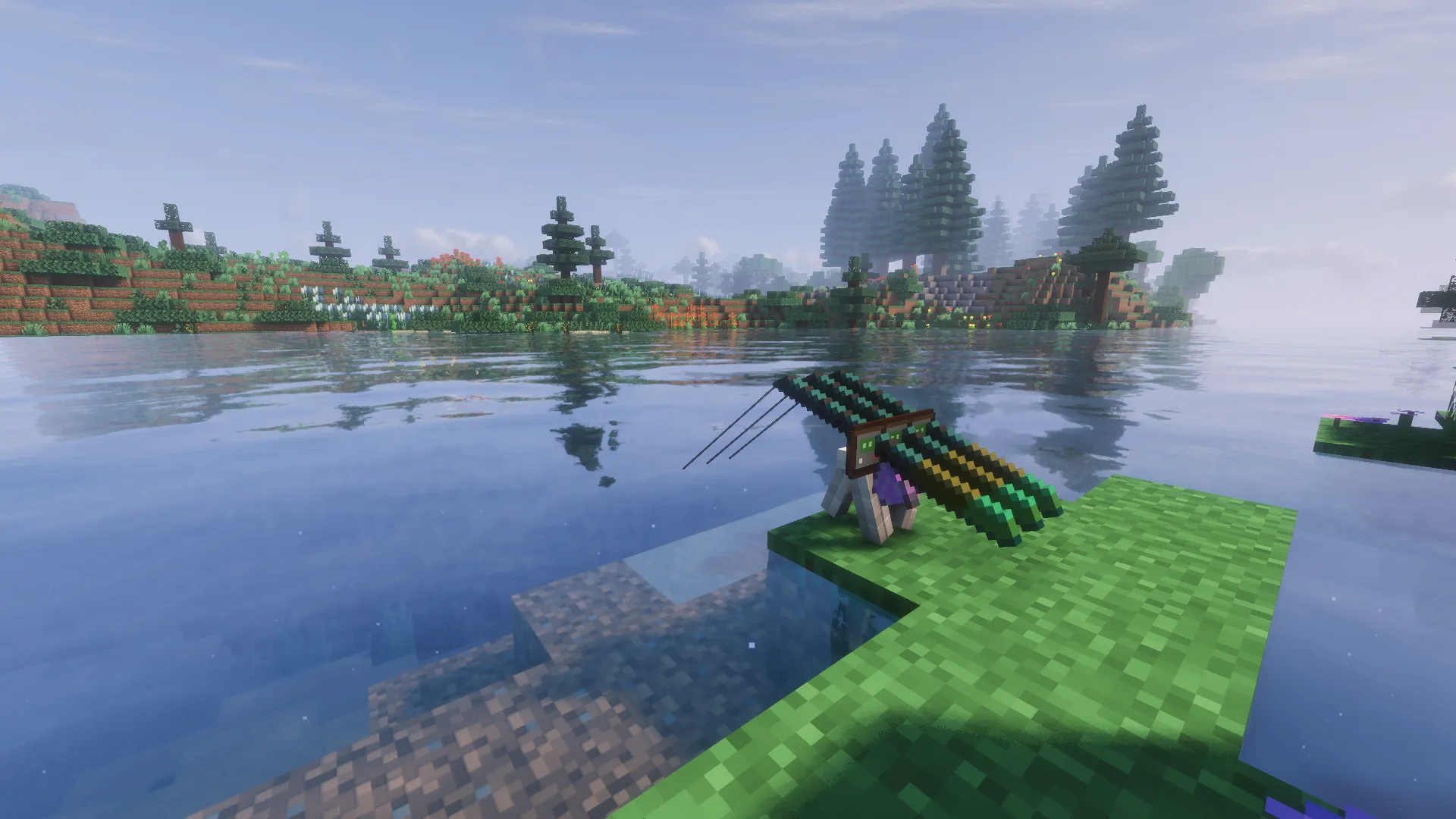
All 13 blanks are modelled, hand-built piece by piece — grips, reel seats, guides — and the one in your hands is drawn at its true length. A feeder rod is three blocks of carbon, because a feeder rod is 3.9 metres of carbon.
They bend as a chain. A blank is cut into sections, up to eight on the sea spinner, and each joint turns a little more than the one behind it, so the tip travels furthest and the butt barely moves. The bend is continuous, driven by the fish's pull against that blank's own power class — a 1.8 kg bass on a trolling rod barely marks it, the same fish on an ultralight folds it over.
And it bends toward the fish. Not down — toward. A fish running left lays the whole blank over to the left; one sounding drives the tip down; one coming up to jump lifts it. Look down past your own line and the rod rolls over and bows up toward it, because that is where the pull is.
The blank has mass. Each rod carries its own spring, so turning your view leaves the tip trailing and it overshoots on the way back. A fish hitting the line kicks that same spring and the rod visibly yanks.
The line is threaded off the spool, through every guide ring, out of the tip and down to the water, drawn in the colour, thickness and transparency of the line you actually spooled. The reel turns — all eleven are modelled and seated on the rod's own seat.
Not to your taste? /rfrod blank off puts the flat sprite back, and the physics has its own switch. Both persist.
You can see into the water
Lean over a lake and the fish are there — each one holding its own position and heading, turned the way it is swimming, its nose swinging on a slow beat. A shoal of roach reads as a shoal. A single big shadow on the bottom is a single big fish, and you will want to know what it is.
What you never get is a label. You get a shape and a size, and working out what it is stays yours.
Muddy water, rain and a roof over the water dim them. And the fish can see you — sprinting, walking heavily, jumping, breaking blocks, wading in the shallows, a boat under way, even your own shadow thrown across the water at a low sun. A spooked patch stops biting and the visible fish bolt. Crouch, stand still, and it forgets you in thirty to ninety seconds. This is what a long cast is for: what you do on the bank does not reach out there.
Six ways to fish
- Float fishing — the classic pole. Set the float depth, watch it plunge, strike on the click — then a timing bar for the pull-out decides whether it comes over the bank. Panfish and silver fish, close in.
- Spinning — active lure work with ten lure forms. A popper is fished on the surface in a pop-and-pause cadence that ends in a visible blowup; a wobbler or crankbait only works on a strict crank rhythm. Against toothy fish a leader is the difference between a fish and a cut line — and which one matters: steel is bomb-proof but glints and costs you bites, fluorocarbon is near-invisible and earns them, titanium is both.
- Long-cast bottom fishing — feeder, bottom and carp rods reach far water and sit there with a loaded groundbait feeder. Patient, and where the big bream, tench, carp and catfish come from.
- Ice fishing — drill a hole with the auger, drop a short winter rod, work the mormyshka in a rhythm. A whole winter mode of its own.
- The sea — surf, sea-spinning and boat blanks, the heavy reels and lines to match, and big-game fights. Cod, seabass, conger, halibut, tuna, marlin, swordfish, mako. How deep and how open the water is decides what lives there.
- Trolling — hold a steady speed in a boat and the line goes out by itself, the lure working astern. Mahi-mahi, wahoo and tuna, with marlin and sharks further out.
The fight asks you questions
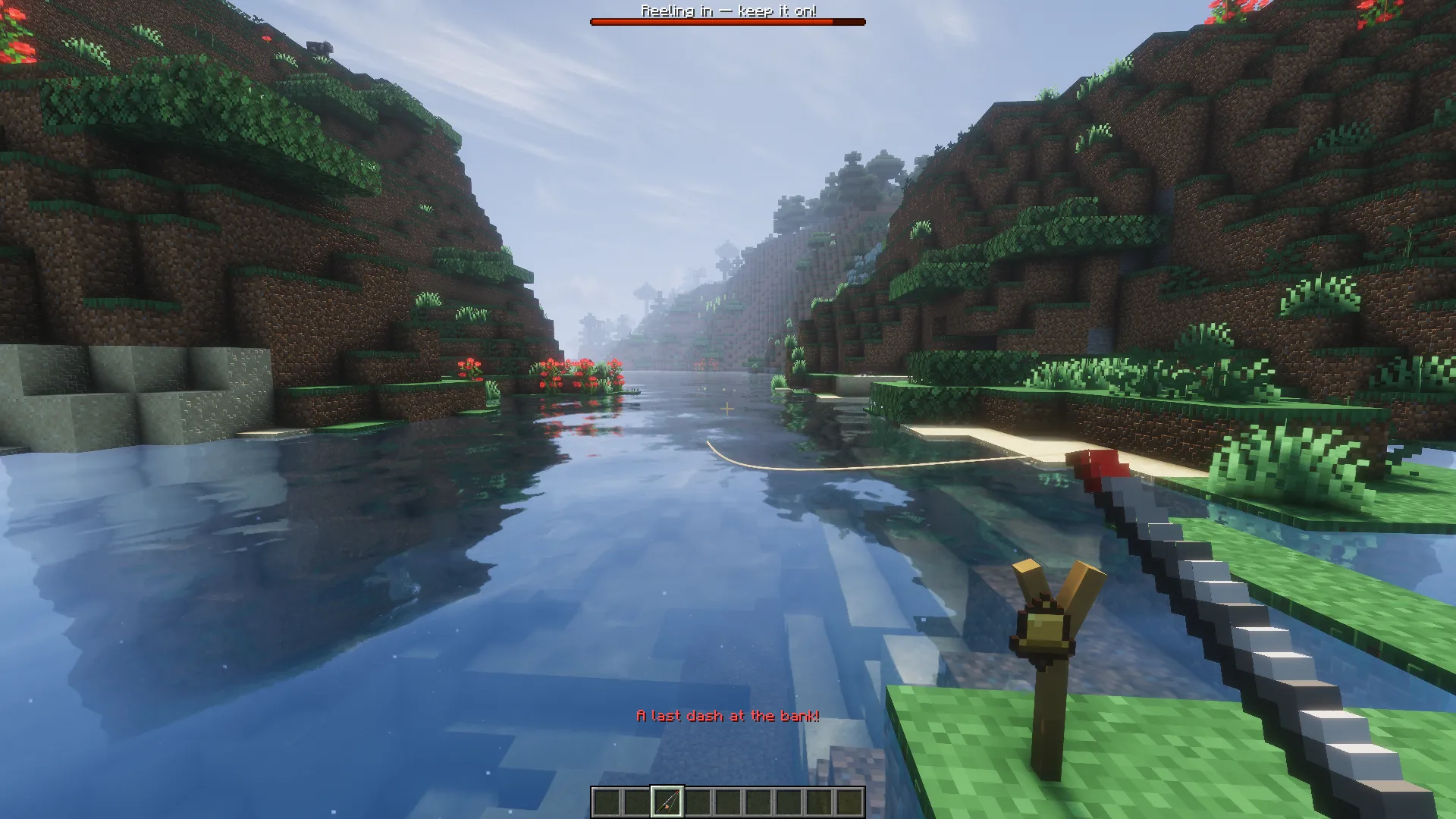
Every run has a course, and you answer it with the camera. Lean your view against the way the fish is going and you are pulling against it; the view is re-anchored every time the course changes, so it is where you look relative to the run that counts. Four arrow keys are there as a quiet override and are rebindable in Minecraft's own controls, but you never have to touch them.
Nothing tells you which way it went — the rod does. There is no arrow on the screen and the boss bar names no direction. The blank is the instrument: it lays over toward the fish and loads with the pull, and reading it is the skill.
Answering right is not a tax — it is what lets you work. The fish tires nearly three times as fast and the run loads your tackle at roughly half rate. Pull the same way it is going and you get none of that.
- Your feet are tackle. Backing away from the water is pumping with your legs: it wins line and loads the rod, the same trade a crank makes. Walk the whole way and you snap. While a fish is on you cannot step off the edge of a block, so a pier is not a trap.
- The angler runs out. Holding a rod against a running fish costs you, and pointing it the wrong way costs more. It comes back only when you stop pulling, so the answer to tired arms is to stop rather than to click faster.
- Over-pull and the line snaps — a real breaking-strain model, so big fish demand the right line and a drag you know how to use, and a heavier line genuinely buys you time.
- The giants are landable. The pull a fish demands tapers above 20 kg, so a 400 kg marlin asks for 210 kg of tackle rather than the 802 kg the linear law wanted. Nothing under 20 kg changed.
- The last dash at the bank is a roll, not a ritual — 35% for an ordinary fish, 85% for a trophy on a hard pattern, never for a boot. Rolled once, and a failed roll is a quiet landing.
- Every species tires differently, and small fry stop fighting like monsters.
Groundbait you mix yourself
There is one groundbait — Base Groundbait, from wheat seeds and bread — and everything else is what you put in it. Drop the base in a crafting grid with up to eight other things from a 27-item pantry and the mix takes on a grind and a richness of its own.
Every one of the 93 species wants its own pair. A bleak wants fine and lean, a carp wants coarse and rich, and a mix aimed at one is actively wrong for the other. Feeding coarse is how you stop catching tiddlers.
You cannot overfeed a spot. Throw as much as you like — more feed is more fish. What a mix cannot do is out-fish its own contents: how strong a swim can get is capped by what went into it, never by how much you threw. The decision is not how much. It is what of.
Tackle you build
- The Tackle Station. Right-click a Fishing Stall with an empty hand and it becomes a bench: pick one of sixteen forms, step the weight, feed it hooks, iron and string. Weight is a decision — it sets your cast distance, it has to fall inside your blank's test window, and a lure's mass is its size, so a heavy pilker genuinely silences the small stuff.
- Dye a lure, at the bench or in a plain crafting grid, mixing dyes the way you mix leather armour. The colour is read against the light — time of day, weather, depth, biome, season — and worth up to +35% on a match.
- The tackle box, in four sizes, 9 to 36 slots. Tackle only. Rename it, dye the inserts, break it and it keeps everything.
- 13 rod blanks, 11 reels, 23 lines, 11 rigs and 9 hook sizes. The lines and hooks craft as ladders — each step is the one below it ringed with string, or plus an iron nugget. The blanks and reels each craft on their own from vanilla materials.
The catch
- The keepnet is a grid, not a stack of slots. A fish takes the space its body needs — a pike lies across three cells and a big one fills ten, a roach takes one — so you choose what is worth keeping.
- A fish wears its age. A young one is paler and greyer than an old one of the same species, and some carry named morphs: a golden tench, a humpbacked fish out of an over-stocked pond, a stunted one that is short and thin for its weight and looks it.
- Fourteen legendary fish, one per world each, with their own names and their own fights — the Tsar-Fish, Grandfather Sazan, the Leviathan, the Caspian Empress, the Megalodon and nine more.
- Land one and you get a unique item carrying the species, weight and length.
A living world
- Over-fish a species and it thins out, per chunk, recovering over time and faster in spring.
- Stock a water yourself and the species settles in — or does not, depending on whether the water suits it.
- The electrofisher (creative only) removes a nuisance species from one particular water — or puts any species you like into it.
- A fisherman villager who sells tackle, ready-made kits and assembled rods, and buys your prime catches at prices that move: overfish a species and its price falls; his order of the day pays ×2.5 for one species, and any stall senior enough to buy it keeps a seat on the counter for it.
Progression
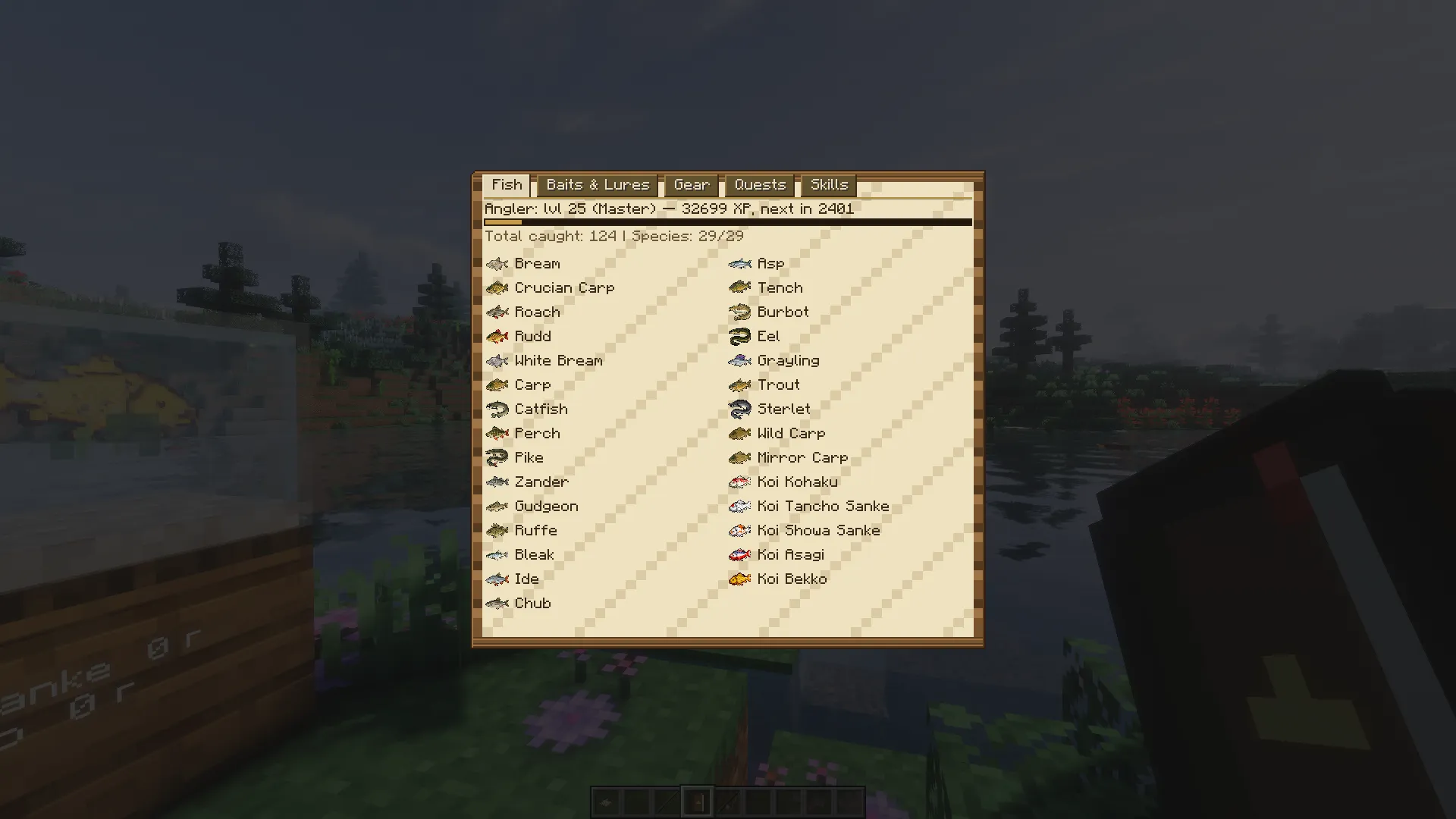
A journal that is a full in-game encyclopedia: eight tabs, a page for every one of the 93 species with its own hand-drawn illustration — no gaps, no placeholders — a family rail, a live search, and sortable tables of every bait, lure and piece of gear with the numbers the engine actually reads. 24 written guides on top of that, from the drag to the sea giants. The species card is built server-side, so it is complete on a dedicated server too.
Angler levels through four ranks and twelve gates, a six-perk skill tree, an eight-stage quest chain that ends at the sea, and 22 hand-crafted advancements including some tricky and some funny ones. Plus bait farms, a live-bait trap, an aquarium and a mini aquarium, cooking and fillets.
The order of the day is the tutorial. The fisherman names a species, and the journal entry for it is one click away — so the game answers "what do I do now" with a specific fish, a place and a bait instead of a menu.
Multiplayer
Built for it, not merely tolerant of it. Everyone within twelve blocks sees your fight on the boss bar, and a friend can net your fish for you — crouched, empty-handed, close in, once you have it past 85% — which lands it for you and pays them angler XP. Every angler's line is drawn for everyone else, in the material they actually spooled.
Configurable
config/riverfishing.json is written on first run with every knob at its default: difficulty presets plus individual dials for phantom bites, break sensitivity, depletion, line and hook wear, snags, foul-hooking, how much the fish notice you, and where the trophy bar sits. A modpack can retune the whole thing without patching.
How to play — the first hour
- Get bait. Dig dirt, grass or mud with a shovel — worms drop about one time in ten. Later: breed your own on a worm or maggot farm, gather live bait in a bait trap, or buy from the fisherman.
- Craft tackle. A Stick Rod is three sticks on the diagonal. Hooks: one iron nugget makes two #16 hooks; add a nugget to step up a size (a bigger number is a smaller hook). Line: a ring of 8 string makes the thinnest mono; put a line in the centre of another ring to thicken it a step.
- Assemble the rod. Hold it and sneak + right-click. Reel-less rods take a line; a reeled rod takes a reel first and the line spools onto it; bottom rods add a swappable rig. Incompatible parts are refused with the reason written in the window.
- Load the rig. Drop a hook and bait into the rig's inline slots. Predators want artificial lures, not worms, and fifteen species bite through a bare line — fit a leader.
- Feed the spot. Craft Wheat Seeds + Bread into Base Groundbait (or buy it), then mix it in a crafting grid with up to eight things from the pantry and right-click water with the result. Feed coarse for big fish, fine for small ones.
- Cast. Hold right-click to charge, release to throw. An under-loaded blank cannot reach.
- Watch the float — silently. There is no "Bite!" text. The float plunges, the line twitches, and you strike. Lure rods and reeled float rods put a timing bar on the strike; a reel-less pole saves its timing bar for the pull-out.
- Fight it. Watch the rod, not the screen — it lays over the way the fish went. Lean your view against it, ease off when it runs, and watch your stamina.
Read the journal for a per-species "how to catch", or scan the water with the fish finder to see what is biting and how the pressure is trending.
Admin commands
/rffish unlockall— fill the journal so every quest goal is met./rffish reset— wipe your records, XP and quests.
Wiki and community
qwazar14.github.io/riverfishing — 27 pages in English, Russian and Ukrainian, one URL with a language switcher. Every rod, reel, line, rig, bait, species, block and mechanic with the actual numbers, an interactive catch calculator that answers "what does a nine-kilo carp want", and every recipe drawn as a real crafting grid generated from the recipe files, so the wiki cannot drift from what the game loads.
discord.gg/Kk2nKvsuRh — bug reports and catches equally welcome. Several features in this mod exist because a player asked for them by name. A report with a screenshot and your mod list gets fixed far faster than one without.
The mod speaks English, Russian and Ukrainian in full — 1093 strings each, with real angling vocabulary and real fish names rather than transliterations.
The River Fishing Team